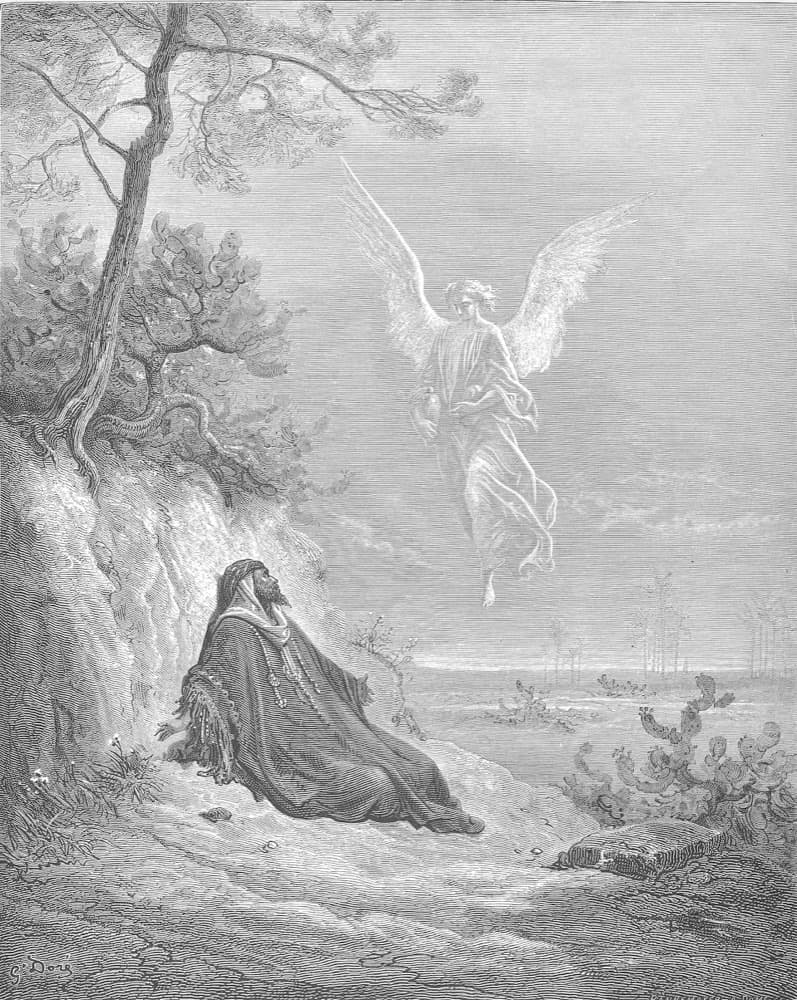
Elijah Is Nourished by an Angel
Old Testament
A Sound of Thin Silence
1 Kings 17–19, and what happened after the fire fell
1 Kings 17–19; Malachi 4:5–6; D&C 110:13–1640 min4 sections
A prophet wins the most public contest in the Old Testament and then, the following day, sits under a juniper tree and asks to die. What God does about it is the reason this chapter is in scripture, and the Hebrew of the famous phrase is stranger than the English.
- Author
- The Deuteronomistic historian
- Date
- Ninth century BC, in the reign of Ahab
- Place
- The northern kingdom of Israel; Mount Carmel; Horeb
- Audience
- A kingdom that had adopted the worship of Baal under royal patronage
- Language
- Biblical Hebrew narrative
- Genre
- Prophetic narrative
By the end you should be able to
- Explain what the contest on Carmel was actually testing.
- Translate the Hebrew of 1 Kings 19:12 and say what the King James softens.
- Describe how God responds to Elijah's despair, in order.
- Connect Elijah's return to the sealing power and to the last two verses of the Old Testament.
Carmel
A public test with a question attached to it.
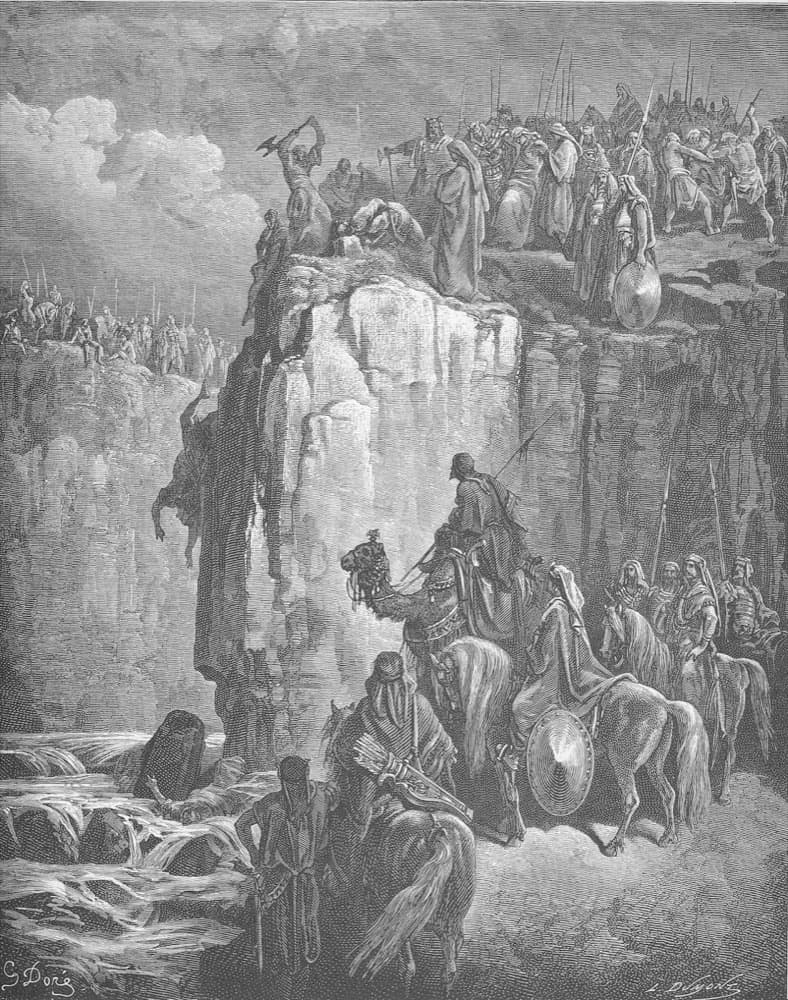
Carmel, after the fire falls. It worked — and within a day Elijah was running for his life.
21And Elijah came unto all the people, and said, How long halt ye between two opinions? if the Lord be God, follow him: but if Baal, then follow him. And the people answered him not a word.
24And call ye on the name of your gods, and I will call on the name of the Lord: and the God that answereth by fire, let him be God. And all the people answered and said, It is well spoken.
37Hear me, O Lord, hear me, that this people may know that thou art the Lord God, and that thou hast turned their heart back again.
39And when all the people saw it, they fell on their faces: and they said, The Lord, he is the God; the Lord, he is the God.
The verb in verse 21
Under the juniper tree
The day after the greatest miracle of his life.
4But he himself went a day's journey into the wilderness, and came and sat down under a juniper tree: and he requested for himself that he might die; and said, It is enough; now, O Lord, take away my life; for I am not better than my fathers.
5And as he lay and slept under a juniper tree, behold, then an angel touched him, and said unto him, Arise and eat.
7And the angel of the Lord came again the second time, and touched him, and said, Arise and eat; because the journey is too great for thee.
8And he arose, and did eat and drink, and went in the strength of that meat forty days and forty nights unto Horeb the mount of God.
The sequence of God's response is the most quietly remarkable thing in the passage. Before any correction, any assignment, or any explanation, Elijah is allowed to sleep, and then fed, and then allowed to sleep again, and then fed again. Only after that does the conversation begin.
- Sleep (v. 5).
- Food and water, brought to him where he lay (v. 6).
- More sleep.
- Food again, with a reason given: “the journey is too great for thee” (v. 7).
- Forty days of walking — solitude, and time.
- Only then: “What doest thou here, Elijah?” (v. 9).
Principle
God's first response to a prophet's despair is rest and food, not rebuke or instruction.
Nothing in the passage treats Elijah's condition as a spiritual failure requiring correction. The angel's stated reason for the second meal is practical — the journey is too great for him — which is the sort of thing a person in that state needs said to them rather than argued with.
Not in the wind
Three spectacles, and then something else.
11And he said, Go forth, and stand upon the mount before the Lord. And, behold, the Lord passed by, and a great and strong wind rent the mountains, and brake in pieces the rocks before the Lord; but the Lord was not in the wind: and after the wind an earthquake; but the Lord was not in the earthquake:
12And after the earthquake a fire; but the Lord was not in the fire: and after the fire a still small voice.
13And it was so, when Elijah heard it, that he wrapped his face in his mantle, and went out, and stood in the entering in of the cave.
The phrase in verse 12
King James renders it “a still small voice”
Three words, and the King James softens all three. Qôl is sound or voice. Dəmāmāh is silence or stillness — the same root as the verb 'to be silent.' Daqqāh means thin, fine, pulverised, the word used of the manna being 'small as the hoar frost.' A sound made of silence, and a fine one. The rendering is beautiful and the Hebrew is stranger.
The point of the sequence is not that God cannot work through wind, earthquake or fire — He had answered by fire the week before, in front of a nation. It is that Elijah had just staked everything on that kind of evidence and it had not held. What he is shown on Horeb is the mode that does.
Horeb — the mountain of the law — is the same mountain Elijah walks forty days to reach. Elijah's flight retraces the Exodus in reverse.
Why he comes back
The last two verses of the Old Testament, and 3 April 1836.
Elijah does not die. 2 Kings 2:11 records that he was taken up by a whirlwind, and in Latter-day Saint understanding that is what made it possible for him to return with a body and confer keys before the resurrection.
5Behold, I will send you Elijah the prophet before the coming of the great and dreadful day of the Lord:
6And he shall turn the heart of the fathers to the children, and the heart of the children to their fathers, lest I come and smite the earth with a curse.
The last two verses of the Old Testament, in the Christian ordering.
Cross-references
- Matthew 17:1–3Elijah appears on the Mount of Transfiguration with Moses, and keys are given.
- D&C 2Moroni's version of Malachi, quoted to Joseph Smith in 1823 with a significant variation.
- D&C 110:13–163 April 1836, in the Kirtland Temple — by the Jewish calendar that year, Passover.
- Luke 1:17John the Baptist comes 'in the spirit and power of Elias.'
Principle
The prophet whose great public miracle failed to convert a nation is the one sent back to turn hearts between generations — quietly, one family at a time.
To consider
- 01The contest on Carmel worked, and it did not last. What does that suggest about what actually changes people?
- 02God feeds Elijah twice before asking him a single question. When has someone done that for you, and when have you done it for someone?
- 03Elijah repeats his complaint word for word after the theophany. Why might scripture record that rather than tidy it up?
What this lesson holds
Spectacular evidence is a poor foundation for conversion; the chapter after Carmel exists to make that point.
God's first response to exhaustion and despair is rest and food, and the questions come afterward.
Revelation ordinarily comes as a sound of thin silence rather than in wind, earthquake or fire.
Check your reading
5 questions01What does the Hebrew verb behind “halt ye between two opinions” mean?
02Why was a drought a targeted argument against Baal?
03What does God do first when Elijah asks to die?
04What does qôl dəmāmāh daqqāh literally mean?
05Why could Elijah return to confer keys before the resurrection?
Where to go next
Sources
- 1 Kings 17–19; 2 Kings 2 — The primary text.
- Old Testament Student Manual: 1 Kings–Malachi
- Gospel Topics, "Elijah"