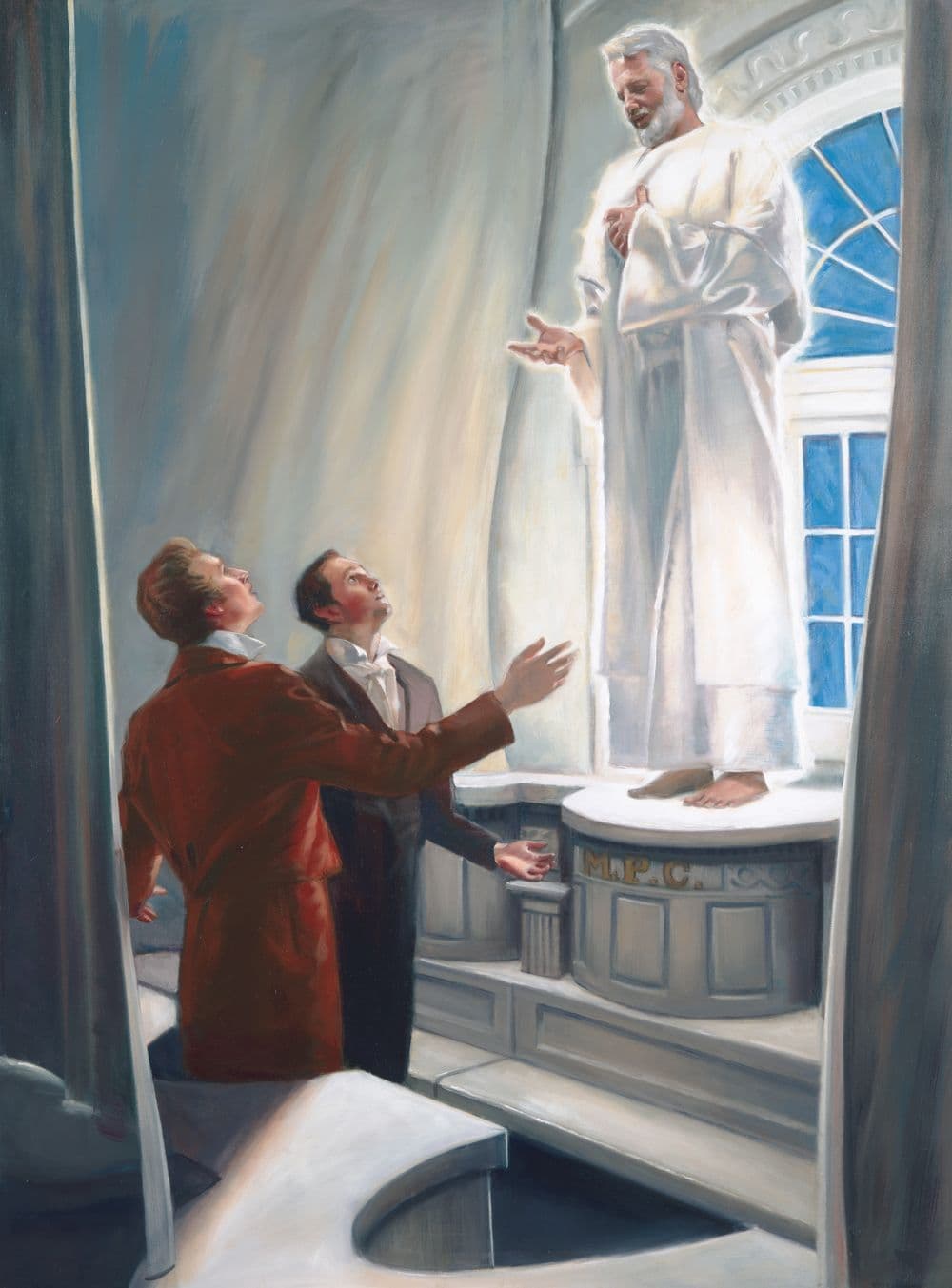
Elijah Appearing in the Kirtland Temple · Mal. 4:5–6
Doctrine and Covenants
The Sealing Power
Matthew 16, Malachi 4, D&C 128, and what binding on earth actually means
Matthew 16:19; Malachi 4:5–6; D&C 2; D&C 110:13–16; D&C 128; D&C 132:7, 1945 min4 sections
One authority, promised to Peter, foretold by Malachi, restored in a temple in 1836 — and it is the reason a Latter-day Saint temple has a baptismal font in the basement and a sealing room upstairs. This lesson follows the power itself: what it is, who holds it, what it binds, and what it cannot do on its own.
- Author
- Joseph Smith; the D&C 128 material is a letter written from hiding
- Date
- 3 April 1836 for the restoration; 6 September 1842 for the letter
- Place
- The Kirtland Temple; and Nauvoo, while Joseph was in hiding from Missouri extradition
- Audience
- The Church at Nauvoo, in the middle of the first serious effort at temple work
- Genre
- Revelation and epistle
By the end you should be able to
- Explain what the sealing power is and distinguish it from priesthood generally.
- Trace the promise from Matthew 16 through Malachi to D&C 110.
- State what the Holy Spirit of promise adds to a sealing, and why that clause exists.
- Explain why work for the dead follows from the doctrine rather than being an addition to it.
The promise, and its two halves
Given to Peter in one sentence, and foretold by Malachi in two verses.
18And I say also unto thee, That thou art Peter, and upon this rock I will build my church; and the gates of hell shall not prevail against it.
19And I will give unto thee the keys of the kingdom of heaven: and whatsoever thou shalt bind on earth shall be bound in heaven: and whatsoever thou shalt loose on earth shall be loosed in heaven.
The verbs of Matthew 16:19
5Behold, I will send you Elijah the prophet before the coming of the great and dreadful day of the Lord:
6And he shall turn the heart of the fathers to the children, and the heart of the children to their fathers, lest I come and smite the earth with a curse.
The last two verses of the Old Testament. Moroni quoted them to Joseph Smith with a variation — the promises made to the fathers planted in the hearts of the children — which D&C 2 preserves.
3 April 1836
The keys delivered, in a temple, on the day the Jewish world was waiting for them.
13After this vision had closed, another great and glorious vision burst upon us; for Elijah the prophet, who was taken to heaven without tasting death, stood before us, and said:
14Behold, the time has fully come, which was spoken of by the mouth of Malachi—testifying that he should be sent, before the great and dreadful day of the Lord come—
15To turn the hearts of the fathers to the children, and the children to the fathers, lest the whole earth be smitten with a curse—
16Therefore, the keys of this dispensation are committed into your hands; and by this ye may know that the great and dreadful day of the Lord is near, even at the doors.
Note the sequence in D&C 110 as a whole: the Lord appears first and accepts the house; then Moses gives the keys of the gathering; then Elias the dispensation of the gospel of Abraham; then Elijah the sealing. Each is a prerequisite for the next. You cannot seal families you have not gathered, and you cannot gather into a covenant you do not hold.
7And verily I say unto you, that the conditions of this law are these: All covenants, contracts, bonds, obligations, oaths, vows, performances, connections, associations, or expectations, that are not made and entered into and sealed by the Holy Spirit of promise… are of no efficacy, virtue, or force in and through the resurrection from the dead; for all contracts that are not made unto this end have an end when men are dead.
Principle
Death ends every arrangement humans make, unless something outside the arrangement binds it. The sealing power is that something.
D&C 132:7 is unusually comprehensive — covenants, contracts, bonds, obligations, oaths, vows, connections, associations. Every human tie is included, and every one of them has an end when men are dead. What is being claimed for the sealing power is not that it improves a marriage but that it is the only mechanism by which any relationship survives at all.
D&C 132:7 · D&C 132:19 · Matthew 22:30 · 1 Corinthians 15:29
The work for the dead
What the doctrine forces, once you take it seriously.
If baptism is required, and most of humanity has died without it, then either most of humanity is lost or something must be done for them. Christian tradition has generally chosen the first horn or softened the requirement. The Restoration takes a third route, and 1 Corinthians 15:29 is the verse that shows it is not a new idea.
29Else what shall they do which are baptized for the dead, if the dead rise not at all? why are they then baptized for the dead?
Paul mentions the practice in passing, as an argument for the resurrection, without explaining or condemning it — which suggests his readers knew what he meant.
15And now, my dearly beloved brethren and sisters, let me assure you that these are principles in relation to the dead and the living that cannot be lightly passed over… For their salvation is necessary and essential to our salvation, as Paul says concerning the fathers—that they without us cannot be made perfect—neither can we without our dead be made perfect.
18…a welding link of some kind or other between the fathers and the children, upon some subject or other—and behold what is that subject? It is the baptism for the dead. For we without them cannot be made perfect; neither can they without us be made perfect.
22Brethren, shall we not go on in so great a cause? Go forward and not backward. Courage, brethren; and on, on to the victory!
Joseph Smith wrote this letter on 6 September 1842 while hiding from Missouri officers who wanted him extradited. The tone of verse 22 — the exclamation marks are his — is worth registering alongside the circumstances. He is describing an enormous, generations-long undertaking from a house he cannot leave.
| Because | Therefore |
|---|---|
| Ordinances are required for salvation (John 3:5) | Those who died without them need them performed |
| Ordinances are physical, and the dead have no bodies | Someone living must stand in their place |
| The dead retain agency (D&C 138:31–34) | Proxy work is an offer, not an imposition — it can be refused |
| A person must be identified to be sealed to anyone | Family history is not a hobby attached to the doctrine; it is the doctrine's necessary first step |
| Everyone who ever lived is included | The work is, by design, not completable in a lifetime |
What a temple is for
The building's floor plan is the doctrine, in architecture.
A Latter-day Saint temple is laid out as a sequence. The baptismal font sits below ground level — deliberately, in imitation of the sea in Solomon's temple and of the grave. Above it are rooms for instruction, then the veil, then the celestial room, then the sealing rooms with their facing mirrors. The building is a diagram of the plan of salvation that a person walks through.
22Let the mountains shout for joy, and all ye valleys cry aloud; and all ye seas and dry lands tell the wonders of your Eternal King! And ye rivers, and brooks, and rills, flow down with gladness. Let the woods and all the trees of the field praise the Lord; and ye solid rocks weep for joy!
23And let the sun, moon, and the morning stars sing together, and let all the sons of God shout for joy! And let the eternal creations declare his name forever and ever!
Principle
The sealing power exists so that the relationships a person actually has can outlast their body — which makes salvation a family matter rather than an individual one.
D&C 128:15 puts it as strongly as it can be put: they without us cannot be made perfect, neither can we without our dead. Latter-day Saint soteriology does not permit a person to be saved alone, and the sealing power is the mechanism by which that is true rather than merely sentimental.
Where to read further
- D&C 138Joseph F. Smith's 1918 vision of the redemption of the dead — the Savior's ministry in the spirit world, and the organisation of the missionary work there.
- D&C 2Moroni's version of Malachi, and the shortest section in the Doctrine and Covenants after section 13.
- D&C 124:25–41The command to build the Nauvoo Temple, and the statement that baptisms for the dead belong in a house built to the Lord's name.
- 1 Peter 3:18–20; 4:6Christ preaching to the spirits in prison, and the gospel preached to them that are dead — the New Testament's own witness to the doctrine.
To consider
- 01D&C 132:7 says every human arrangement ends at death unless it is sealed. What does that change about how you think of the ties you have now?
- 02The Holy Spirit of promise makes a sealing conditional rather than automatic. Is that a harder doctrine or a kinder one?
- 03The work is designed not to be completable in one lifetime. What kind of person does a project like that ask you to become?
What this lesson holds
The sealing power binds on earth what is bound in heaven, and it was promised to Peter, foretold by Malachi, and restored by Elijah on 3 April 1836.
Every human covenant, contract and connection ends at death unless it is sealed by authority and ratified by the Holy Spirit of promise.
Work for the dead follows necessarily from the requirement of ordinances, and it is an offer rather than an imposition, because the dead retain agency.
1 Corinthians 15:29 · D&C 128:15, 18 · D&C 138:31–34 · 1 Peter 4:6
Check your reading
5 questions01What did Christ promise Peter in Matthew 16:19?
02Why was it Elijah who restored the sealing keys?
03What does 'sealed by the Holy Spirit of promise' add?
04What does D&C 128:15 say about the dead and the living?
05How does the doctrine answer the objection that proxy work is presumptuous?
Where to go next
Sources
- D&C 110; D&C 128; D&C 132:7, 19 — The primary texts.
- Gospel Topics, "Temples"
- Gospel Topics, "Baptisms for the Dead"
- Revelations in Context, "Sacred Space and the Kirtland Temple"