Library / Foundations of the Restoration
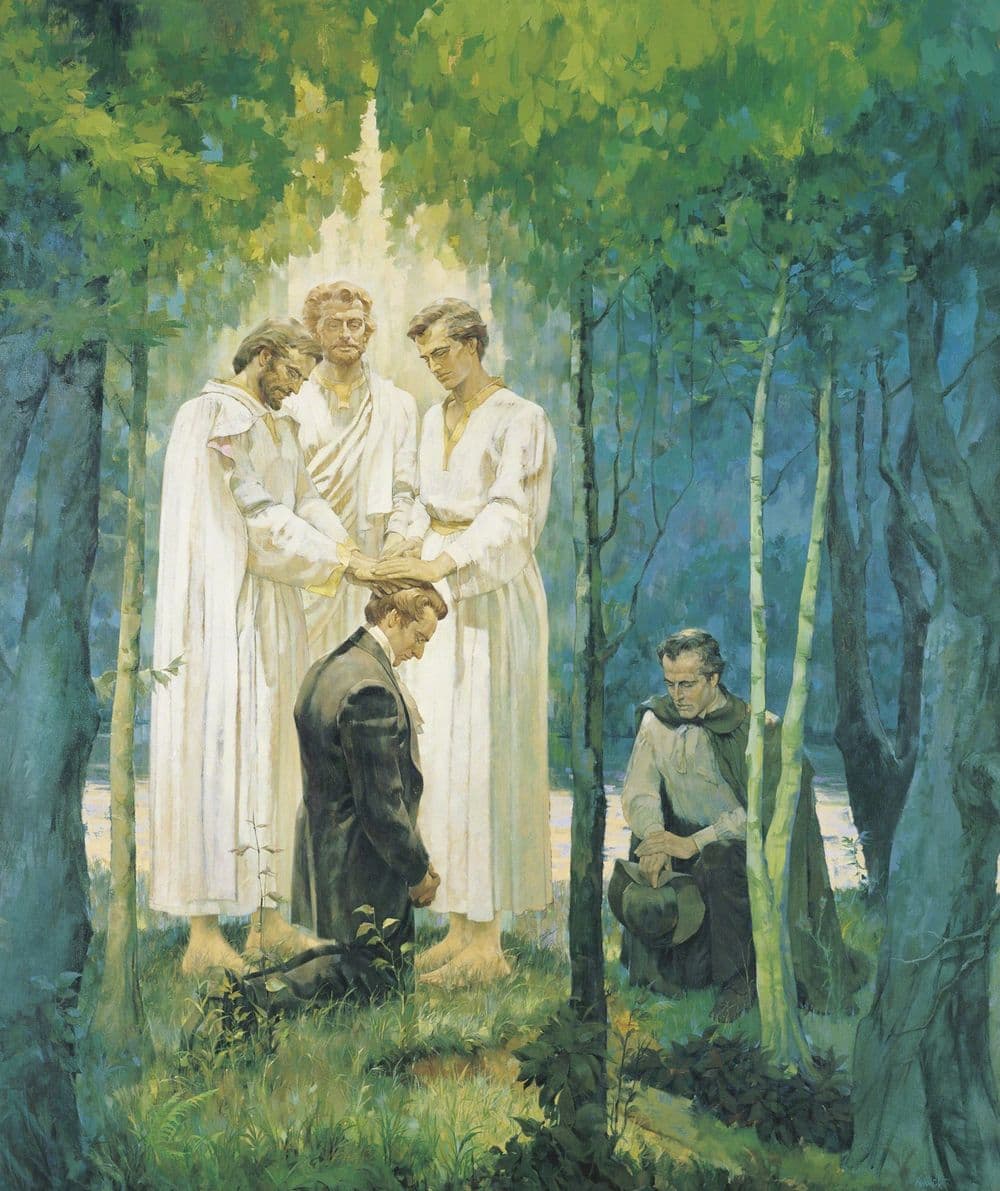
Melchizedek Priesthood Restoration · D&C 27:12–13
Doctrine and Covenants
The Restoration of Authority
D&C 13, D&C 110, and why a line of conferral matters
D&C 13; D&C 27:12–13; D&C 110; D&C 107; Hebrews 5:445 min4 sections
The Restoration's most distinctive claim is not that Joseph Smith had a vision. Plenty of people have visions. It is that authority to act in God's name was conferred by named persons, on datable days, by the laying on of hands — and that without that, ordinances are ceremony.
- Author
- Revelations to Joseph Smith; the D&C 110 account recorded by Warren Cowdery in the third person
- Date
- 15 May 1829 (Aaronic); May or June 1829 (Melchizedek); 3 April 1836 (keys in the Kirtland Temple)
- Place
- The bank of the Susquehanna near Harmony, Pennsylvania; the wilderness between Harmony and Colesville; the Kirtland Temple
- Audience
- Joseph Smith and Oliver Cowdery, then the Church
- Genre
- Revelation and historical record
By the end you should be able to
- State the two orders of priesthood, their proper names, and what each administers.
- Give the dates and the ministering persons for each restoration event.
- Explain what 'keys' means and how it differs from priesthood itself.
- Say what D&C 121 makes conditional, and why that condition exists.
Why authority at all
The problem the Restoration is solving, stated before the solution.
4And no man taketh this honour unto himself, but he that is called of God, as was Aaron.
The constraint is stated as a rule about all priesthood, everywhere. Authority in this system is received, never assumed. Which means the question 'who ordained you, and who ordained them?' is not bureaucratic pedantry — it is the only way the rule can be checked.
Joseph Smith and Oliver Cowdery hit this problem while translating. They came to 3 Nephi 11, where the resurrected Christ gives specific authority to baptize and specific words to use, and they realised they had no such authority themselves. Joseph Smith—History 1:68 says they went into the woods to ask about it. The restoration of the priesthood was, in that sense, an answer to a translation question.
15 May 1829
A named person, on a datable day, with a witness present.
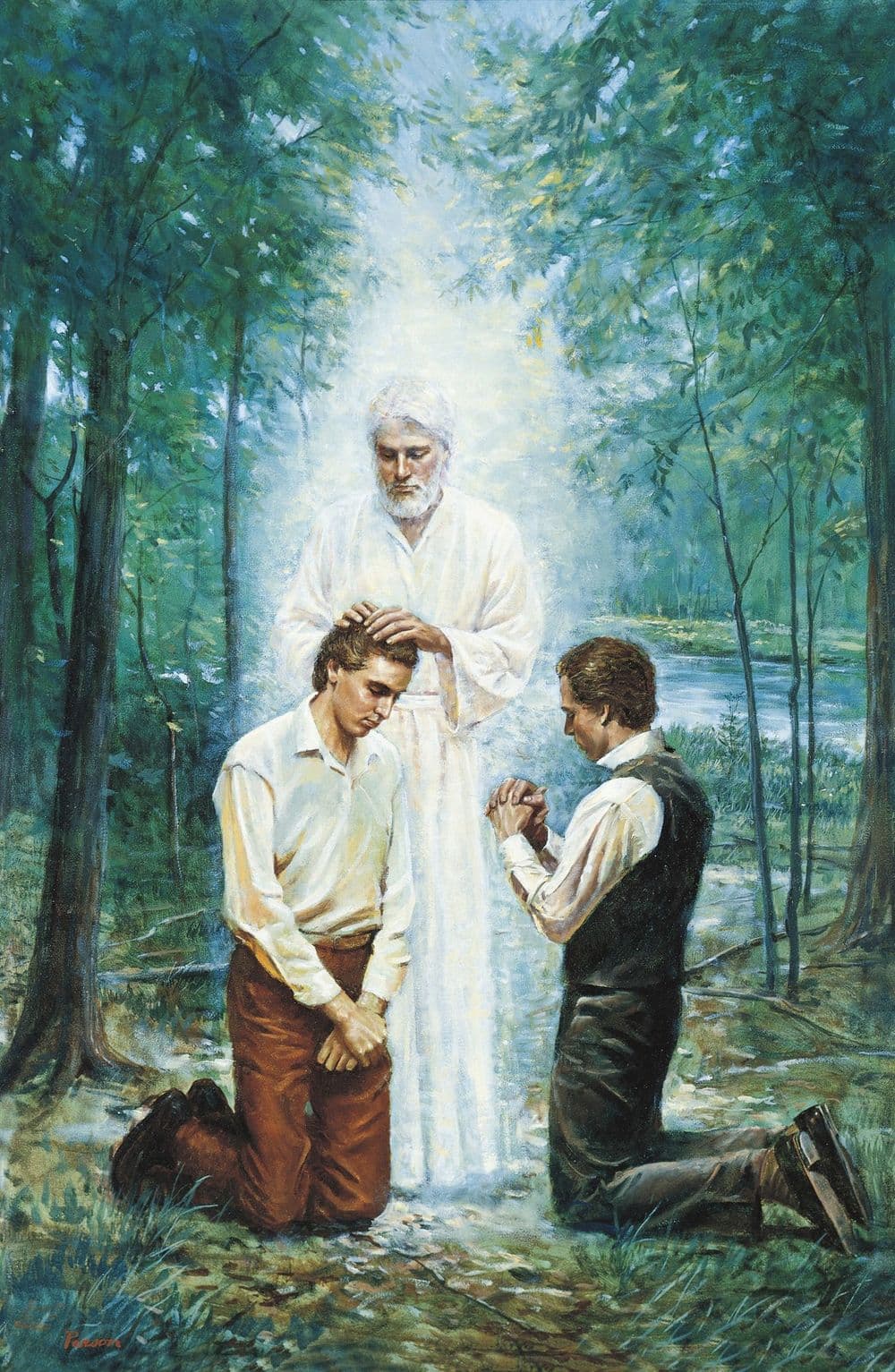
15 May 1829, on the bank of the Susquehanna. His words are preserved verbatim as D&C 13. · D&C 13
1Upon you my fellow servants, in the name of Messiah I confer the Priesthood of Aaron, which holds the keys of the ministering of angels, and of the gospel of repentance, and of baptism by immersion for the remission of sins; and this shall never be taken again from the earth, until the sons of Levi do offer again an offering unto the Lord in righteousness.
The words of John the Baptist, as recorded by Joseph Smith. Section 13 is the shortest in the Doctrine and Covenants.
Four things are worth noticing in one sentence. He calls them 'my fellow servants,' which is a resurrected being's way of describing two young men with nothing. He confers rather than authorises. He names three keys, all of them entry-level and all of them about beginnings — angels, repentance, baptism. And he attaches a duration: never taken again from the earth.
| When | Who | What | Record |
|---|---|---|---|
| 15 May 1829 | John the Baptist | The Aaronic Priesthood conferred, followed by mutual baptism in the Susquehanna | D&C 13; Joseph Smith—History 1:68–72; Oliver Cowdery's own 1834 account, published in the Messenger and Advocate |
| May or June 1829 | Peter, James and John | The Melchizedek Priesthood and the keys of the apostleship | D&C 27:12–13; D&C 128:20. No exact date is recorded, and the sources do not supply one. |
| 3 April 1836 | The Lord, then Moses, Elias and Elijah | The keys of the gathering, of the dispensation of the gospel of Abraham, and of sealing | D&C 110, recorded in Joseph Smith's journal by Warren Cowdery |
71We were, however, commanded to defer this our baptism until we should have gone and been ordained… [and] we should ordain each other after we should be baptized.
72The messenger who visited us on this occasion and conferred this Priesthood upon us, said that his name was John, the same that is called John the Baptist in the New Testament, and that he acted under the direction of Peter, James and John, who held the keys of the Priesthood of Melchizedek.
Two orders, and what keys are
The most commonly confused pair of terms in Latter-day Saint usage.
1There are, in the church, two priesthoods, namely, the Melchizedek and Aaronic, including the Levitical Priesthood.
3Before his day it was called the Holy Priesthood, after the Order of the Son of God.
4But out of respect or reverence to the name of the Supreme Being, to avoid the too frequent repetition of his name, they, the church, in ancient days, called that priesthood after Melchizedek, or the Melchizedek Priesthood.
8The Melchizedek Priesthood holds the right of presidency, and has power and authority over all the offices in the church in all ages of the world, to administer in spiritual things.
14The second priesthood is called the Priesthood of Aaron, because it was conferred upon Aaron and his seed, throughout all their generations.
20[The Aaronic Priesthood] has power in administering outward ordinances, the letter of the gospel, the baptism of repentance for the remission of sins, agreeable to the covenants and commandments.
Aaronic (Levitical)
The 'preparatory priesthood'
Outward ordinances and the letter of the gospel
Baptism for the remission of sins
The ministering of angels
Offices: deacon, teacher, priest, bishop
Melchizedek
Properly: the Holy Priesthood after the Order of the Son of God
Administers in spiritual things; holds the right of presidency
The gift of the Holy Ghost, temple ordinances, sealing
The key of the knowledge of God (D&C 84:19)
Offices: elder, high priest, patriarch, seventy, apostle
11After this vision closed, the heavens were again opened unto us; and Moses appeared before us, and committed unto us the keys of the gathering of Israel from the four parts of the earth, and the leading of the ten tribes from the land of the north.
12After this, Elias appeared, and committed the dispensation of the gospel of Abraham, saying that in us and our seed all generations after us should be blessed.
13After this vision had closed, another great and glorious vision burst upon us; for Elijah the prophet, who was taken to heaven without tasting death, stood before us, and said:
14Behold, the time has fully come, which was spoken of by the mouth of Malachi—testifying that he [Elijah] should be sent, before the great and dreadful day of the Lord come—
16Therefore, the keys of this dispensation are committed into your hands; and by this ye may know that the great and dreadful day of the Lord is near, even at the doors.
3 April 1836 was, by the Jewish calendar of that year, Passover — the feast at which Jewish families set a place for Elijah and open the door for him. Whether or not the timing was deliberate on the human side, it is the kind of detail that rewards noticing.
The limits
The harshest passage in the canon is about people who hold this authority.
34Behold, there are many called, but few are chosen. And why are they not chosen?
35Because their hearts are set so much upon the things of this world, and aspire to the honors of men, that they do not learn this one lesson—
36That the rights of the priesthood are inseparably connected with the powers of heaven, and that the powers of heaven cannot be controlled nor handled only upon the principles of righteousness.
37That they may be conferred upon us, it is true; but when we undertake to cover our sins, or to gratify our pride, our vain ambition, or to exercise control or dominion or compulsion upon the souls of the children of men, in any degree of unrighteousness, behold, the heavens withdraw themselves; the Spirit of the Lord is grieved; and when it is withdrawn, Amen to the priesthood or the authority of that man.
41No power or influence can or ought to be maintained by virtue of the priesthood, only by persuasion, by long-suffering, by gentleness and meekness, and by love unfeigned;
42By kindness, and pure knowledge, which shall greatly enlarge the soul without hypocrisy, and without guile—
Written from a basement cell in Liberty, Missouri, by a man who had every reason to write about his enemies and wrote about his own side instead. Verse 39 states the diagnosis without qualification: 'it is the nature and disposition of almost all men, as soon as they get a little authority, as they suppose, they will immediately begin to exercise unrighteous dominion.'
Principle
Unrighteous dominion does not merely misuse priesthood authority; it ends it.
'Amen to the priesthood or the authority of that man' is not a warning about future consequences. It describes what has already happened. The ordination remains on the records; the authority does not remain in the heavens.
The pattern the limits follow
- Matthew 20:25–28The Gentiles exercise dominion; 'it shall not be so among you.' Greatness is redefined as service in the same breath.
- John 13:4–15The washing of feet — a slave's job, performed by the Lord, with the instruction to do likewise.
- D&C 84:19–22Why the authority exists at all: 'in the ordinances thereof, the power of godliness is manifest.'
- D&C 20:38–60The duties of each office, stated plainly and almost entirely in terms of what is owed to other people.
To consider
- 01The question that prompted the restoration of the priesthood came out of translating 3 Nephi 11. What does it mean that the answer arrived because someone was reading carefully?
- 02Keys govern where authority may be exercised. What does that protect people from?
- 03D&C 121:41–42 lists seven qualities. Which of them is the hardest to sustain when you are certain you are right?
What this lesson holds
Authority to act in God's name is received by conferral from someone who holds it, never assumed — which is why the line of conferral is checkable.
The two orders divide the work: the Aaronic administers outward ordinances and the letter, the Melchizedek administers in spiritual things and holds the right of presidency.
Keys are the right to direct the use of priesthood, and they keep revelation and ordinance work in order rather than in competition.
The authority is conditional on how it is used, and unrighteous dominion ends it outright.
Check your reading
5 questions01What prompted Joseph Smith and Oliver Cowdery to ask about baptismal authority?
02What three keys does D&C 13 name?
03What is the Melchizedek Priesthood's actual name?
04What is the difference between priesthood and keys?
05What does D&C 121:37 say happens when a man exercises unrighteous dominion?
Where to go next
Sources
- D&C 13; D&C 107; D&C 110; D&C 121 — The primary texts.
- Gospel Topics, "Priesthood"
- Revelations in Context, "The Aaronic Priesthood Restored"
- The Joseph Smith Papers — Oliver Cowdery's 1834 account and the Kirtland journal entry for 3 April 1836