Patterns / Narrative shape
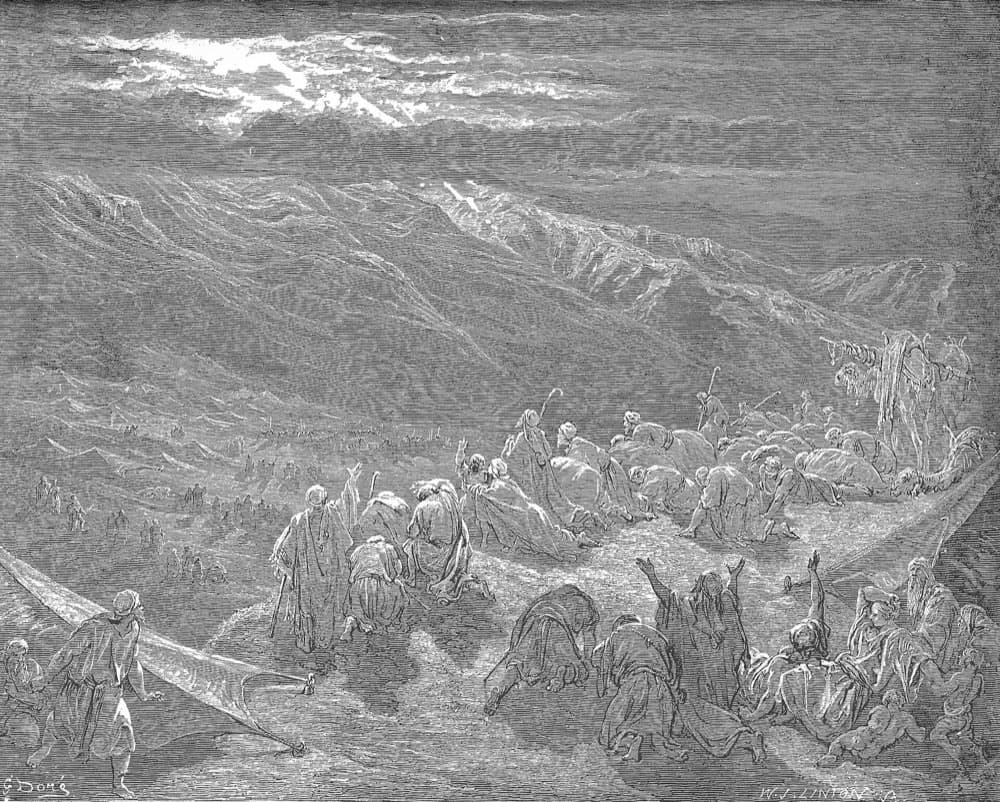
The Giving of the Law on Mount Sinai
The temple before there were temples
The mountain of the Lord
Before Israel had a tabernacle and long before it had a temple, it had a mountain. The same sequence runs through every mountain scene in the canon — separation, ascent, boundary, cloud, presence, commission, descent with something to give away — and it is the sequence a temple is built to reproduce indoors.
32 min10 appearances
The pattern, in one sentence
A high place, a prepared person, an ascent away from the people, a threshold not everyone crosses, God met at the top, and a descent carrying something the people below could not have got for themselves.
What counts as an instance
Stated before the evidence, so that the evidence is able to fail.
Height that is also separation
The elevation is never scenery. It removes the person from the camp, the crowd or the city — mountains in scripture are where you go to be somewhere other people are not.
A threshold that not everyone crosses
Sinai has bounds set around it and a line the people may not touch. The transfiguration takes three of the twelve. Every instance has a boundary, and the boundary is always the interesting part of the scene.
God is met, not merely heard about
Something happens at the top that could not have happened at the bottom: a face-to-face conversation, a vision of the whole plan, a body transfigured, a veil taken away.
The descent carries something back
Nobody comes down empty. Tables of stone, a record, a commission, keys. The mountain is not a retreat — it is a supply run for people who were not permitted up.
The appearances
10 in the canonAnd Abraham called the name of that place Jehovah-jireh: as it is said to this day, In the mount of the LORD it shall be seen.
What recurs
A named mountain, a journey to reach it, a test at the top.
What is new here
The earliest instance is also the harshest: what Abraham carries up is his son, and what he carries down is a covenant and a substitute ram.
The place-name Abraham gives is a promise about the future of that hill, and 2 Chronicles 3:1 places Solomon's temple on Mount Moriah. The mountain where a father was stopped from offering his son becomes the mountain where Israel's sacrifices are offered for a thousand years.
Where it lands
The mountain, brought indoors
The pattern's endpoint is not a better mountain. It is a building that anyone worthy can enter, in a city, on a schedule, with the same threshold, the same ascent through degrees, the same veil and the same promise attached: 'Inasmuch as my people build a house unto me in the name of the Lord… yea, and my presence shall be there… and the pure in heart that shall come into it shall see God.' Everything Israel was offered at Sinai and declined is on offer again, and this time it is on a bus route.
The shape, before the examples
Six steps that recur whether the setting is Sinai, Shelem or Kirtland.
State the sequence first and then test it, rather than the other way round. A pattern assembled after the fact out of whatever the passages happen to contain will always look convincing and will always be worthless. Here is the shape, and every instance below either fits it or is excluded.
| Step | What happens | At Sinai |
|---|---|---|
| Separation | The person leaves the camp, the city or the crowd | Israel camps at the base; Moses goes up |
| Ascent | Movement upward, usually alone or nearly so | Moses ascends; the elders go partway |
| Boundary | A line that not everyone may cross | Bounds set; the people may not touch the mount |
| Cloud or veil | Presence concealed and then entered | The cloud covers the mount six days |
| Encounter | God met, face to face or by voice | Moses in the cloud forty days |
| Descent | Return, carrying something for the people below | The tables of stone |
The tabernacle is the same sequence laid out horizontally: court, holy place, holy of holies, each entered by fewer people through more preparation.
Set the diagram beside the table and the claim of this study becomes visible. A tabernacle is a mountain folded flat and made portable. The degrees of approach are identical, the veil does the work the cloud did, and the person who goes furthest in goes on everyone else's behalf.
Sinai, and the offer Israel declined
The most detailed instance, and the one that did not go as intended.
5Now therefore, if ye will obey my voice indeed, and keep my covenant, then ye shall be a peculiar treasure unto me above all people: for all the earth is mine:
6And ye shall be unto me a kingdom of priests, and an holy nation.
12And thou shalt set bounds unto the people round about, saying, Take heed to yourselves, that ye go not up into the mount, or touch the border of it.
Read verse 6 slowly. The whole nation is offered priesthood — not a tribe of it, not a delegation. The bounds in verse 12 are protective, not permanent; Exodus 19:13 even provides for a trumpet blast at which they may come up. The intent was an ascent by everybody.
18And all the people saw the thunderings, and the lightnings, and the noise of the trumpet, and the mountain smoking: and when the people saw it, they removed, and stood afar off.
19And they said unto Moses, Speak thou with us, and we will hear: but let not God speak with us, lest we die.
That is the hinge of the Old Testament. Offered direct access, Israel asks for a mediator, and gets one, and gets a lesser law with him. The Doctrine and Covenants states the consequence without softening it.
23Now this Moses plainly taught to the children of Israel in the wilderness, and sought diligently to sanctify his people that they might behold the face of God;
24But they hardened their hearts and could not endure his presence; therefore, the Lord in his wrath… swore that they should not enter into his rest while in the wilderness, which rest is the fulness of his glory.
Principle
The barrier at the foot of the mountain was never the mountain. It was the readiness of the people standing at it.
God set bounds and then provided a signal for crossing them. The bounds stayed because Israel stayed, and the pattern has been re-offered in every dispensation since.
The counterfeit mountain
Every genuine ascent in scripture has a rival version, and it is always on a high place too.
This is the part of the pattern most often missed, and it is uncomfortably consistent. Where scripture records a man taken to a high mountain and shown the world by God, it also records an adversary offering the same view on the same terms.
Moses 1:1–11
Caught up into an exceedingly high mountain.
Sees God face to face; shown the world and all its inhabitants.
Conclusion: “man is nothing, which thing I never had supposed.”
Moses 1:12–22
Satan comes immediately after, on the same ground.
“Moses, son of man, worship me.”
Cast out only when Moses names the difference in glory.
Matthew 4:8–10
“Taketh him up into an exceeding high mountain.”
Shows all the kingdoms of the world and their glory.
“All these things will I give thee, if thou wilt fall down and worship me.”
The vocabulary is the same, the altitude is the same, and the panorama is the same. What differs is the direction of the transaction. On the true mountain a man is shown the world and told what it cost God; on the counterfeit he is shown the world and told what it will cost him. Moses 1:13–15 shows exactly how the difference is detected — not by the impressiveness of the vision but by asking whose glory is being displayed.
Bountiful: the pattern reversed
At Sinai the people were told to keep back. At the temple in Bountiful they were told to come.
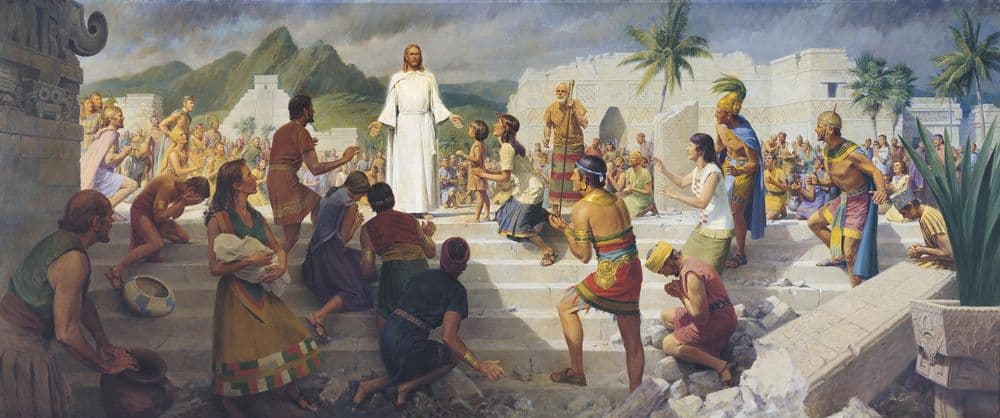
The multitude comes forward, one by one. · 3 Ne. 11:8–41
Sinai — Exodus 19–20
Bounds set about the mount.
“Lest he break forth upon them.”
The people stand afar off.
“Let not God speak with us, lest we die.”
A mediator goes up alone.
Bountiful — 3 Nephi 11
Gathered round about the temple.
“Arise and come forth unto me.”
They go forth one by one.
“Thrust your hands into my side.”
About two thousand and five hundred souls.
3 Nephi 11:15 records that they went forward 'one by one' — a phrase the Book of Mormon uses again in Ether 3:6 for the stones the Lord touched, and one that anybody who has been through a temple will recognise as a description of how ordinances are actually administered. There is no efficient way to do this and no attempt to find one.
Principle
The mountain pattern is fulfilled not by a more impressive theophany but by an ordinary person being allowed all the way in.
What to do with it
The pattern is not a curiosity. It is a description of an available process.
The pattern in one column
- Psalm 24:3–4The entrance question, asked and answered: who shall ascend, and on what terms — clean hands and a pure heart.
- Isaiah 2:2–3The mountain becomes a house, and the nations come to be taught rather than to watch.
- D&C 97:15–17The conditions, stated as a covenant: build it, keep it undefiled, and the pure in heart shall see God.
- D&C 109:12–13Joseph's dedicatory prayer asks for exactly the Sinai list — glory, power, presence — in a building.
- D&C 110:1–10The answer, eight months later, in the same room.
To take up the mountain
- 01Every instance has a separation before it. What in a week's routine actually functions as the walk away from the camp?
- 02Israel was offered a kingdom of priests and asked for a mediator instead. Where is the modern form of that trade?
- 03Nobody in this pattern comes down empty-handed. If the temple is the mountain, what is meant to be in your hands when you leave it?
What the pattern holds
The temple is not a metaphor drawn from the mountain scenes; the mountain scenes are the temple, held outdoors before there was a building for them.
Every ascent in scripture has a threshold, and the threshold is the doctrine.
Bounds at Sinai, three disciples out of twelve, a veil, a recommend. The restriction is not God rationing Himself; it is the shape of an approach that has to be survivable.
Israel's refusal at the foot of Sinai is the founding example of preferring a mediator to an encounter, and it cost them the higher law.
Exodus 20:18–19 · D&C 84:19–25 · JST Exodus 34:1–2
High-mountain experiences have counterfeits that use the same imagery, and the test between them is doctrinal, not emotional.
The pattern ends in reversal: the people who were kept back are the ones invited forward, one by one.
What this will not carry
- Not every hill in scripture is doing this work. Mountains are simply where much of the ancient Near East happened, and a study that counts every one of them proves nothing.
- The transfiguration as a conferral of keys is the Latter-day Saint reading, supported by the identity of the three witnesses and later revelation. The Gospel accounts themselves do not say so, and the distinction is worth keeping when teaching outside the Church.
- Mount Moriah as the temple mount rests on 2 Chronicles 3:1, which is a scriptural statement — but the precise identification of Abraham's site is debated by historians, and the doctrine does not need it.
- Nothing here implies that a temple experience must feel like Sinai. Elijah's instance exists in the canon specifically to say the opposite.
Check your reading
4 questions01What did Israel say at the foot of Sinai after the thunder and the trumpet?
02Which phrase appears in both Moses 1:1 and 1 Nephi 11:1?
03How does the encounter at Horeb differ from the one at Sinai?
04At the temple in Bountiful, how did the multitude approach the Savior?
Where to go next
Sources
- “Temple” — Guide to the Scriptures, churchofjesuschrist.org
- Old Testament Student Manual: Genesis–2 Samuel — Church Educational System, on Exodus 19–24
- Doctrine and Covenants 110 — The Kirtland Temple visions, Gospel Library
- “Why Are Temples Built on Mountains?” — 2 Chronicles 3:1 identifies the temple mount as Moriah