Patterns / Recurring symbol
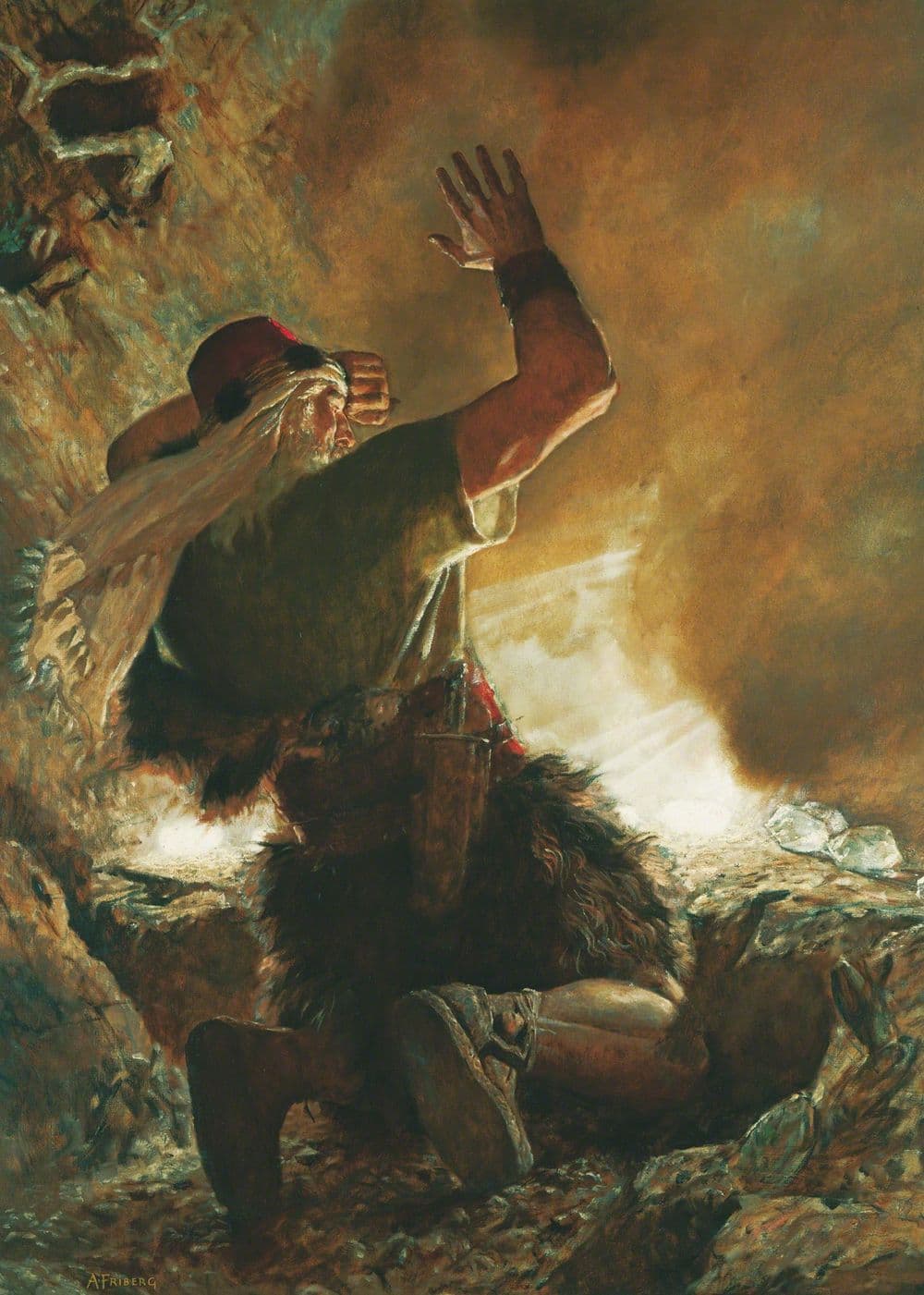
The Brother of Jared Sees the Finger of the Lord · Ether 3:1–16
Where an unseen God touches a seen world
The finger of the Lord
Scripture speaks of God's hand constantly and of His finger almost never. The few places it does are not decorative: at every one of them something physical is touched and marked, and somebody who did not expect it is left holding evidence. Nine appearances, from the Jaredite barges to a Roman-era temple courtyard, and the doctrine they add up to.
34 min9 appearances
The pattern, in one sentence
Whenever the canon names the finger of God rather than His hand, an unseen God is doing something to matter — writing, touching, delivering, judging — in front of a witness who is thereby forced to reckon with a Being who has one.
What counts as an instance
Stated before the evidence, so that the evidence is able to fail.
The word is 'finger', not 'hand'
The hand of the Lord and the arm of the Lord are common Hebrew idioms for power in the abstract, and they appear hundreds of times. The finger is different. In the whole Hebrew Bible it is said of God in four places, and each is an event rather than a figure of speech. That rarity is the reason this is a pattern and not a word cloud.
Something material is touched, and keeps the mark
Stone, plaster, dust, sixteen molten stones. In every appearance the finger leaves the world different from how it found it, and usually leaves writing. Nothing here is God gesturing at a distance.
There is a witness who did not ask for it
Egypt's magicians, Belshazzar mid-feast, a courtroom of accusers, Moses at the top of a mountain. The finger arrives on people who are in the middle of doing something else, and it settles a question they were arguing about.
It converts inference into encounter
Before the finger, God is deduced. After it, He is met. Every one of these scenes is the moment a person stops reasoning about God and starts dealing with Him — which is why the pattern ends where it does.
The appearances
9 in the canonHe stretched forth his hand and touched the stones one by one with his finger. And the veil was taken from off the eyes of the brother of Jared, and he saw the finger of the Lord; and it was as the finger of a man, like unto flesh and blood.
What recurs
God's finger touches physical objects and changes them.
What is new here
Here alone the finger is seen, and described: like a man's, flesh and blood, at a date centuries before any of the other appearances.
Note what he asked for and what he got. He asked for light in the barges and offered God sixteen stones to work with; he did not ask to see anything. The veil parts on the strength of the faith behind the request, not the content of it — which is the whole argument of Ether 12:19–21.
Where it lands
The earliest appearance is the fullest
Every other instance shows what the finger does. Ether 3 shows what it is — and it comes first in the chronology, not last. The brother of Jared is shown, more than two thousand years early, the fact the rest of the canon spends its length approaching: that God has a body, that the body is like ours, and that the reason it is like ours is that He intends to take flesh. 'Because of thy faith thou hast seen that I shall take upon me flesh and blood.' The pattern does not build toward its climax. Its climax was disclosed to one man at the beginning and sealed up, and the rest of scripture is the world catching up.
One word, four places
Why the vocabulary is the whole reason this is a pattern.
Scripture is full of God's hand. It is stretched out, it is heavy, it is mighty, it saves and it smites; the arm of the Lord is a standing figure for His power and appears in every volume. All of that is idiom, and reading doctrine out of it would be a mistake. The finger is a different case, and the difference is countable.
The two words the pattern turns on
Principle
The canon is careful with this phrase, so the reader should be too.
A pattern built out of a common idiom proves nothing, because a common idiom is everywhere. This one is built out of a rare and concrete word, used in a small number of narratively significant places, on two hemispheres, across two and a half thousand years.
Egypt: the finger as the limit of the counterfeit
The one time the phrase is spoken by people who do not believe it.
17…and all the dust of the land became lice throughout all the land of Egypt.
18And the magicians did so with their enchantments to bring forth lice, but they could not: so there were lice upon man, and upon beast.
19Then the magicians said unto Pharaoh, This is the finger of God: and Pharaoh's heart was hardened, and he hearkened not unto them; as the Lord had said.
The structure of the first three plagues is a competition. Aaron turns the river to blood and the magicians match it. Aaron brings up frogs and the magicians match it — which is worth pausing on, since the useful trick would have been removing them. At the third, they try and fail, and their report to Pharaoh is a professional opinion: this one is not ours, and it is not the sort of thing our methods produce.
The testimony is worth more for coming from them. These men had every institutional reason to keep quiet, and they name the source out loud in front of the king. And it changes nothing. Verse 19 puts the concession and the hardening in the same sentence, which is the earliest statement in the canon of a principle the pattern keeps making: the finger of God produces evidence, and evidence does not produce faith.
To consider
- 01The magicians could imitate a miracle but not create life from dust. Where is the line, in your reading, between what a counterfeit can do and what it cannot?
- 02Pharaoh receives a report from the people most likely to dispute it, and hardens. What does that suggest about the relationship between proof and belief?
Sinai: the finger as author
The one text in scripture claimed as God's own handwriting — and what happened to it.
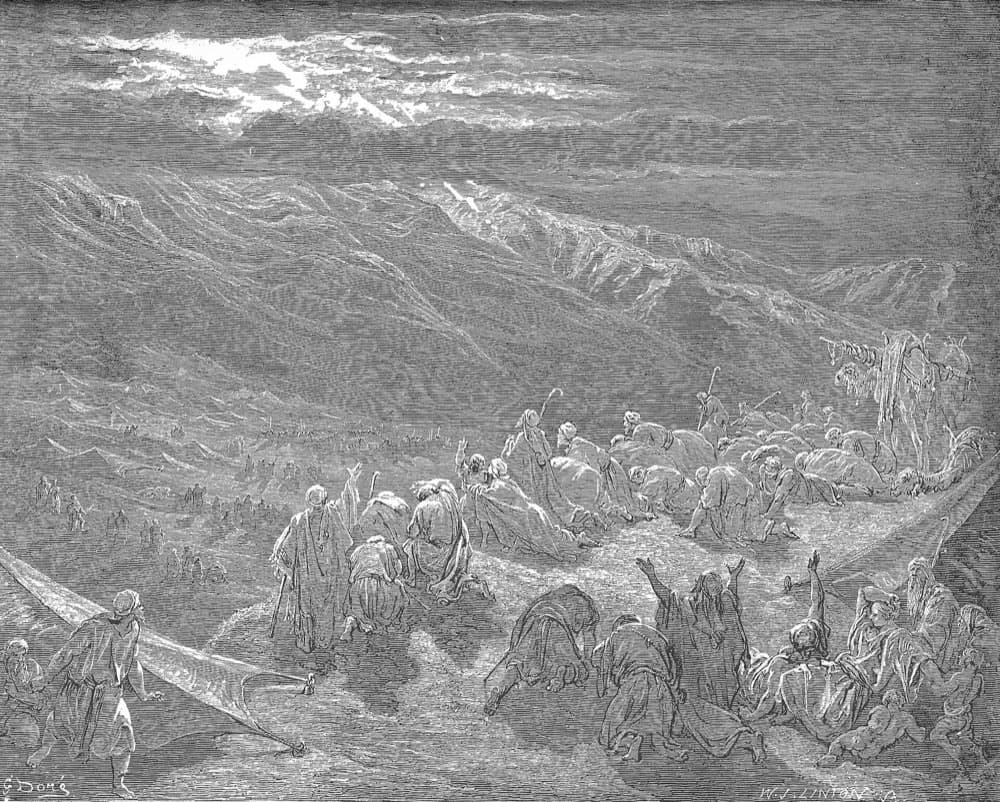
Moses receives the tables written with the finger of God.
18And he gave unto Moses, when he had made an end of communing with him upon mount Sinai, two tables of testimony, tables of stone, written with the finger of God.
Prophets write; scribes copy; God speaks and is written down. That is the normal machinery of revelation everywhere else in the canon. Exodus 31:18 is the exception, and Exodus 32:16 will not let the reader treat it as a flourish: 'the tables were the work of God, and the writing was the writing of God, graven upon the tables.' Three claims, stacked — the stone was His work, the text was His text, and it was cut into the surface rather than laid on it.
Moses tells the story again in Deuteronomy 9:10, forty years later, to people who were children when it happened or not yet born. He keeps the detail. Of everything he might have compressed in the retelling, the finger stays in.
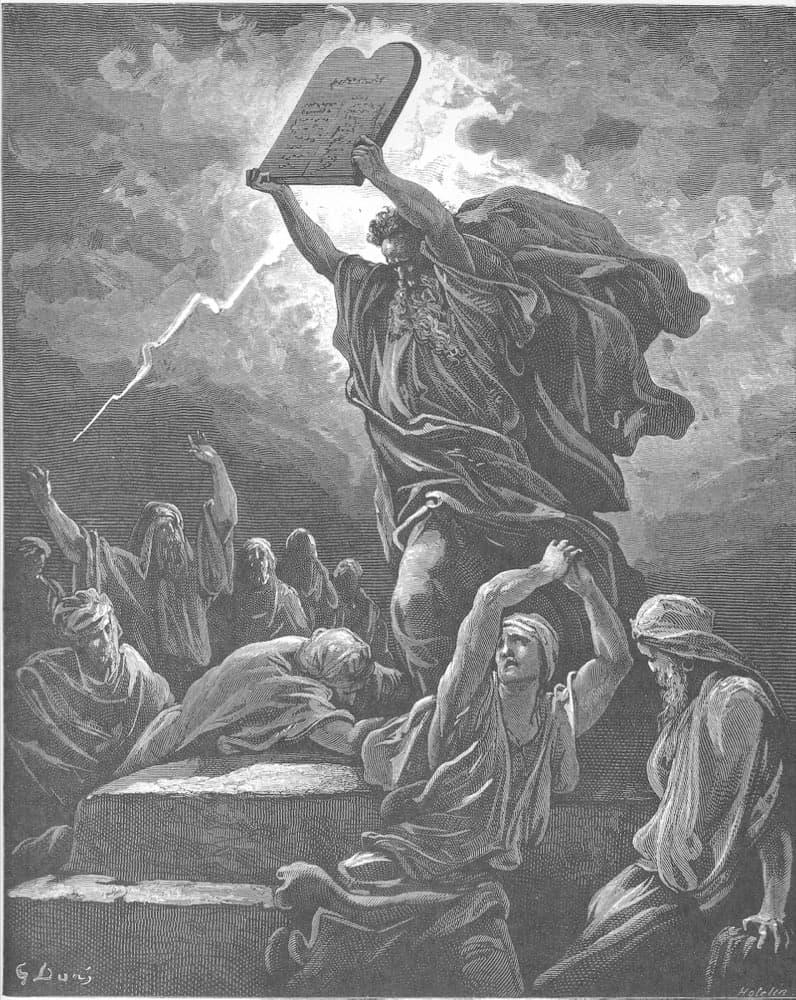
The tables broken at the foot of the mountain.
And then it is broken
This is the part of the pattern that is usually skipped, and it is the part with the most to say. Moses comes down, sees the calf, and throws the tables at the base of the mountain. The one autograph document in the history of the world lasts less than a day in human hands.
Principle
What the finger of God writes can be lost by the people it was written for.
Not destroyed — God rewrites. But what comes back is not always what went away. The Sinai instance is the pattern's warning, and it sits at the exact centre of the sequence.
Exodus 32:15–19 · JST Exodus 34:1–2 · D&C 84:19–25
Two walls, two hemispheres
Belshazzar in Babylon, Aminadi in the land of Ammonihah, and a description that matches.
5In the same hour came forth fingers of a man's hand, and wrote over against the candlestick upon the plaister of the wall of the king's palace: and the king saw the part of the hand that wrote.
Belshazzar is not merely feasting. He has sent for the vessels his father took out of the temple in Jerusalem and is drinking wine from them while praising gods of gold and silver. The writing appears in the same hour. Whatever else the finger is doing across the canon, in this instance it is answering a specific desecration with a specific sentence, and the sentence is arithmetic: numbered, weighed, divided.
Now the detail worth stopping on. Daniel's Aramaic says the writing was done by 'fingers of a man's hand.' Ether 3:6 says the finger the brother of Jared saw was 'as the finger of a man.' Two records with no possible literary contact reach for the same comparison — not that God's hand was terrifying or strange, but that it looked like ours.
2I am Amulek; I am the son of Giddonah, who was the son of Ishmael, who was a descendant of Aminadi;
3and it was that same Aminadi who interpreted the writing which was upon the wall of the temple, which was written by the finger of God.
Amulek is a hostile witness's nightmare: a wealthy, well-connected local man establishing that he is nobody's outsider. He lists his ancestry, and the ancestor he stops to explain is the one who read writing on a temple wall. He gives no details, offers no comparison to Daniel, and moves on. The episode is preserved only because a man in a legal argument needed a surname.
| Daniel 5 | Alma 10:2 | |
|---|---|---|
| Where | Palace wall, Babylon | Temple wall, among the Nephites |
| Written by | Fingers of a man's hand | The finger of God |
| Readable? | No — the wise men fail | No — it required interpreting |
| Who reads it | Daniel, a prophet in exile | Aminadi, an ancestor of Amulek |
| Told at length? | A whole chapter | One clause, in passing |
To consider
- 01Why would a record keep an episode this significant in a single subordinate clause?
- 02In both scenes the writing is unreadable without a prophet. What is that saying about revelation that a legible sign would not?
Mount Shelem: the finger as flesh
The appearance that explains all the others, delivered to a man who asked for something else entirely.
The Lord touches the stones on Mount Shelem. · Ether 3:1–16
Set the scene precisely, because the details are the argument. The barges are finished, watertight, and dark. God has already told him the problem cannot be solved with fire and has asked him the question He does not usually ask: 'What will ye that I should do that ye may have light?' (Ether 2:23). The brother of Jared goes up the mountain, melts sixteen small stones out of a rock, carries them up, and asks God to touch them.
6And it came to pass that when he had said these words, behold, the Lord stretched forth his hand and touched the stones one by one with his finger. And the veil was taken from off the eyes of the brother of Jared, and he saw the finger of the Lord; and it was as the finger of a man, like unto flesh and blood; and the brother of Jared fell down before the Lord, for he was struck with fear.
9And because of thy faith thou hast seen that I shall take upon me flesh and blood; and never has man come before me with such exceeding faith as thou hast; for were it not so ye could not have seen my finger.
He did not ask to see God. He asked for light in a boat. The veil parts because of what was behind the request rather than what was in it — and verse 9 gives the reason in God's own words: he saw the finger because of faith, and what he saw in it was the incarnation, announced by the finger's own texture more than two thousand years before it happened.
Moroni, writing the abridgement, thinks the mechanism matters more than the marvel. His commentary in Ether 12:19–21 is the best short statement in scripture of how the veil actually works: these were men whose faith was so strong that they could not be kept from within the veil, and 'having faith they could not be kept from beholding.' Not rewarded with sight. Unable to be kept from it.
Principle
The veil is not a wall God maintains against us; it is a condition faith is capable of exhausting.
The finger with a body on it
Luke 11 replays Exodus 8 with the verdict reversed; John 8 answers stone with dust.
Exodus 8:18–19
Professionals attempt the same work and fail.
They name the cause: “This is the finger of God.”
The ruler hardens and hears them not.
Luke 11:14–20
The work is done and cannot be duplicated.
The professionals assign it to Beelzebub.
He names the cause Himself: “the finger of God.”
In Egypt the experts told the truth and the king refused it. In Galilee the crowd sees plainly and the experts refuse it. Christ then uses the Exodus phrase deliberately, and His conclusion is a claim about timing rather than about power: if this is the finger of God, then the kingdom of God has arrived on you — present tense, already here, whether or not you are ready to have it.
The last appearance is the quietest. In the temple court a woman is brought for judgement under a law cut into stone, and He stoops and writes in the dust with His finger. What He wrote is not recorded and the guesses are worthless. What the scene does is put the finger back in contact with the ground, twice, while men who came holding stones put them down and leave from the eldest to the last.
And the connection between the two writings — stone at Sinai, dust in the temple — is a reading, not a claim the text makes. It is offered as one, because the alternative is to pretend a suggestive parallel is an exegetical fact. What the text does say is that on the day the written law was invoked to kill someone, the finger that had written it was in the room, on the ground, in silence.
What the pattern is for
The incarnation, argued backwards through the canon.
Put the appearances in order and a single doctrine assembles itself. God writes, so He is articulate. He touches stones, so He is present in matter. His finger looks like a man's on two continents, so the resemblance between God and man is not flattery. He tells the brother of Jared what the resemblance is for — 'I shall take upon me flesh and blood' — and two millennia later He is casting out devils with the same finger and writing in dust with it.
22The Father has a body of flesh and bones as tangible as man's; the Son also; but the Holy Ghost has not a body of flesh and bones, but is a personage of Spirit. Were it not so, the Holy Ghost could not dwell in us.
The Restoration's statement about embodiment is not a novelty grafted onto a Bible that resisted it. It is the plain reading of a thread the Bible had been carrying for a very long time, made explicit — and the Book of Mormon supplies the missing scene that shows what the thread was for.
Why an embodied God changes what the other passages are describing.
One last observation on the order. This pattern has no crescendo. Its fullest disclosure is its earliest instance, given privately on a mountain to a man who wanted light for a boat, and then sealed up in a record that would not be read for thousands of years. Everything else in the sequence is partial. The canon is not building toward the truth about God's finger; it is circling something already shown, to one man, off the record, because he asked well.
What the pattern holds
When scripture names the finger of God rather than His hand, it is reporting an event, not using a figure of speech.
Four occurrences in the Hebrew Bible, each attached to a specific act on specific matter with specific witnesses. The rarity is the evidence.
Evidence of God does not produce faith in God.
Pharaoh's own magicians identify the finger of God and he hardens in the same verse. Belshazzar sees the hand write and dies that night. The scribes watch a devil cast out and credit Beelzebub. The pattern is consistent enough to be a doctrine.
What God writes for a people can be forfeited by that people.
The only autograph text in scripture was broken within a day, and what replaced it was, by the JST's account, deliberately less.
Exodus 32:15–19 · JST Exodus 34:1–2 · D&C 84:23–25
Faith of a sufficient order does not earn the veil's removal; it makes the veil unable to remain.
Moroni's language is not reward language. 'Having faith they could not be kept from beholding.' The brother of Jared did not ask to see and was not able not to.
The resemblance between God's hand and a man's is the physical form of the doctrine that man is made in God's image.
Two records, separated by an ocean and a thousand years, describe it the same way — like a man's. The Restoration states plainly what those two witnesses had already reported.
What this will not carry
- The hand and the arm of the Lord are ordinary Hebrew idioms for power and appear hundreds of times. Folding them into this pattern would swell it to nothing. The narrowness of the word is what gives the study its force.
- Reading John 8's writing in the dust as a deliberate answer to the finger-written law of Sinai is a homiletic reading. It is a good one, and it is not what the text says. Keep the two apart when teaching it.
- Exodus 8:19 is spoken by Egyptian magicians, not by a prophet or a narrator. It is a hostile concession, valuable precisely because of who says it — but it is not scripture endorsing their theology.
- Ether 3:15 is genuinely difficult, and any teaching of this pattern that presents one resolution as settled doctrine is overreaching. The Church has not resolved it.
- John 7:53–8:11 is textually disputed in the earliest Greek manuscripts. The instance is included here with that stated, and a reader who wants the pattern to stand without it will find the other eight appearances carry it.
Check your reading
5 questions01Who identifies the third plague as “the finger of God”?
02What did the brother of Jared actually ask God for on Mount Shelem?
03Which Book of Mormon passage records writing on a temple wall by the finger of God?
04According to the Joseph Smith Translation, how did the second set of tables differ from the first?
05Where Luke writes “the finger of God,” Matthew's parallel account reads —
Where to go next
Sources
- Ether 3 — Book of Mormon Student Manual, Church Educational System
- Joseph Smith Translation, Exodus 34:1–2 — Bible appendix, Gospel Library
- “Hand”, “Finger” — Guide to the Scriptures, churchofjesuschrist.org
- Brown, Driver and Briggs, A Hebrew and English Lexicon of the Old Testament — s.v. אֶצְבַּע ('etsba'), H676
- Bruce M. Metzger, A Textual Commentary on the Greek New Testament — On the manuscript evidence for John 7:53–8:11