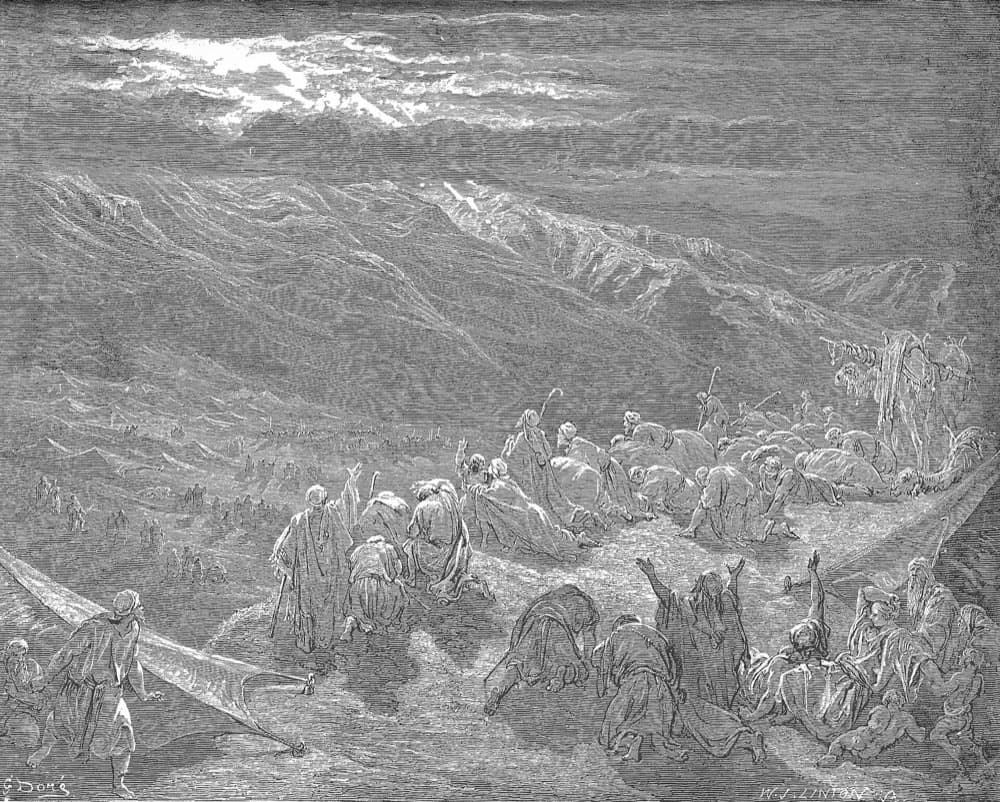
The Giving of the Law on Mount Sinai
Old Testament
The Mountain and the Covenant
Exodus 19–24, and what a nation agreed to
Exodus 19–20; Exodus 24; Deuteronomy 5; JST Exodus 34:1–245 min4 sections
Israel arrives at a mountain three months out of Egypt and is offered terms. The Ten Commandments are the famous part; the covenant ceremony around them is the part that explains what the commandments are for, and why a second, lesser law followed.
- Author
- The Pentateuchal tradition; Moses in the narrative
- Date
- Traditionally c. 1450 BC or c. 1250 BC — the same two candidates as the Exodus
- Place
- The wilderness of Sinai, at the mountain
- Audience
- A nation of former slaves, three months out of Egypt
- Language
- Biblical Hebrew
- Genre
- Covenant ceremony, in the form of an ancient Near Eastern treaty
By the end you should be able to
- Describe the covenant offer of Exodus 19:5–6 and what Israel promised in reply.
- Recognise the treaty form the chapter follows, and what that form implies.
- State the two ways the Ten Commandments are divided, and what the division shows.
- Explain what the Joseph Smith Translation adds about why the lesser law was given.
The offer
Terms proposed, and accepted, before a single commandment is given.
4Ye have seen what I did unto the Egyptians, and how I bare you on eagles' wings, and brought you unto myself.
5Now therefore, if ye will obey my voice indeed, and keep my covenant, then ye shall be a peculiar treasure unto me above all people: for all the earth is mine:
6And ye shall be unto me a kingdom of priests, and an holy nation.
8And all the people answered together, and said, All that the Lord hath spoken we will do.
The order is worth noticing. God recites what He has already done, then states terms, then Israel agrees — and only afterwards does chapter 20 give the commandments. The law arrives inside a relationship that has already been established and already been accepted, which is not how it is usually remembered.
Two phrases in verse 5–6
The Ten
Two tables, and two directions.
2I am the Lord thy God, which have brought thee out of the land of Egypt, out of the house of bondage.
3Thou shalt have no other gods before me.
8Remember the sabbath day, to keep it holy.
12Honour thy father and thy mother: that thy days may be long upon the land which the Lord thy God giveth thee.
Verse 2 is not a commandment; it is an identification, and it is what everything after it hangs on. The Hebrew tradition counts it as the first of the ten 'words' — the term Exodus 34:28 actually uses is not 'commandments' but dəbārîm, words or sayings.
| Toward God | Toward other people |
|---|---|
| No other gods | Honour father and mother |
| No graven image | Do not kill |
| Do not take the name in vain | Do not commit adultery |
| Remember the sabbath day | Do not steal |
| Do not bear false witness | |
| Do not covet |
The division is the same one Christ makes when He is asked for the greatest commandment: love God, and love your neighbour, and on these two hang all the law and the prophets. Honouring parents sits at the hinge, which is where a good deal of ink has been spent.
The ceremony
The covenant is not signed. It is eaten, and sprinkled.
3And Moses came and told the people all the words of the Lord, and all the judgments: and all the people answered with one voice, and said, All the words which the Lord hath said will we do.
7And he took the book of the covenant, and read in the audience of the people: and they said, All that the Lord hath said will we do, and be obedient.
8And Moses took the blood, and sprinkled it on the people, and said, Behold the blood of the covenant, which the Lord hath made with you concerning all these words.
11And upon the nobles of the children of Israel he laid not his hand: also they saw God, and did eat and drink.
Three things happen that are easy to read past. The people agree three separate times. Blood is sprinkled on them, and the phrase 'the blood of the covenant' is the one Christ will use over a cup at the Last Supper. And the elders go up the mountain, see God, and have a meal — which is the standard way a treaty was ratified in that world, and an astonishing thing to report.
Where the phrase goes
- Matthew 26:28'This is my blood of the new testament, which is shed for many for the remission of sins.' The same phrase, over a cup.
- Hebrews 9:18–22The writer of Hebrews reads Exodus 24 as the pattern the new covenant fulfils.
- Zechariah 9:11'By the blood of thy covenant I have sent forth thy prisoners out of the pit.'
- 3 Nephi 18:1–11The sacrament instituted at Bountiful, in the same covenantal grammar.
A sequence of thresholds: court, holy place, holy of holies — each entered by fewer people, through more preparation. The veil is the last of them.
Why a lesser law
The Restoration supplies a reason the biblical text only implies.
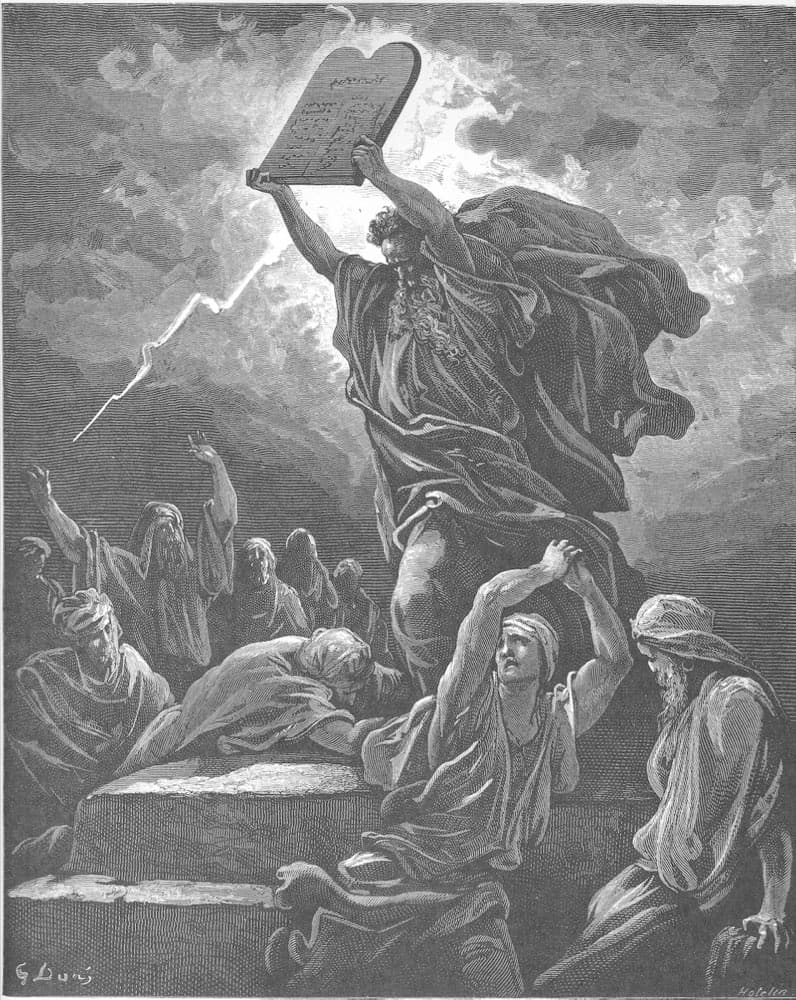
Moses breaks the tables. The Joseph Smith Translation says the second set did not contain what the first did.
Exodus 32 records the golden calf; Exodus 34 records Moses returning with a second set of tables. The biblical text does not say the second set differed from the first. The Joseph Smith Translation does.
King James
“Hew thee two tables of stone like unto the first: and I will write upon these tables the words that were in the first tables, which thou brakest.”
Joseph Smith Translation
“…and I will write upon them also, the words of the law, according as they were written at the first on the tables which thou brakest; but it shall not be according to the first, for I will take away the priesthood out of their midst; therefore my holy order, and the ordinances thereof, shall not go before them.”
23Now this Moses plainly taught to the children of Israel in the wilderness, and sought diligently to sanctify his people that they might behold the face of God;
24But they hardened their hearts and could not endure his presence; therefore, the Lord in his wrath, for his anger was kindled against them, swore that they should not enter into his rest while in the wilderness, which rest is the fulness of his glory.
25Therefore, he took Moses out of their midst, and the Holy Priesthood also;
Principle
The law of Moses was a lesser law given to a people who had refused a greater one — a schoolmaster, not a punishment.
Galatians 3:24 calls it a paidagōgos, the household slave who walked a child to school. The word implies a term: something that ends when the child arrives. Read this way, the whole sacrificial system is a rehearsal for something the people were not yet prepared to receive directly.
Galatians 3:24–25 · D&C 84:23–27 · Mosiah 13:29–32 · 2 Nephi 25:24–27
To consider
- 01The covenant is offered and accepted before any commandment is given. What changes if the law is read as terms of a relationship rather than as conditions of one?
- 02The tenth commandment cannot be enforced. What is it for, then?
- 03Israel asked not to hear God directly, and was given a mediator. Where do you ask for the same thing?
What this lesson holds
The covenant at Sinai was offered to the whole nation as a kingdom of priests, and the law came inside a relationship rather than instead of one.
The Decalogue divides into duties toward God and duties toward people — the same division Christ makes when asked for the greatest commandment.
The law of Moses was a lesser law, given after Israel declined to approach God directly, and it was always meant to end.
JST Exodus 34:1–2 · D&C 84:23–27 · Galatians 3:24–25
Check your reading
5 questions01What does God do before giving any commandment at Sinai?
02What does the Hebrew səgullāh mean?
03What is distinctive about the tenth commandment?
04How is the covenant ratified in Exodus 24?
05What does the Joseph Smith Translation add about the second set of tables?
Where to go next
Sources
- Exodus 19–24 — The primary text.
- Bible Dictionary, "Law of Moses"
- Old Testament Student Manual: Genesis–2 Samuel
- JST Exodus 34:1–2 — Printed in the appendix of the Latter-day Saint edition of the Bible.