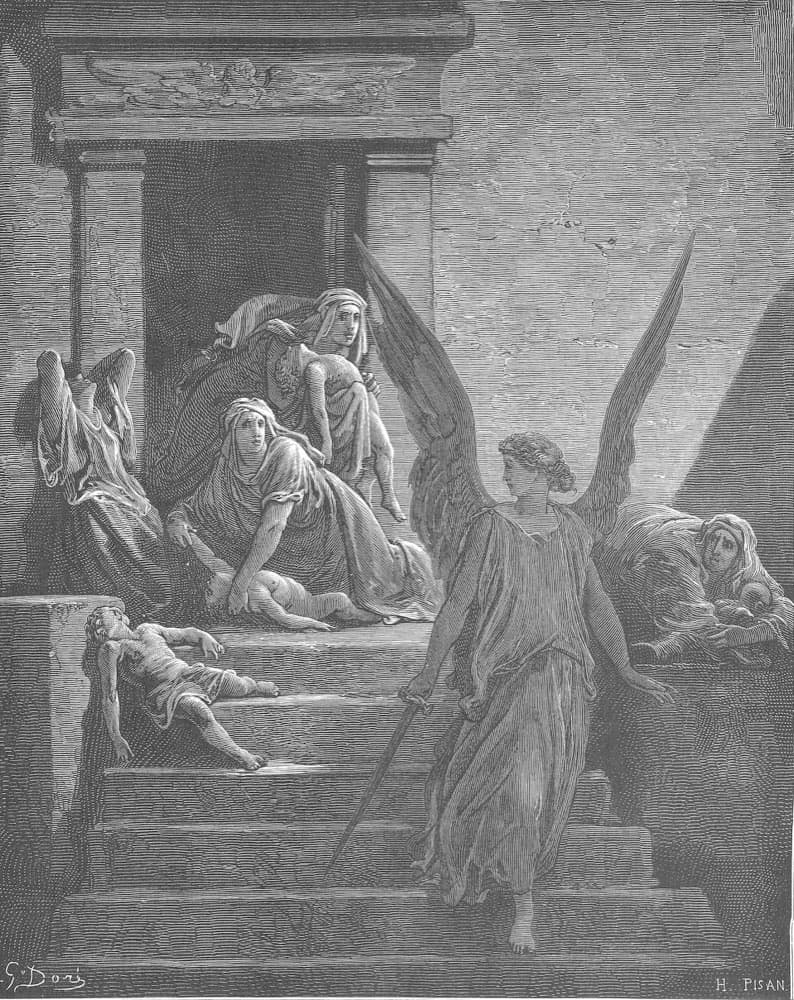
The Firstborn of the Egyptians Are Slain
Old Testament
A Lamb for a House
Passover, and the meal that keeps being kept
Exodus 12; Luke 22; John 1945 min4 sections
A rite instituted on the last night of slavery, designed from the start to be re-enacted, and answered fourteen centuries later on a Friday afternoon in Jerusalem. The details are not decoration — nearly every one of them is claimed by the New Testament.
- Author
- Attributed to Moses
- Date
- The Exodus traditionally placed in the fifteenth or thirteenth century BC
- Place
- Goshen, in Egypt
- Audience
- Israel on the night before the Exodus, and every generation after
- Genre
- Narrative interrupted by liturgical instruction — the rite is legislated before it is performed
By the end you should be able to
- List the specifications of the Passover lamb and say which of them the New Testament claims for Christ.
- Explain what the Hebrew verb pāsaḥ may mean besides "pass over."
- Describe how the rite was designed to be taught to children.
- Trace the line from Passover through the Last Supper to the sacrament.
The specifications
Out of Goshen, across the sea, to Sinai and the law, then Kadesh, then forty years, then around Edom to the plains of Moab.
3...In the tenth day of this month they shall take to them every man a lamb, according to the house of their fathers, a lamb for an house:
5Your lamb shall be without blemish, a male of the first year: ye shall take it out from the sheep, or from the goats:
6And ye shall keep it up until the fourteenth day of the same month: and the whole assembly of the congregation of Israel shall kill it in the evening.
7And they shall take of the blood, and strike it on the two side posts and on the upper door post of the houses, wherein they shall eat it.
13And the blood shall be to you for a token upon the houses where ye are: and when I see the blood, I will pass over you, and the plague shall not be upon you to destroy you, when I smite the land of Egypt.
| Exodus 12 | The requirement | Claimed for Christ |
|---|---|---|
| v. 5 | Without blemish (tāmîm) | 1 Peter 1:18–19 — "a lamb without blemish and without spot" |
| v. 5 | A male of the first year | The Lamb slain in the prime of life |
| v. 3 | A lamb for a house — not for an individual | The household as the unit of salvation; Acts 16:31 |
| v. 6 | Kept from the tenth to the fourteenth, then killed | Christ enters Jerusalem days before, is examined publicly, then killed at Passover |
| v. 7 | Blood applied to the doorframe, or it does nothing | Blood applied by covenant and ordinance, not merely shed — Mosiah 4:2 |
| v. 8 | Eaten, not merely offered | "Except ye eat the flesh of the Son of man" — John 6:53 |
| v. 46 | Not a bone of it broken | John 19:33–36, cited explicitly as fulfilment |
| v. 11 | Eaten in haste, dressed to travel | A meal for people about to leave somewhere |
Verse 13 contains the sentence that does the theological work: "when I see the blood." Not when I see your faith, or your worthiness, or your record. The token is external, applied, and visible — which is a fair description of what an ordinance is.
Built to be repeated
14And this day shall be unto you for a memorial; and ye shall keep it a feast to the Lord throughout your generations; ye shall keep it a feast by an ordinance for ever.
26And it shall come to pass, when your children shall say unto you, What mean ye by this service?
27That ye shall say, It is the sacrifice of the Lord's passover, who passed over the houses of the children of Israel in Egypt, when he smote the Egyptians, and delivered our houses...
Verses 26–27 legislate a question. The rite is designed so that a child will eventually ask what it means, and the answer is a story. Jewish practice built the entire Passover seder around this instruction, with the youngest child asking the four questions. It is one of the oldest deliberate pedagogies in the world.
The Friday
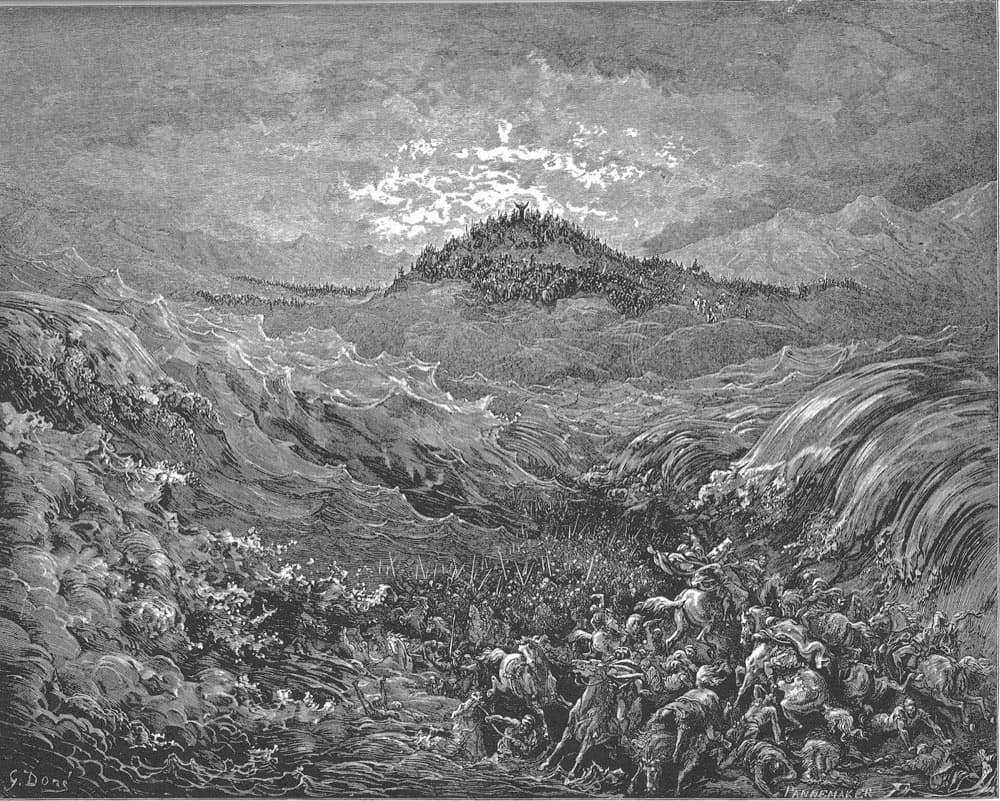
The sea closes. Passover and the crossing are one night's work, and the New Testament reads both as types.
A sequence of thresholds: court, holy place, holy of holies — each entered by fewer people, through more preparation. The veil is the last of them.
John's Gospel is unusually careful about Passover chronology. It places the trial before Pilate at "the preparation of the passover, and about the sixth hour" (John 19:14), which sets the crucifixion at the hour the lambs were being killed in the temple. And when the soldiers come to break the legs of the crucified to hasten death, they find Jesus already dead.
33But when they came to Jesus, and saw that he was dead already, they brake not his legs:
36For these things were done, that the scripture should be fulfilled, A bone of him shall not be broken.
Citing Exodus 12:46 and Numbers 9:12.
John the Baptist's title for Him is the same identification made in advance: "Behold the Lamb of God, which taketh away the sin of the world" (John 1:29). Paul states it without metaphor: "Christ our passover is sacrificed for us" (1 Corinthians 5:7).
The meal that continued
15And he said unto them, With desire I have desired to eat this passover with you before I suffer:
19And he took bread, and gave thanks, and brake it, and gave unto them, saying, This is my body which is given for you: this do in remembrance of me.
20Likewise also the cup after supper, saying, This cup is the new testament in my blood, which is shed for you.
King James renders it “the new testament in my blood”
The word the Septuagint uses for Hebrew bərît. "New testament" here means new covenant — Jesus is announcing the fulfilment of Jeremiah 31:31–33 over a Passover table. The English word testament, inherited through Latin, is why the two halves of the Bible carry the names they do.
Full lexicon entry →
Notice what is continuous and what changes. A meal, a household, a memorial, a covenant sealed in blood, and an instruction to keep doing it — all continuous. What changes is that the lamb is no longer on the table. He is at it.
3 Nephi 18 records the Savior administering the same ordinance in the New World, and D&C 20:75–79 gives the prayers still used. The Latter-day Saint sacrament is thus the third form of one rite: Passover, the Last Supper, the sacrament — each a covenant meal with a deliverance behind it.
What this lesson holds
The blood had to be applied, not merely shed.
The distinction between an atonement made and an atonement received runs through the whole canon, and it starts at a doorframe in Egypt.
God instituted a rite designed to provoke a child's question and to be answered with a story.
Jesus Christ is the Passover lamb, and the New Testament claims the specifications one by one.
John 1:29 · John 19:36 · 1 Corinthians 5:7 · 1 Peter 1:18–19
The sacrament is a covenant meal in the same line as Passover.
Check your reading
5 questions01According to Exodus 12:13, what is the condition for the plague to pass over a house?
02Which specification does John cite explicitly as fulfilled at the crucifixion?
03What other meaning has been proposed for the Hebrew verb pāsaḥ?
04What does Exodus 12:26–27 legislate?
05What does Jesus call the cup at the Last Supper?
Where to go next
Sources
- Exodus 12; Luke 22; John 19; 1 Corinthians 5 — The primary texts.
- Bible Dictionary, "Passover"
- Old Testament Student Manual, Genesis–2 Samuel — Church Educational System, chapter on Exodus 12