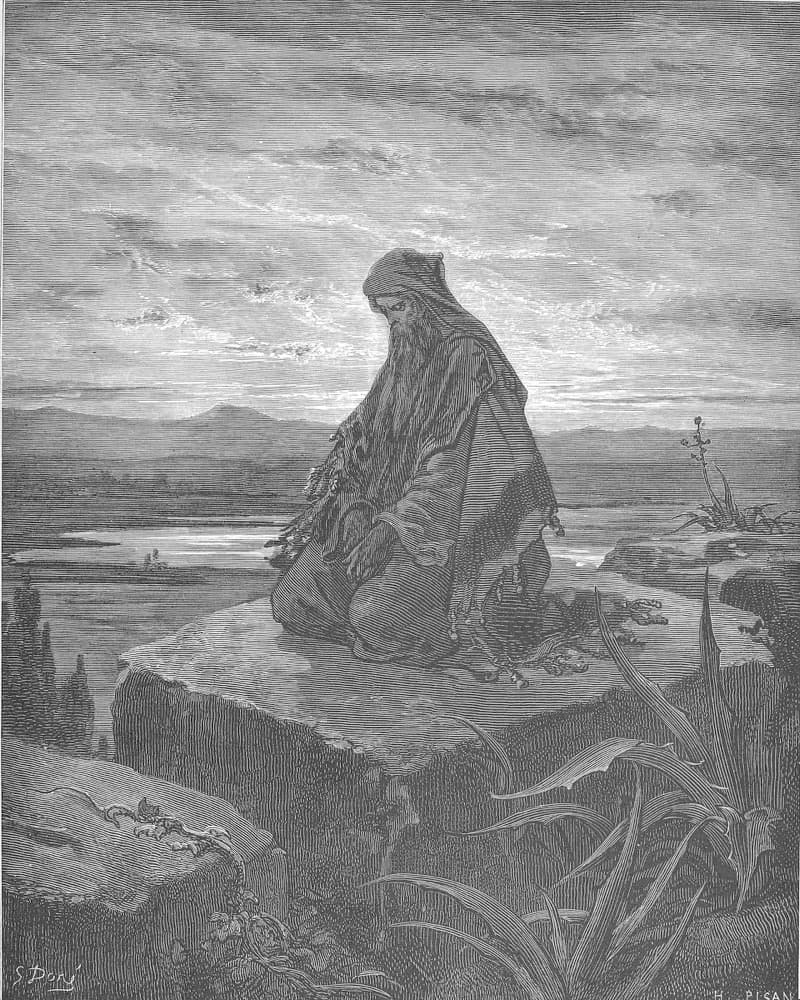
The Prophet Isaiah
Old Testament
The Servant
Isaiah 52:13–53:12, and what the Hebrew actually says
Isaiah 52:13–53:12; Mosiah 14–15; Acts 8:26–3950 min4 sections
Fifteen verses written seven centuries before the crucifixion that read, to Christian eyes, like a report from the scene. The Hebrew is sharper than the King James, the Jewish reading deserves a hearing, and Abinadi's exposition adds something neither tradition supplies.
- Author
- Isaiah of Jerusalem, or the prophetic tradition bearing his name
- Date
- Eighth century BC for Isaiah; the Servant Songs are often placed in chapters 40–55, whose setting is exilic
- Place
- Judah, and the exile
- Language
- Biblical Hebrew poetry
- Genre
- The fourth of four Servant Songs
By the end you should be able to
- Read the key Hebrew terms of Isaiah 53:4–5 and see what the KJV softened.
- State the corporate (Israel) reading fairly, and say what pushes against it inside the chapter.
- Explain what Abinadi adds in Mosiah 15 that the Isaiah text alone does not supply.
- Say why Philip could begin "at the same scripture" and preach Jesus.
The chapter
Four kinds, with examples. Reading the second line as new information is the commonest mistake made with the Psalms, Proverbs and Isaiah.
3He is despised and rejected of men; a man of sorrows, and acquainted with grief: and we hid as it were our faces from him; he was despised, and we esteemed him not.
4Surely he hath borne our griefs, and carried our sorrows: yet we did esteem him stricken, smitten of God, and afflicted.
5But he was wounded for our transgressions, he was bruised for our iniquities: the chastisement of our peace was upon him; and with his stripes we are healed.
6All we like sheep have gone astray; we have turned every one to his own way; and the Lord hath laid on him the iniquity of us all.
7He was oppressed, and he was afflicted, yet he opened not his mouth: he is brought as a lamb to the slaughter, and as a sheep before her shearers is dumb, so he openeth not his mouth.
Verses 4–5, under the English
Taken together, the Hebrew of verses 4–5 is harder and more physical than the King James makes it: he carried our sicknesses and our pains; he was pierced through for our transgressions and crushed for our iniquities; the discipline that makes us whole fell on him. Very little softening survives contact with the original.
Who is the Servant?
The question the Ethiopian asked, and it is a good one.
32The place of the scripture which he read was this, He was led as a sheep to the slaughter...
34And the eunuch answered Philip, and said, I pray thee, of whom speaketh the prophet this? of himself, or of some other man?
35Then Philip opened his mouth, and began at the same scripture, and preached unto him Jesus.
The Servant is Israel
Isaiah calls Israel "my servant" repeatedly and by name (41:8–9; 44:1–2; 49:3).
The nation's exile is read as vicarious suffering among the nations.
This is the standard Jewish reading, and it is ancient, coherent, and textually grounded.
The Servant is an individual
53:8 says he was stricken "for the transgression of my people" — the Servant is distinguished from the people he suffers for.
53:9 gives him a grave and a death; 53:10 has him see his seed and prolong his days afterward.
53:9 says he had done no violence and no deceit — difficult to say of a nation.
A student should be able to state the corporate reading honestly rather than dismissing it. Isaiah does call Israel his servant, and the exile was real suffering among the nations. What pushes hardest against it, from within the chapter, is verse 8: the Servant suffers for "my people," which sets him apart from them.
Latter-day Saints have an unusual additional consideration. Abinadi quotes this chapter entire in Mosiah 14, roughly 148 BC, and then expounds it as being about Christ — before the crucifixion, in a text claiming to derive from a pre-exilic brass-plates Isaiah. Whatever a reader concludes about that claim, it means the Christological reading is not, in this canon, a later Christian retrofit.
Abinadi's exposition
Mosiah 15 is Abinadi's commentary on the chapter he has just quoted, and it does something no other ancient exposition of Isaiah 53 does: it explains how one person can be both the Father and the Son.
1And now Abinadi said unto them: I would that ye should understand that God himself shall come down among the children of men, and shall redeem his people.
2And because he dwelleth in flesh he shall be called the Son of God, and having subjected the flesh to the will of the Father, being the Father and the Son—
3The Father, because he was conceived by the power of God; and the Son, because of the flesh; thus becoming the Father and Son—
5And thus the flesh becoming subject to the Spirit, or the Son to the Father, being one God, suffereth temptation, and yieldeth not to the temptation, but suffereth himself to be mocked, and scourged, and cast out, and disowned by his people.
7Yea, even so he shall be led, crucified, and slain, the flesh becoming subject even unto death, the will of the Son being swallowed up in the will of the Father.
"He shall see of the travail of his soul, and shall be satisfied"
10Yet it pleased the Lord to bruise him; he hath put him to grief: when thou shalt make his soul an offering for sin, he shall see his seed, he shall prolong his days, and the pleasure of the Lord shall prosper in his hand.
11He shall see of the travail of his soul, and shall be satisfied: by his knowledge shall my righteous servant justify many; for he shall bear their iniquities.
Verse 10 is jarring in English: "it pleased the LORD to bruise him." The Hebrew verb ḥāpēṣ means to delight in or to will — it is the language of purpose rather than of enjoyment. The line says the crushing was within God's will, which is what makes the death a sacrifice rather than a murder that God observed.
Then two extraordinary claims in the same breath. The Servant, having been killed, will "see his seed" and "prolong his days." And he will look at the travail and be satisfied — Hebrew śābaʿ, to have enough, the word used of a full meal. Whatever the Atonement cost, the chapter says the one who paid it looks back and finds it worth what it bought.
Mosiah 15:10–12 takes up the "seed" and identifies it: "who shall be his seed? Behold I say unto you, that whosoever has heard the words of the prophets... and believed that the Lord would redeem his people... these are his seed, or they are the heirs of the kingdom of God."
What this lesson holds
The Servant bore sicknesses and pains, not only sins.
The suffering was substitutionary and purposed, not accidental.
The Servant's offering is described in the technical language of the guilt offering, which required restitution.
Those who believe and are redeemed become the Servant's seed.
Check your reading
5 questions01What do the Hebrew words behind "griefs" and "sorrows" in Isaiah 53:4 actually mean?
02What is the strongest argument inside the chapter against reading the Servant as the nation of Israel?
03What technical term does Isaiah 53:10 use for the Servant's offering?
04In Mosiah 15, what does Abinadi say is 'swallowed up'?
05Isaiah 53:11 says the Servant will see the travail of his soul and —
Where to go next
Sources
- Isaiah 52:13–53:12; Mosiah 14–15; Acts 8 — The primary texts.
- First Presidency, "The Father and the Son: A Doctrinal Exposition" — 1916 — on the senses in which Christ is called the Father
- Old Testament Student Manual, 1 Kings–Malachi — Church Educational System, chapter on Isaiah 53