Topics / Atonement
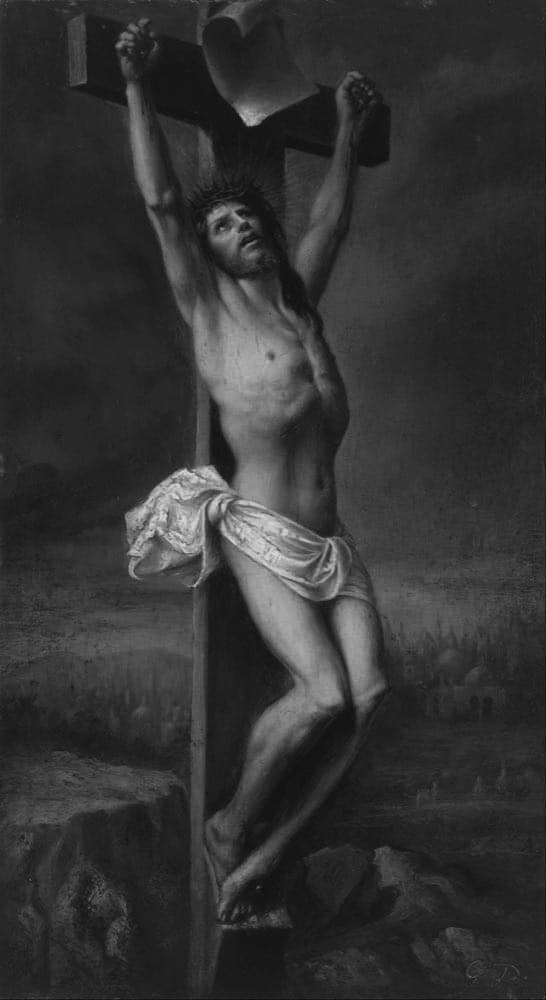
Christ on the Cross
What it accomplishes, and by what mechanism
The Atonement of Jesus Christ
Not a mood, not a metaphor, and not only about sin. Scripture names specific things the Atonement does — undoes both deaths, satisfies justice without suspending it, and gives Christ a knowledge of suffering acquired in the flesh.
25 min3 sections
The word
Both words point the same way: the problem is separation, and the solution is a restored relationship purchased at a cost. 'At-one-ment' is not a folk etymology; it is what the English word was constructed to say.
What it does
The Fall introduced two separations. One is undone for everyone without condition; the other requires a response. Most confusion about grace and works comes from applying a statement about one to the other.
| What was broken | What the Atonement does | Conditional? |
|---|---|---|
| Physical death | Universal resurrection | No — everyone, regardless |
| Spiritual death | Reconciliation with God | Yes — faith, repentance, covenant |
| Sin's penalty | Justice satisfied by payment, not waiver | Yes — 'that they might not suffer if they would repent' |
| Pain, sickness, injustice, loneliness | Succour from One who knows 'according to the flesh' | Offered to all; received by asking |
| Weakness itself | Weak things made strong | Yes — humility and faith |
11And he shall go forth, suffering pains and afflictions and temptations of every kind; and this that the word might be fulfilled which saith he will take upon him the pains and the sicknesses of his people.
12And he will take upon him death, that he may loose the bands of death which bind his people; and he will take upon him their infirmities, that his bowels may be filled with mercy, according to the flesh, that he may know according to the flesh how to succor his people according to their infirmities.
This is the verse that widens the Atonement past sin. Pains, afflictions, temptations, sicknesses and infirmities are all named, and a reason is given: so that He would know how to help. An omniscient God could have known about suffering without any of this; the text insists on a knowledge acquired in the flesh.
Principle
Mercy does not suspend justice; it satisfies it. The penalty is paid rather than waived.
Alma 34:14–16 states the mechanism: mercy 'can satisfy the demands of justice, and encircles them in the arms of safety.' Amulek does not say the law was set aside for you; he says it was met for you — which is why the Atonement is a payment and not a pardon.
"Infinite and eternal"
16For behold, I, God, have suffered these things for all, that they might not suffer if they would repent;
18Which suffering caused myself, even God, the greatest of all, to tremble because of pain, and to bleed at every pore, and to suffer both body and spirit—and would that I might not drink the bitter cup, and shrink—
19Nevertheless, glory be to the Father, and I partook and finished my preparations unto the children of men.
The only first-person account of the Atonement in scripture.
'Infinite' in Alma 34:10 is doing technical work: unbounded in scope, in duration, and in the person offering it. Amulek's argument is that no ordinary sacrifice suffices because a finite person cannot pay an unbounded debt — which is why the offering had to be made by someone who was not merely a person.
What this topic holds
The Atonement covers both deaths — one unconditionally, one on condition of repentance.
It extends beyond sin to pain, sickness and infirmity, and the reason given is succour.
Justice is satisfied by payment, not waived — which is what makes forgiveness just.
Check your reading
3 questions01What does the Hebrew kāpar mean?
02Why does Alma 7:12 say Christ took upon Him infirmities?
03How does mercy relate to justice in Alma 34?
Where to go next
Sources
- Gospel Topics, "Atonement of Jesus Christ"
- Alma 34; Alma 42; D&C 19; Isaiah 53 — The primary texts.