Topics / Atonement
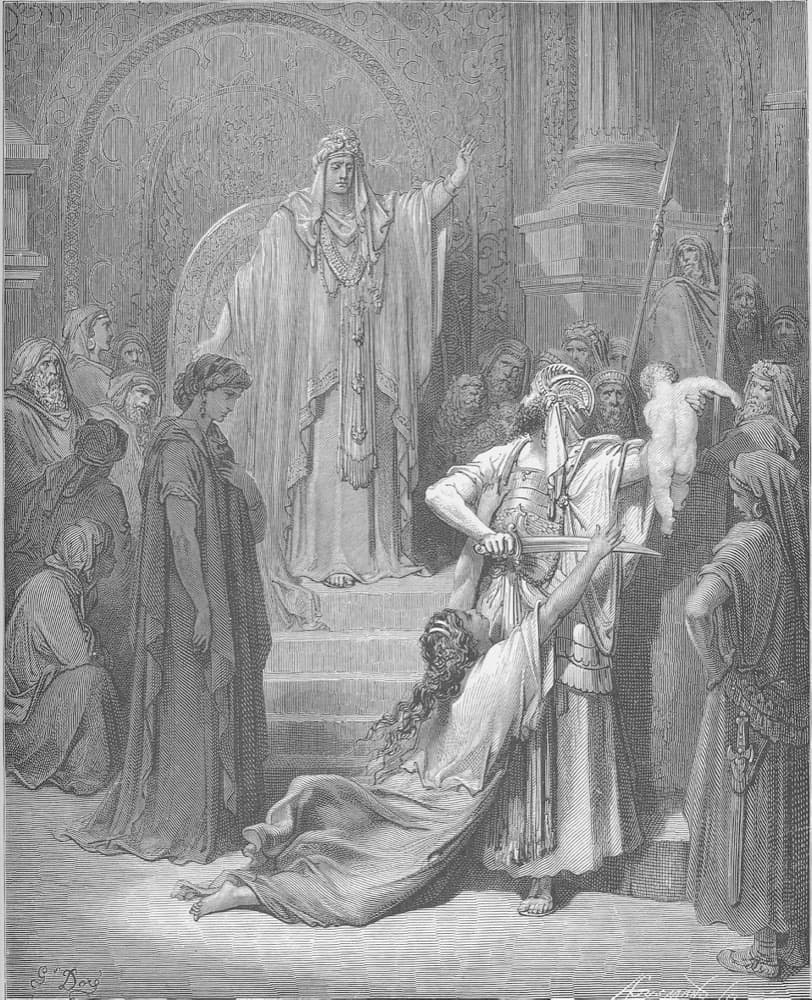
The Judgment of Solomon
How both can be satisfied at once
Justice and Mercy
Alma 42 is the canon's most careful treatment of a genuinely hard problem: how God can forgive without ceasing to be just. The answer is not that the penalty is waived but that someone else paid it — and that the arrangement is voluntary on all sides.
20 min2 sections
The problem, stated properly
Corianton's objection is not stupid, and Alma treats it seriously: it is not fair that a sinner should be consigned to misery. Alma's answer runs through the whole of chapter 42, and the first move is to establish that a law with no penalty attached is not a law.
17Now, how could a man repent except he should sin? How could he sin if there was no law? How could there be a law save there was a punishment?
22But there is a law given, and a punishment affixed, and a repentance granted; which repentance, mercy claimeth; otherwise, justice claimeth the creature and executeth the law, and the law inflicteth the punishment; if not so, the works of justice would be destroyed, and God would cease to be God.
23But God ceaseth not to be God, and mercy claimeth the penitent, and mercy cometh because of the atonement.
25What, do ye suppose that mercy can rob justice? I say unto you, Nay; not one whit. If so, God would ceaseth to be God.
'God would cease to be God' appears twice in three verses. Alma's claim is that a God who forgave by fiat would not be merciful but arbitrary, and that arbitrariness is incompatible with divinity. It is a stronger claim than most treatments of forgiveness make.
The answer
Three parties, not two. Justice is not waived; the penalty is paid by someone who did not owe it, which is what gives mercy a claim.
- A law exists, with a penalty attached; without the penalty there is no law.
- The penalty is real and must be executed on someone.
- Someone with no debt of His own offered to bear it, voluntarily.
- Mercy therefore has a claim on the penitent — not because justice was set aside but because it was satisfied.
- The offer is conditional on repentance, because a mercy applied to someone who does not want it would be a compulsion.
Principle
Mercy does not rob justice; the Atonement pays justice so that mercy has something to claim.
What this topic holds
A law without a penalty is not a law, and forgiveness by fiat would make God arbitrary rather than merciful.
The penalty was borne voluntarily by one with no debt of His own, which is what gives mercy its claim.
Check your reading
3 questions01What does Alma say twice would happen if mercy robbed justice?
02Why must repentance be a condition?
03How many parties does the doctrine require?
Where to go next
Sources
- Alma 34; Alma 42 — The primary texts.
- Boyd K. Packer, "The Mediator" — General conference, April 1977