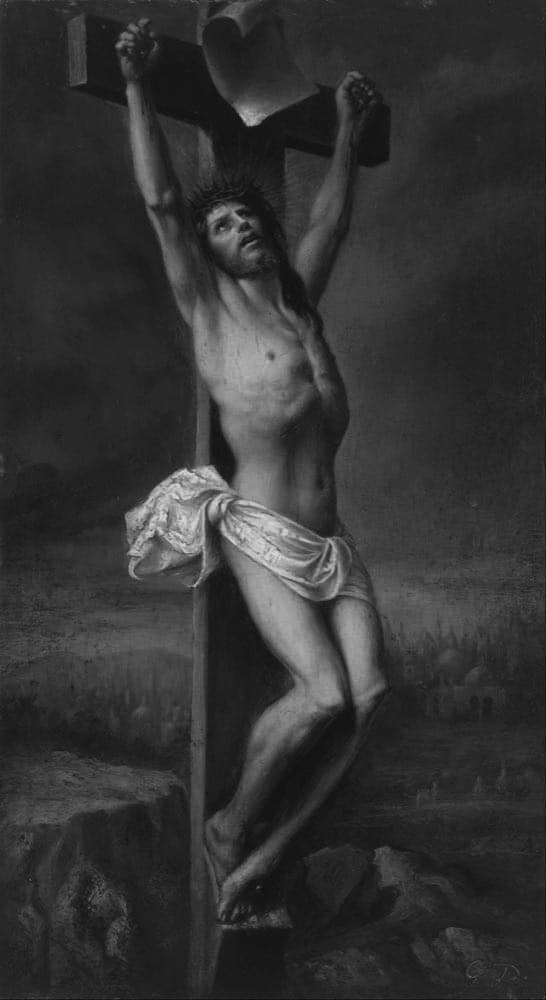
Christ on the Cross
Book of Mormon
Justice, Mercy, and an Infinite Atonement
Amulek's argument, and Alma's answer to Corianton
Alma 34; 42; Alma 7:11–1355 min4 sections
Two of the most rigorous chapters in scripture on why an atonement was necessary at all, why it had to be infinite, and how mercy can be extended without justice being cheated. Alma 42 is a father explaining it to a son who has failed badly.
- Author
- Mormon's abridgement of Alma's record
- Date
- c. 74 BC
- Place
- Antionum (Alma 34) and Zarahemla or its environs (Alma 42)
- Audience
- The Zoramite poor; and Corianton, Alma's son, after serious sin
- Genre
- Missionary sermon; and private paternal instruction
By the end you should be able to
- State Amulek's argument for why the sacrifice had to be infinite rather than human.
- Explain Alma's answer to the objection that mercy robs justice.
- Distinguish the demands of justice from the character of God, and see why Alma says God would "cease to be God."
- Read Alma 7:11–12 as a claim about knowledge, not only about suffering.
Why an atonement at all
8And now, behold, I will testify unto you of myself that these things are true. Behold, I say unto you, that I do know that Christ shall come among the children of men, to take upon him the transgressions of his people, and that he shall atone for the sins of the world; for the Lord God hath spoken it.
9For it is expedient that an atonement should be made; for according to the great plan of the Eternal God there must be an atonement made, or else all mankind must unavoidably perish; yea, all are hardened; yea, all are fallen and are lost, and must perish except it be through the atonement which it is expedient should be made.
10For it is expedient that there should be a great and last sacrifice; yea, not a sacrifice of man, neither of beast, neither of any manner of fowl; for it shall not be a human sacrifice; but it must be an infinite and eternal sacrifice.
11Now there is not any man that can sacrifice his own blood which will atone for the sins of another. Now, if a man murdereth, behold will our law, which is just, take the life of his brother? I say unto you, Nay.
12But the law requireth the life of him who hath murdered; therefore there can be nothing which is short of an infinite atonement which will suffice for the sins of the world.
Amulek argues from ordinary law. No legal system accepts a substitute execution: you cannot discharge a murderer's sentence by killing his brother. If human substitution is unjust, then no human sacrifice — however willing, however noble — can atone for anyone else. Whatever the Atonement is, it cannot be a case of one man taking another man's punishment in the ordinary sense.
Hence "infinite and eternal." The sacrifice must be of a kind that human arithmetic does not govern, offered by someone who is not merely one more member of the class of persons under sentence. That is the doctrinal reason the Incarnation matters: only a being who is both kinsman and God is qualified and able (compare Mosiah 15:1–9).
"Do ye suppose that mercy can rob justice?"
Alma 42 is the closest thing in scripture to a formal argument, and it is addressed to a son in trouble.
Three parties, not two. Justice is not waived; the penalty is paid by someone who did not owe it, which is what gives mercy a claim.
Corianton has forsaken the ministry and gone after the harlot Isabel (Alma 39:3). Alma 42 answers a specific worry his son has raised: that it is unjust for a sinner to be consigned to misery. Everything in the chapter is shaped by the fact that a father is trying to give an honest answer to a son who would prefer a different one.
22But there is a law given, and a punishment affixed, and a repentance granted; which repentance, mercy claimeth; otherwise, justice claimeth the creature and executeth the law, and the law inflicteth the punishment; if not so, the works of justice would be destroyed, and God would cease to be God.
23But God ceaseth not to be God, and mercy claimeth the penitent, and mercy cometh because of the atonement; and the atonement bringeth to pass the resurrection of the dead; and the resurrection of the dead bringeth back men into the presence of God; and thus they are restored into his presence, to be judged according to their works, according to the law and justice.
24For behold, justice exerciseth all his demands, and also mercy claimeth all which is her own; and thus, none but the truly penitent are saved.
25What, do ye suppose that mercy can rob justice? I say unto you, Nay; not one whit. If so, God would cease to be God.
Read verse 24 slowly. Justice exercises all its demands. Mercy claims all that is its own. Neither is reduced. This is not a compromise in which justice accepts less so mercy can have some — it is a settlement in which both are satisfied entirely, because a third party has met the demand.
15And thus he shall bring salvation to all those who shall believe on his name; this being the intent of this last sacrifice, to bring about the bowels of mercy, which overpowereth justice, and bringeth about means unto men that they may have faith unto repentance.
16And thus mercy can satisfy the demands of justice, and encircles them in the arms of safety, while he that exercises no faith unto repentance is exposed to the whole law of the demands of justice; therefore only unto him that has faith unto repentance is brought about the great and eternal plan of redemption.
"Overpowereth justice" (Alma 34:15)
Mercy prevails — but the object of the verb is the claim, not the principle.
What is overpowered is justice's hold on the penitent, because the demand has been met elsewhere.
"Satisfy the demands of justice" (Alma 34:16)
The same verse supplies the mechanism.
Satisfaction, not suspension. The debt is paid, not waived.
The condition attached in both chapters is faith unto repentance. Alma 42:24 states it as starkly as scripture ever does: "none but the truly penitent are saved." The Atonement is unconditional in its offer and in the resurrection it gives to everyone (Alma 11:41–45), and conditional in the remission of sins it makes available.
This life is the time
32For behold, this life is the time for men to prepare to meet God; yea, behold the day of this life is the day for men to perform their labors.
33And now, as I said unto you before, as ye have had so many witnesses, therefore, I beseech of you that ye do not procrastinate the day of your repentance until the end; for after this day of life, which is given us to prepare for eternity, behold, if we do not improve our time while in this life, then cometh the night of darkness wherein there can be no labor performed.
34Ye cannot say, when ye are brought to that awful crisis, that I will repent, that I will return to my God. Nay, ye cannot say this; for that same spirit which doth possess your bodies at the time that ye go out of this life, that same spirit will have power to possess your body in that eternal world.
Verse 34 is often quoted as a warning that the door closes at death. Read carefully, it makes a different and more searching claim: what carries over is not a verdict but a disposition. The person you have become is the person who wakes up. That is why deathbed reversal is doubtful — not because God is unwilling, but because character does not change by relocation.
"That he may know how to succor"
The verses that turn a legal transaction into a personal knowledge.
11And he shall go forth, suffering pains and afflictions and temptations of every kind; and this that the word might be fulfilled which saith he will take upon him the pains and the sicknesses of his people.
12And he will take upon him death, that he may loose the bands of death which bind his people; and he will take upon him their infirmities, that his bowels may be filled with mercy, according to the flesh, that he may know according to the flesh how to succor his people according to their infirmities.
The purpose clause in verse 12 is doing something Alma 34's legal argument does not. There, the question is how a debt gets paid. Here, the question is how God comes to know — "according to the flesh" — what it is like. The answer is that He went and found out.
Note what is listed: pains, afflictions, temptations, sicknesses, infirmities. Not only sins. The Atonement in Book of Mormon theology reaches what was done to you and what merely happened to you, not just what you did.
What this lesson holds
The sacrifice had to be infinite because no human substitution can satisfy justice.
Mercy does not rob justice; the demands of justice are met, not waived.
What passes through death is a disposition, not merely a record.
Christ suffered infirmities as well as sins, so that His help would be knowledgeable rather than merely powerful.
Check your reading
5 questions01Why does Amulek say the sacrifice could not be a human one?
02In Alma 42:25, what would follow if mercy robbed justice?
03According to Alma 7:12, why did Christ take upon Him our infirmities?
04What does Alma 34:34 say carries over at death?
05Who is Alma 42 addressed to?
Where to go next
Sources
- Alma 7; 34; 39–42 — The primary text.
- Gospel Topics, "Atonement of Jesus Christ"
- Book of Mormon Student Manual — Church Educational System, chapters on Alma 34 and Alma 40–42
- D&C 19:10–12 — On how to read "eternal" and "endless."