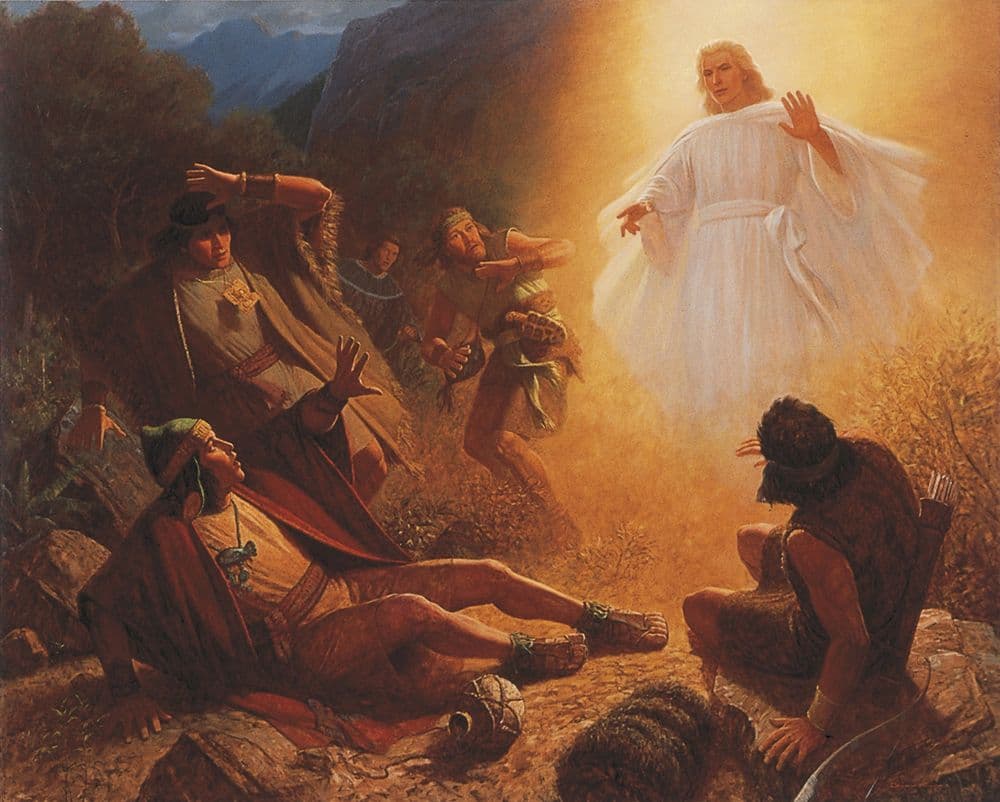
Conversion of Alma the Younger · Mosiah 27:8–37
Book of Mormon
Faith as an Experiment
Alma among the Zoramites
Alma 32–3345 min5 sections
Turned out of their own synagogues for being poor, a group of Zoramites ask Alma what they should do. His answer is the most careful description of how faith actually works anywhere in scripture — and it is framed as a procedure, not a mood.
- Author
- Mormon's abridgement of Alma's record
- Date
- c. 74 BC
- Place
- Antionum, the land of the Zoramites, east of Zarahemla
- Audience
- The Zoramite poor, cast out of the synagogues they had helped build
- Genre
- Missionary sermon, delivered on a hill to a hostile-adjacent minority
By the end you should be able to
- Distinguish being compelled to be humble from choosing humility, and say why Alma treats the second as better.
- State Alma's definition of faith precisely, including what it excludes.
- Walk through the experiment as a sequence of steps rather than a metaphor.
- Explain what happens to faith once knowledge is obtained in one thing.
The Rameumptom
A congregation with one prayer, said once a week, from a raised platform.
13For they had a place built up in the center of their synagogue, a place for standing, which was high above the head; and the top thereof would only admit one person.
14Therefore, whosoever desired to worship must go forth and stand upon the top thereof, and stretch forth his hands towards heaven, and cry with a loud voice...
21Now, the place was called by them Rameumptom, which, being interpreted, is the holy stand.
23Now, after the people had all offered up thanks after this manner, they returned to their homes, never speaking of their God again until they had assembled themselves together again to the holy stand.
Mormon's satire is unusually sharp here. The prayer is memorised, identical for every worshipper, offered from a platform that admits exactly one person at a time, and thanks God chiefly that the Zoramites are not like everybody else. Then they go home and do not mention God again for a week.
It is a portrait of religion that has become entirely a matter of position — literal elevation, weekly, in public. And the people Alma will end up teaching are the ones this system has expelled.
Compelled, or willing
Alma's first move is to complicate the assumption that poverty made them humble.
13And now, because ye are compelled to be humble blessed are ye; for a man sometimes, if he is compelled to be humble, seeketh repentance; and now surely, whosoever repenteth shall find mercy...
14And now, as I said unto you, that because ye were compelled to be humble ye were blessed, do ye not suppose that they are more blessed who truly humble themselves because of the word?
15Yea, he that truly humbleth himself, and repenteth of his sins, and endureth to the end, the same shall be blessed—yea, much more blessed than they who are compelled to be humble because of their exceeding poverty.
16Therefore, blessed are they who humble themselves without being compelled to be humble; or rather, in other words, blessed is he that believeth in the word of God, and is baptized without stubbornness of heart, yea, without being brought to know the word, or even compelled to know, before they will believe.
Alma does not tell them that their poverty is a blessing in disguise. He says that being compelled into humility can start something good, and then immediately says that choosing it is better. That is a delicate thing to say to people who have just been humiliated, and he says it without condescension because he is about to give them something to do.
Points to ponder
- 01Where in your life has God had to compel humility, and what would it have taken to choose it first?
- 02The Zoramite system rewarded position. What in your own religious practice depends on being seen?
What faith is, and is not
21And now as I said concerning faith—faith is not to have a perfect knowledge of things; therefore if ye have faith ye hope for things which are not seen, which are true.
Three constraints in one sentence. Faith is not perfect knowledge — so certainty is not required, and claiming it is not faith. It is hope, so it is directed forward and it moves. And its object must be true: faith in a falsehood, however sincere, is not faith in Alma's sense at all. That last clause is doing serious work; it makes faith answerable to reality rather than self-validating.
Faith, in three languages and one century
The experiment, step by step
Read as a procedure, the passage is startlingly precise.
27But behold, if ye will awake and arouse your faculties, even to an experiment upon my words, and exercise a particle of faith, yea, even if ye can no more than desire to believe, let this desire work in you, even until ye believe in a manner that ye can give place for a portion of my words.
28Now, we will compare the word unto a seed. Now, if ye give place, that a seed may be planted in your heart, behold, if it be a true seed, or a good seed, if ye do not cast it out by your unbelief, that ye will resist the Spirit of the Lord, behold, it will begin to swell within your breasts; and when you feel these swelling motions, ye will begin to say within yourselves—It must needs be that this is a good seed, or that the word is good, for it beginneth to enlarge my soul; yea, it beginneth to enlighten my understanding, yea, it beginneth to be delicious to me.
| Step | In Alma's words | What it asks of you |
|---|---|---|
| 1. Entry condition | "even if ye can no more than desire to believe" | The threshold is a desire, not a conviction. This is the lowest bar scripture ever sets. |
| 2. Consent | "give place, that a seed may be planted" | Make room. The one thing that stops the experiment is casting the seed out. |
| 3. Intervention | the word planted in the heart | Something specific and testable — not religion in general. |
| 4. Observation | "it will begin to swell"; "enlarge my soul"; "enlighten my understanding"; "delicious" | Three named effects: expansion, illumination, and taste. Notice that two of the three are cognitive. |
| 5. Interim verdict | "your knowledge is perfect in that thing" (v. 34) | Knowledge in that one thing — carefully bounded, not global certainty. |
| 6. Continuation | "nourish it with great care" (v. 37) | The result is provisional until it is fed. A neglected seed dies whether or not it was good. |
34And now, behold, is your knowledge perfect? Yea, your knowledge is perfect in that thing, and your faith is dormant; and this because you know, for ye know that the word hath swelled your souls, and ye also know that it hath sprouted up, that your understanding doth begin to be enlightened, and your mind doth begin to expand.
35O then, is not this real? I say unto you, Yea, because it is light; and whatsoever is light, is good, because it is discernible, therefore ye must know that it is good...
Verse 34 contains a word most readers pass over: dormant. Once you know a thing, faith in that thing goes to sleep — it is not needed there any more. It does not disappear; it becomes available for the next thing. This is why Alma insists in verse 36 that they are not to "lay aside your faith," because the experiment has "only tried your experiment to plant the seed."
Verse 35's criterion is also worth pressing: it is real "because it is light... because it is discernible." Alma's test for a spiritual experience is whether it gives you something you can tell apart from what you had before. That is an unusually demanding standard, and an unusually usable one.
41But if ye will nourish the word, yea, nourish the tree as it beginneth to grow, by your faith with great diligence, and with patience, looking forward to the fruit thereof, it shall take root; and behold it shall be a tree springing up unto everlasting life.
42And because of your diligence and your faith and your patience with the word in nourishing it, that it may take root in you, behold, by and by ye shall pluck the fruit thereof, which is most precious, which is sweet above all that is sweet, and which is white above all that is white, yea, and pure above all that is pure; and ye shall feast upon this fruit even until ye are filled, that ye hunger not, neither shall ye thirst.
43Then, my brethren, ye shall reap the rewards of your faith, and your diligence, and patience, and long-suffering, waiting for the tree to come to spring up unto everlasting life.
The tree, the whiteness, the sweetness above all sweetness — Alma has walked the Zoramite poor all the way back to Lehi's dream, seventy years and half a continent away, without ever naming it. The fruit at the end of the experiment is the fruit at the end of the rod.
Zenos, and worship without a stand
Alma 33 answers the question the Zoramites actually asked in 32:5 — where and how they should worship, having been cast out of the synagogue. He quotes a prophet named Zenos, otherwise unknown to us and preserved only on the plates of brass, whose prayer catalogues every place a person might pray: in the wilderness, in the field, in the house, in the closet, in the congregation, and "when I was cast out and was despised by mine enemies" (Alma 33:3–10).
The answer to expulsion from a building is not a better building. Alma then quotes Zenock and Moses, and lands on the bronze serpent: many perished because the remedy was too simple to be believed (Alma 33:19–20). Then verse 22 states the seed to be planted, which turns out not to be a proposition about religion but a person: "begin to believe in the Son of God, that he will come to redeem his people."
What this lesson holds
Faith is not perfect knowledge, and its object must be true.
A desire to believe is a sufficient beginning.
The threshold Alma sets is the lowest in scripture: not belief, not hope, but a willingness to let a desire work in you.
Spiritual knowledge is obtained in particulars, not in general, and it must be nourished or it dies.
Where a person may worship is not limited by where they are permitted to gather.
Check your reading
5 questions01How does Alma define faith in Alma 32:21?
02What is the minimum Alma requires to begin the experiment?
03After the seed swells and the understanding is enlightened, what does Alma say has happened to faith in that thing?
04What does Alma say makes a spiritual experience recognisably real?
05In Alma 33, what does Alma finally identify as the seed to be planted?
Where to go next
Sources
- Alma 31–33 — The primary text.
- Book of Mormon Student Manual — Church Educational System, chapters on Alma 30–35
- Gospel Topics, "Faith"