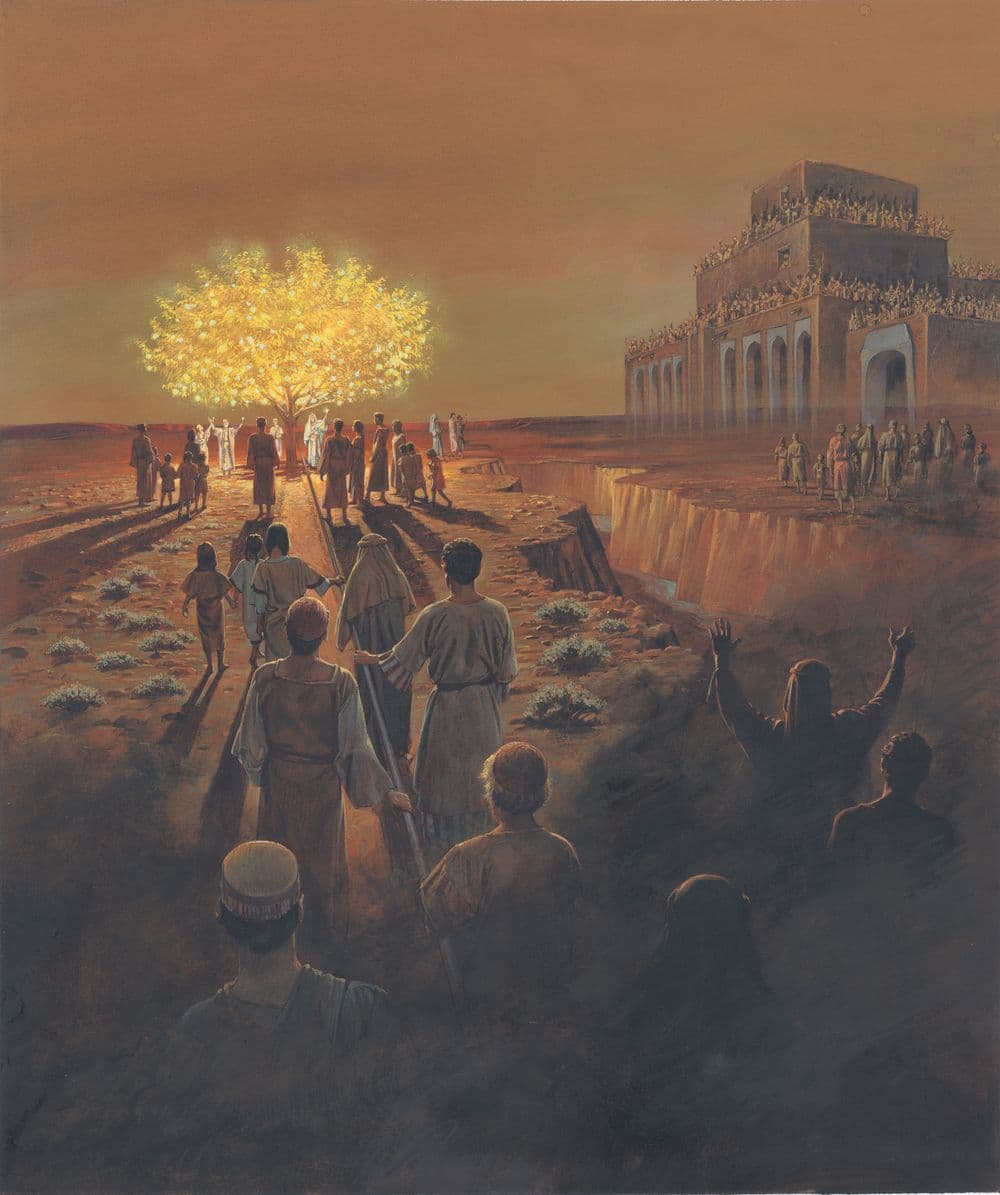
Lehi's Dream · 1 Ne. 8; 11–12
Book of Mormon
The Tree, the Rod, and the Building
Lehi's dream and Nephi's interpretation
1 Nephi 8; 11–12; 1545 min5 sections
A father's dream about a tree, and a son who asks what it means and is shown. The most systematically interpreted vision in scripture — and a map of discipleship that names four ways of approaching the same fruit.
- Author
- Nephi, writing on the small plates decades after the events
- Date
- c. 600–592 BC for the dream; the record made c. 570 BC
- Place
- The valley of Lemuel, in the wilderness south of Jerusalem
- Audience
- Lehi's family first; then, explicitly, a latter-day readership
- Genre
- Vision report, followed by an interpretive vision and a family dispute
By the end you should be able to
- Trace the dream's symbols to the interpretations scripture itself supplies, rather than inventing your own.
- Distinguish the four groups in 1 Nephi 8 and identify what separates the third from the fourth.
- Explain why Nephi's vision answers a question about a tree with a vision of Christ's birth and ministry.
- Read "strait" correctly, and see why the spelling matters.
Where the dream happens
The family is eight years from anywhere, and already fracturing.
Lehi's dream arrives at a specific moment in a specific crisis. The family has left Jerusalem, returned twice — once for the plates of brass, once for Ishmael's household — and is now camped in the valley of Lemuel. Two sons believe their father. Two do not. The dream is not an abstract allegory delivered to a congregation; it is a father's vision about whether his children will come to him at the tree, and it ends with two of them refusing.
Read it with that in view and the emotional weight lands differently. The most anguished line in the chapter is not about the building or the mists. It is verse 37: "he did exhort them then with all the feeling of a tender parent, that they would hearken to his words."
A Hebraism in the dream's first line
King James renders it “"Behold, I have dreamed a dream" (1 Nephi 8:2)”
English prefers "I had a dream." Hebrew regularly pairs a verb with a noun from the same root — a cognate accusative — and the King James Bible preserves the pattern (Genesis 37:5, "Joseph dreamed a dream"). The Book of Mormon is full of these: "work a work," "cursed with a sore cursing," "taxed with a tax." On its own this proves nothing; as a pattern running through a long text dictated by an unschooled farmer, it is a datum worth noticing.
The tree, and what it is
Scripture interprets its own symbol — twice, and in two directions.
Every element of the vision in one frame, with the angel's interpretations keyed to it — including the detail that the great and spacious building has no foundation.
10And it came to pass that I beheld a tree, whose fruit was desirable to make one happy.
11And it came to pass that I did go forth and partake of the fruit thereof; and I beheld that it was most sweet, above all that I ever before tasted. Yea, and I beheld that the fruit thereof was white, to exceed all the whiteness that I had ever seen.
12And as I partook of the fruit thereof it filled my soul with exceedingly great joy; wherefore, I began to be desirous that my family should partake of it also; for I knew that it was desirable above all other fruit.
The first thing Lehi does after tasting is look for his family. That instinct is the dream's moral centre, and it is repeated by everyone in scripture who receives something real: Enos prays for his brethren, then his enemies; Alma the Younger wishes he could cry repentance to every soul; the brother of Jared is not shown the finger of the Lord until he has asked on behalf of others.
Nephi asks the right question
21And the angel said unto me: Behold the Lamb of God, yea, even the Son of the Eternal Father! Knowest thou the meaning of the tree which thy father saw?
22And I answered him, saying: Yea, it is the love of God, which sheddeth itself abroad in the hearts of the children of men; wherefore, it is the most desirable above all things.
23And he spake unto me, saying: Yea, and the most joyous to the soul.
Notice the order of events in chapter 11. Nephi asks to see what his father saw. The Spirit shows him a tree. Then — before answering — he is shown Nazareth, a virgin "exceedingly fair and white," and the Son of God in her arms. Only after that is he asked whether he knows the meaning of the tree. The vision answers a question about a symbol by showing him the Incarnation.
That is not a detour. The love of God is not an abstraction in this vision; it has a location and a face. When Nephi answers "it is the love of God," he has just watched what that love did.
The rod, the path, and the mists
The one element in the dream that is a handhold rather than a landscape.
19And I beheld a rod of iron, and it extended along the bank of the river, and led to the tree by which I stood.
20And I also beheld a strait and narrow path, which came along by the rod of iron, even to the tree by which I stood; and it also led by the head of the fountain, unto a large and spacious field, as if it had been a world.
21And I saw numberless concourses of people, many of whom were pressing forward, that they might obtain the path which led unto the tree by which I stood.
22And it came to pass that they did come forth, and commence in the path which led to the tree.
23And it came to pass that there arose a mist of darkness; yea, even an exceedingly great mist of darkness, insomuch that they who had commenced in the path did lose their way, that they wandered off and were lost.
24And it came to pass that I beheld others pressing forward, and they came forth and caught hold of the end of the rod of iron; and they did press forward through the mist of darkness, clinging to the rod of iron, even until they did come forth and partake of the fruit of the tree.
The English of 1829
Two details in verse 24 do the work. First, those who succeed catch hold of "the end of the rod of iron" — they take hold where they are, at the near end, not at some superior starting point. Second, they are "clinging." The mists do not lift for them; they go through the mists holding on.
The interpretations, given in the text
- 1 Nephi 11:25The rod of iron is the word of God, leading to the fountain of living waters and the tree of life.
- 1 Nephi 12:16The river of filthy water is the depths of hell.
- 1 Nephi 12:17The mists of darkness are the temptations of the devil, which blind and lead away.
- 1 Nephi 12:18The great and spacious building is the vain imaginations and the pride of the children of men.
- 1 Nephi 15:23–24Nephi's plainest statement: those who hearken to the word and hold fast to it will never perish.
It is worth taking seriously how much interpretation the text supplies. Latter-day Saints have sometimes treated the dream as an open invitation to allegorise — assigning meanings to the field, the bank, the direction of travel. Discipline here is a virtue. Where scripture interprets itself, that interpretation governs; where it does not, a reader is guessing, and should say so.
Four groups, one fruit
The classic reading — and the uncomfortable question it raises.
| Group | What they do | Where they end |
|---|---|---|
| First (v. 21–23) | Press forward toward the path, commence in it — but take no hold of the rod | Lost in the mists of darkness |
| Second (v. 24–28) | Catch hold of the rod, press through the mists, partake of the fruit — then look about, and are ashamed | Fall away into forbidden paths |
| Third (v. 30) | Catch hold of the rod, hold fast continually, come forth, fall down, and partake | Remain at the tree |
| Fourth (v. 31–33) | Feel their way toward the great and spacious building; enter it | Never approach the tree at all |
The second and third groups both reach the tree. Both taste the fruit. What separates them is what happens next: one group casts its eyes about and feels ashamed under mockery; the other falls down and holds fast. The difference is not knowledge, and it is not experience — both had those. It is whose opinion decides the matter.
26And I also cast my eyes round about, and beheld, on the other side of the river of water, a great and spacious building; and it stood as it were in the air, high above the earth.
27And it was filled with people, both old and young, both male and female; and their manner of dress was exceedingly fine; and they were in the attitude of mocking and pointing their fingers towards those who had come and were partaking of the fruit.
28And after they had tasted of the fruit they were ashamed, because of those that were scoffing at them; and they fell away into forbidden paths and were lost.
The building has no foundation — it "stood as it were in the air." It is also, as Elder Jeffrey R. Holland and others have observed, full of people who are not enjoying themselves; their whole occupation is pointing at somebody else. Pride in this dream is not confident. It is preoccupied with the people at the tree.
“Don't you quit. You keep walking. You keep trying. There is help and happiness ahead.”
Points to ponder
- 01The third group holds "continually." What does continual holding look like on an ordinary Tuesday, as distinct from holding during a crisis?
- 02The second group fell away because of shame, not because of doubt. Where does the pressure of other people's opinions actually reach you?
- 03Lehi partakes and immediately looks for his family. Who is at the edge of your vision when you receive something good?
What the dream teaches
Principle
The love of God is the most desirable of all things, and it is given in the person of Jesus Christ.
Nephi is shown the Incarnation as the answer to what the tree means. Any account of God's love that can be stated without reference to what Christ actually did is not the love this vision is about.
Principle
Holding fast to the word of God brings a person safely through temptation — not around it.
The mists never disperse in the dream. The promise is passage, not exemption.
Principle
Shame at the scorn of the world can undo an experience of God that was entirely real.
What this lesson holds
Scripture's own interpretations govern its symbols.
1 Nephi 11–15 exists so that the dream would not be guessed at. Where the text explains, follow it; where it does not, hold your reading loosely.
Receiving the fruit produces a desire to share it.
The difference between enduring and falling away is often whose approval decides the matter.
Check your reading
5 questions01In the dream, what separates the group that falls away after tasting the fruit from the group that remains?
02"Strait and narrow" — what does strait mean?
03What does the great and spacious building represent, according to the text itself?
04Before answering Nephi's question about the tree, what is he shown?
05Where do those who succeed take hold of the rod?
Where to go next
Sources
- 1 Nephi 8; 11–12; 15 — The primary text; all interpretations here are the text's own.
- Book of Mormon Student Manual — Church Educational System, chapters on 1 Nephi 8–15
- Daniel C. Peterson, "Nephi and His Asherah" — Journal of Book of Mormon Studies 9/2 (2000). Scholarly, not doctrinal.
- Jeffrey R. Holland, "An High Priest of Good Things to Come" — General Conference, October 1999