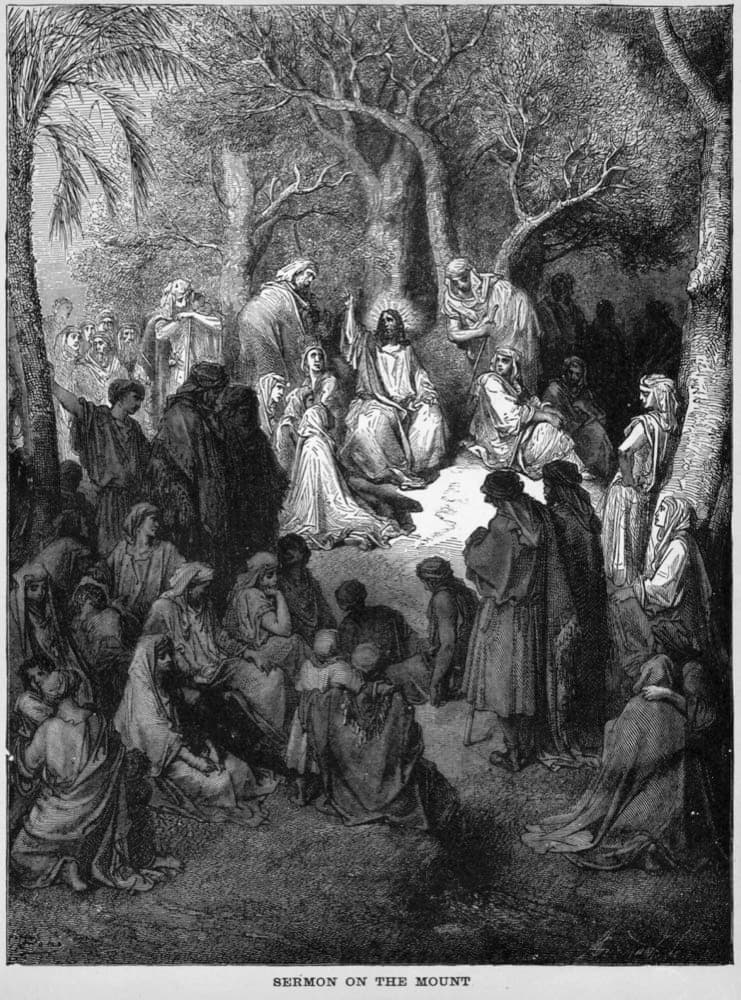
The Sermon on the Mount
New Testament
The Sermon, Twice
Matthew 5–7 beside 3 Nephi 12–14
Matthew 5–7; 3 Nephi 12–1455 min4 sections
The same sermon delivered in two hemispheres, and the differences between the two versions are small, deliberate, and doctrinally loaded. Read side by side, the Book of Mormon functions as a commentary on the Gospel.
- Author
- Matthew; and the Nephite record kept after the Savior's visit
- Date
- c. AD 30 in Galilee; c. AD 34 at Bountiful
- Place
- A mountain in Galilee; the temple in the land Bountiful
- Audience
- Disciples with a crowd listening; and a covenant people who had just touched His wounds
- Language
- Koine Greek for Matthew
- Genre
- Sustained discourse, arranged thematically
By the end you should be able to
- Compare the two versions of the Beatitudes and state what the Book of Mormon additions do.
- Read teleios accurately and explain why the 3 Nephi version of Matthew 5:48 changes the demand.
- Use the JST and 3 Nephi to read "Judge not" without either weaponising or dissolving it.
- Name three of the Greek words in the Sermon whose English translations have drifted.
The Beatitudes, in parallel
Galilee, Samaria, Judea and Perea, with the places the Gospels name most. Roughly seventy miles separate Nazareth from Jerusalem.
| Matthew 5 | 3 Nephi 12 | What changes |
|---|---|---|
| Blessed are the poor in spirit: for theirs is the kingdom of heaven. (v. 3) | Yea, blessed are the poor in spirit who come unto me, for theirs is the kingdom of heaven. (v. 3) | Adds the destination. Poverty of spirit is not itself the virtue; coming to Him is. |
| Blessed are they which do hunger and thirst after righteousness: for they shall be filled. (v. 6) | ...for they shall be filled with the Holy Ghost. (v. 6) | Names what fills the appetite. The promise stops being vague. |
| Blessed are the meek: for they shall inherit the earth. (v. 5) | Identical (v. 5) | Unchanged — and a promise about this earth, which D&C 88:17–20 takes literally. |
| Blessed are the pure in heart: for they shall see God. (v. 8) | Identical (v. 8) | D&C 93:1 makes the same promise with conditions attached. |
| Be ye therefore perfect, even as your Father which is in heaven is perfect. (v. 48) | Therefore I would that ye should be perfect even as I, or your Father who is in heaven is perfect. (v. 48) | Spoken after the Resurrection, He includes Himself. The standard is now demonstrably reachable in a mortal life completed. |
"Be ye therefore perfect"
President Russell M. Nelson took this up directly in October 1995. Perfection in the full sense, he taught, is not attainable in mortality; the commandment points to a completeness made possible by the Atonement and realised after the Resurrection. The 3 Nephi wording supports that reading, since there the Savior can include Himself only after His own mortal work is finished.
“We need not be dismayed if our earnest efforts toward perfection now seem so arduous and endless. Perfection is pending.”
The chapter about being watched
Matthew 6 has one subject, repeated three times.
Almsgiving, prayer and fasting — the three pillars of Jewish piety — are each handled with the same structure: do not do it to be seen; the seen version has already collected its payment; do it in secret, and the Father who sees in secret will reward you. Matthew 6 is not three teachings. It is one teaching applied three times.
Matthew 6:13 (KJV)
And lead us not into temptation, but deliver us from evil.
3 Nephi 13:12
And suffer us not to be led into temptation, but deliver us from evil.
JST Matthew 6:14
And suffer us not to be led into temptation, but deliver us from evil.
The change is small and the doctrine behind it is not: God does not lead people into temptation (James 1:13). Both Restoration versions make the petition a request for protection rather than a request that God refrain from doing something He would not do. Note that the Book of Mormon and the JST agree independently.
"Judge not"
1Judge not, that ye be not judged.
2For with what judgment ye judge, ye shall be judged: and with what measure ye mete, it shall be measured to you again.
3And why beholdest thou the mote that is in thy brother's eye, but considerest not the beam that is in thine own eye?
5Thou hypocrite, first cast out the beam out of thine own eye; and then shalt thou see clearly to cast out the mote out of thy brother's eye.
The JST supplies the clause that keeps the passage from collapsing: "Judge not unrighteously, that ye be not judged; but judge righteous judgment" (JST Matthew 7:1–2). That matches John 7:24, where Jesus says exactly this in Greek, and it matches Moroni 7:15–17, where a duty to judge good from evil is assumed.
Verse 5 makes the same point structurally. The instruction is not to leave the mote alone. It is to remove the beam first, and then — "then shalt thou see clearly" — to help. Elder Dallin H. Oaks's 1999 address "Judge Not and Judging" distinguishes final judgements, which belong to God, from the intermediate judgements everyone must make daily.
24Therefore whosoever heareth these sayings of mine, and doeth them, I will liken him unto a wise man, which built his house upon a rock:
25And the rain descended, and the floods came, and the winds blew, and beat upon that house; and it fell not: for it was founded upon a rock.
27And the rain descended, and the floods came, and the winds blew, and beat upon that house; and it fell: and great was the fall of it.
Note what the parable does not say. The rain, the floods and the winds arrive in both cases, identically. The foundation does not change the weather. Helaman 5:12 states the same doctrine and adds the promise: build on the rock of the Redeemer, and "when all his hail and his mighty storm shall beat upon you, it shall have no power over you."
What this lesson holds
The Beatitudes describe a state of blessedness, not a mood — and the Book of Mormon versions name the destination and the filling.
Perfection means wholeness and completion, achieved through Christ and finished after the Resurrection.
Righteousness performed to be seen has already been paid.
Final judgement belongs to God; intermediate judgement is required, and must be righteous.
JST Matthew 7:1–2 · John 7:24 · Moroni 7:15–17
Check your reading
5 questions01What does 3 Nephi 12:6 add to "they shall be filled"?
02What does the Greek teleios mean?
03How do 3 Nephi 13:12 and the JST render "lead us not into temptation"?
04What does the Greek word hypokritēs literally mean?
05In the parable of the two houses, what differs between the two cases?
Where to go next
Sources
- Matthew 5–7; 3 Nephi 12–14; JST Matthew 6–7 — The primary texts.
- Russell M. Nelson, "Perfection Pending" — General Conference, October 1995
- Dallin H. Oaks, "Judge Not and Judging" — Brigham Young University devotional, 1 March 1998; Ensign, August 1999
- New Testament Student Manual — Church Educational System, chapters on Matthew 5–7