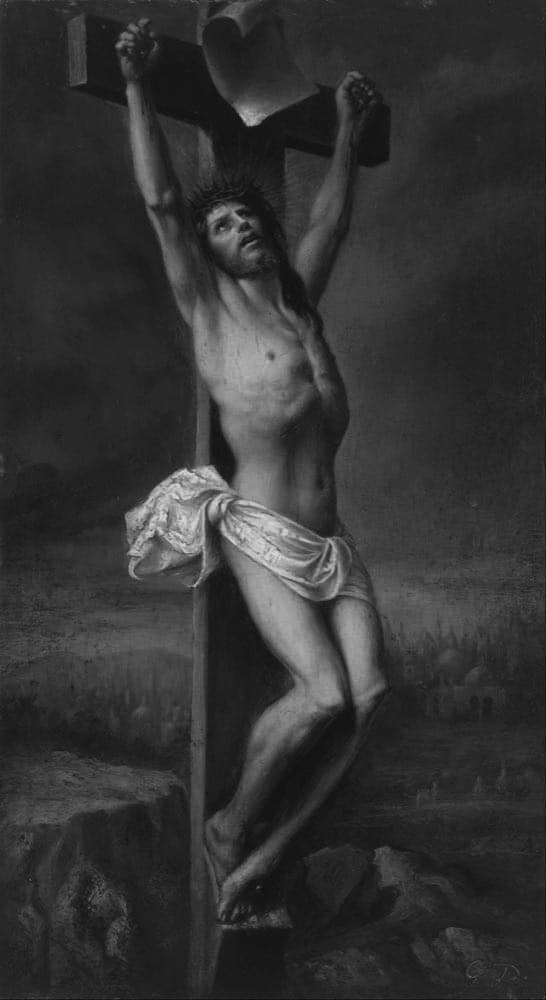
Christ on the Cross
New Testament
Grace, Works, and a Preposition
Paul, James, and 2 Nephi 25:23
Romans 3–5; Ephesians 2; James 2; 2 Nephi 25; Moroni 1050 min4 sections
The oldest argument in Christianity, and the one Latter-day Saints are most often accused of getting wrong. The Greek is more interesting than either side of the usual debate, and one small English word in the Book of Mormon has caused a great deal of unnecessary anguish.
- Author
- Paul; James; Nephi; Moroni
- Date
- Romans c. AD 57; James perhaps the earliest New Testament letter; 2 Nephi c. 550 BC
- Place
- Corinth (Romans); Jerusalem (James)
- Audience
- A mixed Jewish and Gentile congregation in Rome; scattered Jewish Christians
- Language
- Koine Greek
- Genre
- Sustained theological argument, and pastoral correction
By the end you should be able to
- State what Paul means by "the works of the law" and why the phrase is narrower than "good deeds."
- Show that Paul and James are answering different questions.
- Read 2 Nephi 25:23 in a way that survives contact with Moroni 10:32.
- Distinguish justification from sanctification as D&C 20:30–31 does.
What Paul is arguing against
Eph 2:8For by grace are ye saved through faith; and that not of yourselves: it is the gift of God:
Eph 2:9Not of works, lest any man should boast.
Eph 2:10For we are his workmanship, created in Christ Jesus unto good works, which God hath before ordained that we should walk in them.
Rom 3:20Therefore by the deeds of the law there shall no flesh be justified in his sight: for by the law is the knowledge of sin.
Rom 3:28Therefore we conclude that a man is justified by faith without the deeds of the law.
Verse 10 is the half of Ephesians 2 that rarely gets quoted. Having said salvation is not of works, Paul immediately says we are created in Christ Jesus unto good works, prepared in advance for us to walk in. Works are excluded as a basis and required as an outcome, in consecutive sentences.
James, answering a different question
14What doth it profit, my brethren, though a man say he hath faith, and have not works? can faith save him?
17Even so faith, if it hath not works, is dead, being alone.
19Thou believest that there is one God; thou doest well: the devils also believe, and tremble.
24Ye see then how that by works a man is justified, and not by faith only.
Paul asks:
On what basis is a sinner accepted by God?
Answer: not by keeping Torah, but by grace through faith in Christ.
His opponent is someone insisting on circumcision.
James asks:
What kind of faith actually saves?
Answer: not the sort that produces nothing — even devils believe.
His opponent is someone claiming faith while ignoring a hungry brother (2:15–16).
Both quote Genesis 15:6 — "Abraham believed God, and it was counted unto him for righteousness" — and reach opposite-sounding conclusions, because Paul is looking at Genesis 15 and James at Genesis 22. Paul sees a man trusting a promise before he had done anything. James sees the same man, decades later, on Moriah, demonstrating that the trust was real.
Latter-day Saints have no need to reconcile these by subordinating one to the other. The Book of Mormon holds both without embarrassment: salvation is by the merits, mercy and grace of the Holy One of Israel (2 Nephi 2:8), and "none but the truly penitent are saved" (Alma 42:24).
The preposition
23For we labor diligently to write, to persuade our children, and also our brethren, to believe in Christ, and to be reconciled to God; for we know that it is by grace that we are saved, after all we can do.
Read as "grace applies once you have exhausted your own efforts," this verse has produced a great deal of quiet despair — because nobody ever finishes doing all they can do. That reading also makes Nephi contradict Moroni, who says flatly that it is by grace that we are made perfect (Moroni 10:32–33).
English "after" can mean sequence (after dinner), but it can also mean despite or apart from — "after all he did for you, this is how you repay him." Hebrew and the English of Joseph Smith's era both allow the second sense. Latter-day Saint teachers including Stephen E. Robinson and Brad Wilcox have argued at length that the verse reads better as "notwithstanding all we can do" or "apart from all we can do," and Elder Dieter F. Uchtdorf's April 2015 address "The Gift of Grace" makes essentially the same point from the pulpit.
Note also the immediate context. Nephi is not writing a formula for salvation; he is explaining why his people keep the law of Moses while looking to Christ (2 Nephi 25:24–27). The verse's own purpose is to subordinate obedience to Christ, not to condition grace on obedience.
“Grace is not a debt God owes us. It is a gift He offers us.”
Justified, and then sanctified
30And we know that justification through the grace of our Lord and Savior Jesus Christ is just and true;
31And we know also, that sanctification through the grace of our Lord and Savior Jesus Christ is just and true, to all those who love and serve God with all their mights, minds, and strength.
| Justification | Sanctification | |
|---|---|---|
| What it does | Puts a person right with God — the verdict | Makes a person holy — the change |
| Basis | Grace, through faith in Christ | Grace, working in one who loves and serves |
| Greek | dikaioō — to declare righteous | hagiazō — to make holy, to set apart |
| Texts | Romans 3:24–28; D&C 20:30 | 1 Thessalonians 5:23; Helaman 3:35; D&C 20:31 |
Both, D&C 20 insists, come through grace. That is the distinctively Latter-day Saint contribution to this argument: the tradition that separated justification from sanctification and assigned the second to human effort is not the one the Restoration inherited. Here grace is not only the pardon at the beginning but the power throughout.
Helaman 3:35 gives the process in one sentence, and it is worth memorising: they "did fast and pray oft, and did wax stronger and stronger in their humility, and firmer and firmer in the faith of Christ, unto the filling their souls with joy and consolation, yea, even to the purifying and the sanctification of their hearts, which sanctification cometh because of their yielding their hearts unto God."
Yielding, not achieving. Which is where King Benjamin's natural man ends up too (Mosiah 3:19), and where Ether 12:27 puts it: grace is what makes weak things strong, and the condition is humility rather than accomplishment.
What this lesson holds
Salvation is a gift, given by grace through faith in Jesus Christ.
Works are excluded as a basis of salvation and required as its fruit.
Grace is enabling power as well as pardon.
Sanctification comes because of yielding the heart to God.
Check your reading
5 questions01What phrase does Paul actually use in Romans 3:20, 28?
02Which verse of Ephesians 2 is usually left out of the quotation?
03Paul and James both cite Abraham. What is the difference?
04What reading of "after all we can do" resolves the tension with Moroni 10:32?
05What does D&C 20:30–31 say comes through grace?
Where to go next
Sources
- Romans 3–5; Ephesians 2; James 2; 2 Nephi 25; D&C 20 — The primary texts.
- Dieter F. Uchtdorf, "The Gift of Grace" — General Conference, April 2015
- Bible Dictionary, "Grace"
- Brad Wilcox, "His Grace Is Sufficient" — Brigham Young University devotional, 12 July 2011