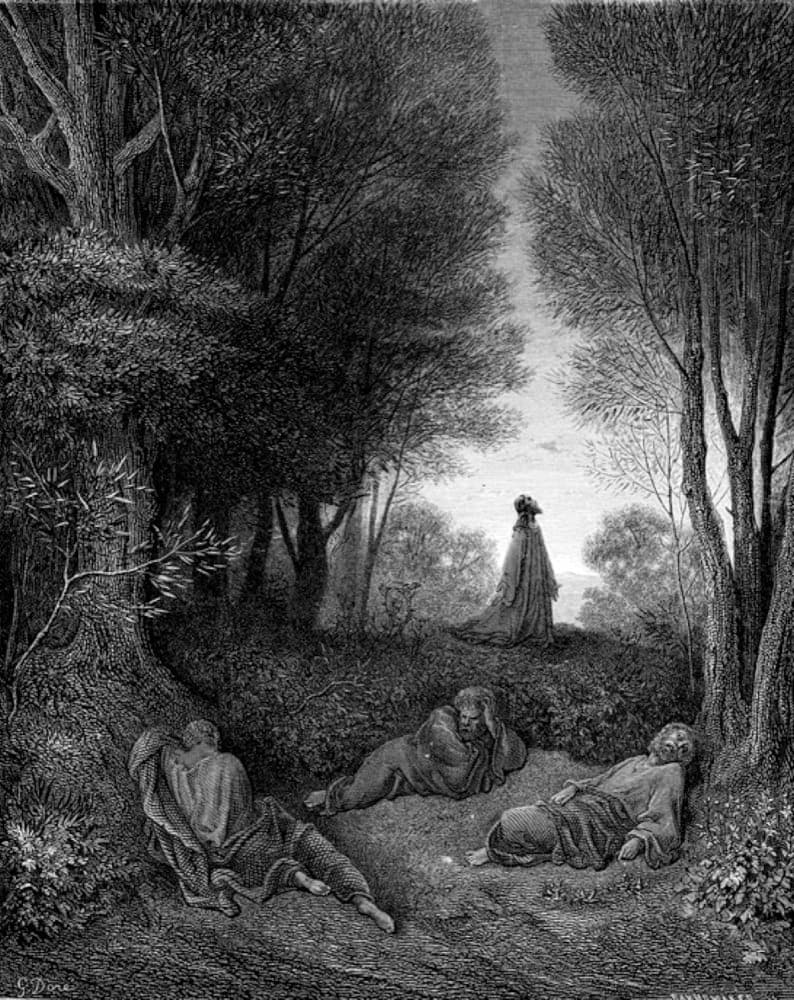
Jesus Praying in the Garden
New Testament
The Oil Press
Gethsemane, the cross, and what the Greek records
Matthew 26:36–46; Mark 14:32–42; Luke 22:39–46; D&C 19:15–2450 min4 sections
Three Gospel accounts, one of which contains a detail the earliest manuscripts dispute — and two Restoration texts that supply it independently. The most closely examined half-hour in scripture.
- Author
- Matthew, Mark and Luke; and the Lord Himself in D&C 19
- Date
- Passover week, c. AD 30–33; D&C 19 received in summer 1829
- Place
- A garden across the Kidron on the Mount of Olives
- Audience
- Peter, James and John were nearest; the record is for everyone
- Language
- Koine Greek, preserving two Aramaic words
- Genre
- Narrative, unusually restrained
By the end you should be able to
- Say what Gethsemane means and why the name is not incidental.
- Read the Greek of Mark 14:33–34 and Luke 22:44 and describe what each says.
- State the manuscript question about Luke 22:43–44 accurately, and what Restoration scripture contributes.
- Explain what D&C 19:16–19 adds that the Gospels do not contain.
The name of the place
33And he taketh with him Peter and James and John, and began to be sore amazed, and to be very heavy;
34And saith unto them, My soul is exceeding sorrowful unto death: tarry ye here, and watch.
35And he went forward a little, and fell on the ground, and prayed that, if it were possible, the hour might pass from him.
36And he said, Abba, Father, all things are possible unto thee; take away this cup from me: nevertheless not what I will, but what thou wilt.
Mark 14:33 — two verbs the KJV softens
Luke 22:44, and an honest textual problem
43And there appeared an angel unto him from heaven, strengthening him.
44And being in an agony he prayed more earnestly: and his sweat was as it were great drops of blood falling down to the ground.
King James renders it “an agony”
From agōn, an athletic contest. The word carries exertion, not merely suffering — something was being fought and won. Luke, traditionally a physician, is also the only evangelist to record the sweat as blood.
Full lexicon entry →
What the Lord says about it Himself
16For behold, I, God, have suffered these things for all, that they might not suffer if they would repent;
17But if they would not repent they must suffer even as I;
18Which suffering caused myself, even God, the greatest of all, to tremble because of pain, and to bleed at every pore, and to suffer both body and spirit—and would that I might not drink the bitter cup, and shrink—
19Nevertheless, glory be to the Father, and I partook and finished my preparations unto the children of men.
This is, so far as the Latter-day Saint canon goes, the only first-person account of Gethsemane in scripture. The Gospels report what the disciples saw from a stone's cast away, half asleep. D&C 19 reports it from inside.
Two things in verse 18 deserve to be sat with. "Even God, the greatest of all" — the sentence takes care to establish who is speaking before describing what happened to Him. And "would that I might not drink the bitter cup, and shrink" — the desire not to is stated in His own words, and then verse 19 records that He did it anyway. The obedience is not made easier by being divine.
Mosiah 3:7 (c. 124 BC)
"...blood cometh from every pore, so great shall be his anguish for the wickedness and the abominations of his people."
Spoken by an angel to King Benjamin, before the event.
Luke 22:44 (first century)
"...his sweat was as it were great drops of blood falling down to the ground."
Disputed in the manuscript tradition.
D&C 19:18 (1829)
"...to tremble because of pain, and to bleed at every pore, and to suffer both body and spirit."
First person.
"Why hast thou forsaken me?"
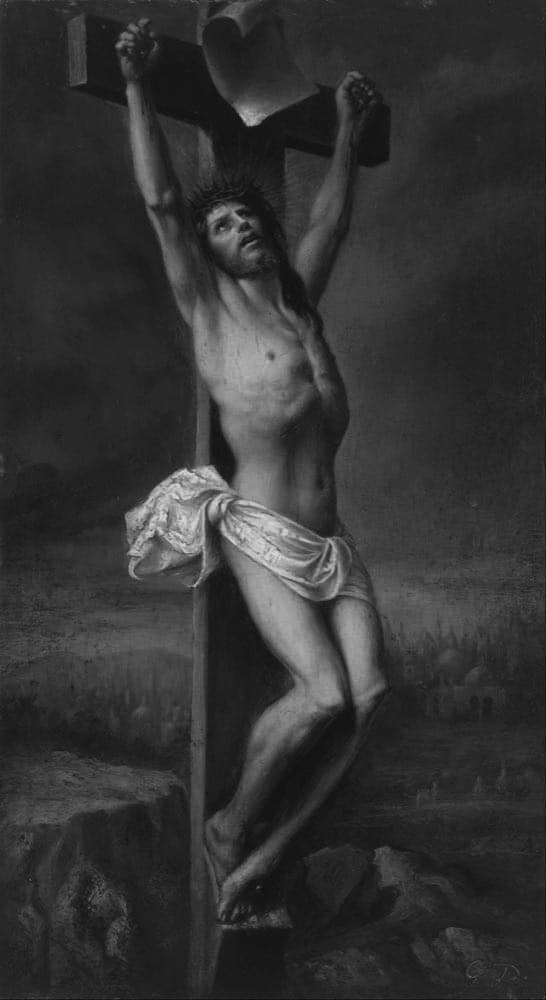
Golgotha. On this reading the Atonement spans the garden and the cross rather than either alone.
46And about the ninth hour Jesus cried with a loud voice, saying, Eli, Eli, lama sabachthani? that is to say, My God, my God, why hast thou forsaken me?
The words are the first line of Psalm 22, quoted in Aramaic. That psalm goes on to describe pierced hands and feet, bones out of joint, garments parted and lots cast — and then turns, in its second half, into a declaration of vindication and praise. A first-century Jewish hearer would have recognised the citation and known where it goes.
That does not soften the cry. Elder Jeffrey R. Holland, in April 2009, argued that the withdrawal of the Father's sustaining Spirit at that moment was itself part of the Atonement — that Christ had to complete the descent alone, so that no one else would ever have to. It is among the most searching sermons the Church has produced on the subject.
“I speak of those final moments for which Jesus must have been prepared intellectually and physically but which He could not have been prepared for emotionally and spiritually.”
What this lesson holds
The Savior's suffering was voluntary, and He said so while it was happening.
The Atonement includes a real, physical suffering in Gethsemane as well as death on the cross.
He suffered so that those who repent need not suffer as He did.
The unity of the Father and the Son is a unity of will, achieved under maximum pressure.
Check your reading
5 questions01What does the name Gethsemane mean?
02What is the Old Testament background of "this cup"?
03What is the manuscript situation with Luke 22:43–44?
04What does D&C 19:16–17 say about why He suffered?
05The words "Eli, Eli, lama sabachthani" quote —
Where to go next
Sources
- Matthew 26–27; Mark 14; Luke 22; D&C 19 — The primary texts.
- Jeffrey R. Holland, "None Were with Him" — General Conference, April 2009
- Bruce R. McConkie, "The Purifying Power of Gethsemane" — General Conference, April 1985
- New Testament Student Manual — Church Educational System, chapters on the Passion narratives