Patterns / Narrative shape
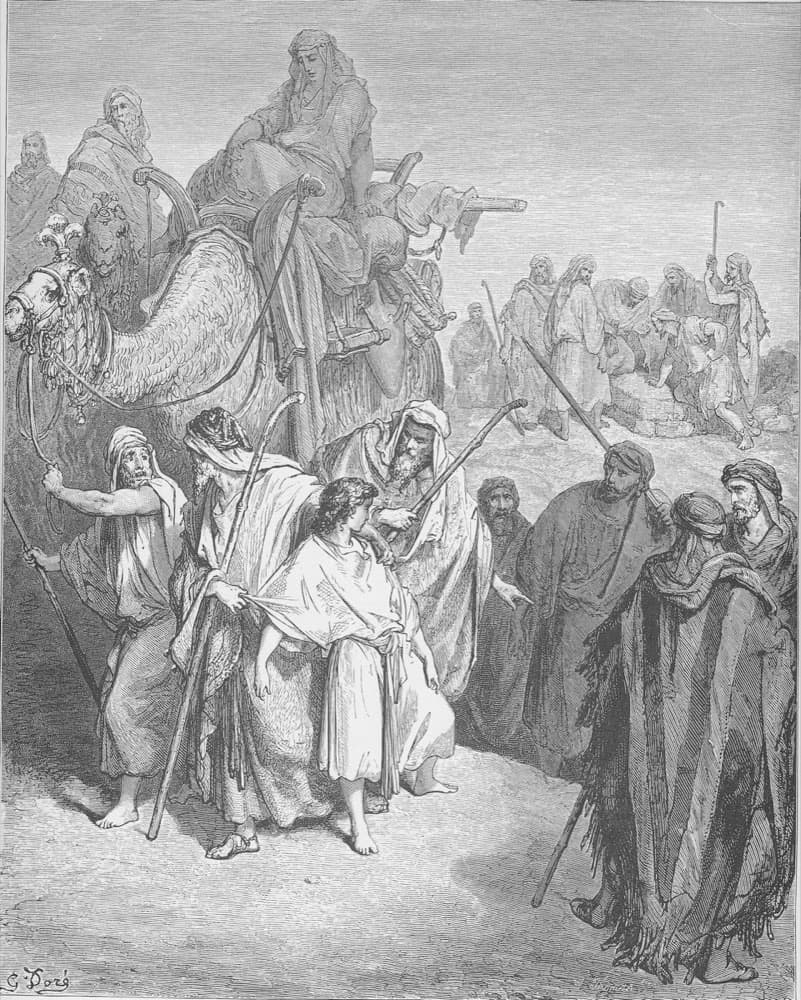
Joseph Is Sold by His Brothers
Down before up, without exception
The descent
Joseph goes into a pit before he governs Egypt. Israel goes into Egypt before it becomes a nation. Daniel goes into the den, Jonah into the deep, Alma into three days of torment, Joseph Smith into Liberty Jail. And Christ, the doctrine says, descended below all things — which is the sentence that turns a narrative habit into a doctrine of the Atonement.
27 min10 appearances
The pattern, in one sentence
In scripture the route upward runs downward first, the descent is deeper than the person expected, and the height afterwards is proportional to the depth — because the one who went lowest is the one who can reach anyone.
What counts as an instance
Stated before the evidence, so that the evidence is able to fail.
The descent is real and usually involuntary
A pit, a prison, a den, a fish, a tomb. Not a metaphorical low point — scripture is oddly literal about this, and the person is nearly always put there by someone else.
It is deeper than expected
Joseph is sold after the pit. Jeremiah sinks in the mire of the dungeon. The bottom is repeatedly not where the person thought it was, and the pattern keeps going.
Nothing is achieved down there by effort
Nobody in this pattern climbs out. They are drawn out, bought out, vomited out, released, resurrected. The descent is not a proving ground where the person earns the ascent.
The ascent uses the descent
Joseph governs the country that imprisoned him. Alma preaches what he learned unconscious. Christ succours by knowing 'according to the flesh'. What was suffered becomes the qualification.
The appearances
10 in the canonAnd they took him, and cast him into a pit: and the pit was empty, there was no water in it… Thou shalt be over my house.
What recurs
Cast down by others, then raised over them.
What is new here
The descent has four stages — pit, slavery, false accusation, prison — and each one looks like the bottom until the next.
The detail in 37:24 that the pit was empty and had no water is the kind of thing narrative includes when it is being precise about how bad something was. And Genesis 50:20 is Joseph's own reading of the whole arc, delivered to the brothers who started it: ye thought evil against me; but God meant it unto good.
Where it lands
Why the depth was necessary
Alma says He took upon Him pains, afflictions, temptations, sicknesses and infirmities, and gives a reason that is not about payment at all: 'that he may know according to the flesh how to succor his people.' D&C 88:6 says the same thing structurally — He descended below all things so that He might comprehend all things and be in and through all things. The descent is not a price the Atonement had to pay before it could work. It is how the Atonement works. There is no depth a person can reach where the answer is not already there ahead of them.
Scripture is oddly literal about this
Pits, dungeons, dens, deeps — the descents are usually physical.
It would be easy to make this pattern into a mood — hard times before good times, the usual thing. The texts resist that. Over and over the person is put in an actual hole in the ground, and the narrator describes the hole.
| Who | Where | What the text stops to say about it |
|---|---|---|
| Joseph | A pit, then Potiphar's prison | “The pit was empty, there was no water in it” — Genesis 37:24 |
| Jeremiah | The dungeon of Malchiah | “There was no water, but mire: so Jeremiah sunk in the mire” — 38:6 |
| Jonah | The belly of the fish | “The bottoms of the mountains; the earth with her bars was about me” — 2:6 |
| Daniel | The lions' den | “A stone was brought, and laid upon the mouth of the den” — 6:17 |
| Joseph Smith | Liberty Jail | Fourteen feet square, six feet to the ceiling, one winter |
| Christ | The tomb, and lower | “He descended below all things” — D&C 88:6 |
The third column is the argument. These accounts are not interested in the emotional register of the experience; they are interested in the mire, the absent water, the stone on the mouth. It is a literature written by and for people who expected the descent to be actual.
The bottom keeps moving
Joseph's four descents, and why the pattern refuses to let anyone measure it.
Joseph sold by his brothers.
Read Genesis 37 to 41 as one movement and the structure is brutal. He is thrown in a pit — that could be the bottom. He is sold into Egypt — that could be the bottom. He rises in Potiphar's house and is falsely accused and imprisoned — that could be the bottom. He interprets the butler's dream, and the butler forgets him for two full years, which the text records in one of its most deliberate sentences.
23Yet did not the chief butler remember Joseph, but forgat him.
1And it came to pass at the end of two full years, that Pharaoh dreamed…
Two full years between those verses. The narrator puts them side by side because the gap is the point: the moment that looked like the exit was not one, and nothing at all happened for two years afterwards.
Principle
The descent is repeatedly deeper than the person's estimate of it, and no instance in the pattern includes an accurate forecast of the bottom.
And then Genesis 50:20, spoken by Joseph to the brothers who began it: 'ye thought evil against me; but God meant it unto good, to bring to pass, as it is this day, to save much people alive.' Note what he does not say. He does not say it was not evil, and he does not say it was sent. He says it was meant — repurposed — which is a much stronger and much stranger claim.
Liberty Jail
The revelation where the pattern is named and used.

Liberty Jail, winter of 1838–39. · D&C 121–23
1O God, where art thou? And where is the pavilion that covereth thy hiding place?
3Yea, O Lord, how long shall they suffer these wrongs and unlawful oppressions…
7…know thou, my son, that all these things shall give thee experience, and shall be for thy good.
8The Son of Man hath descended below them all. Art thou greater than he?
Section 122:5–7 is a list, and the list is worth reading whole because of how far it goes: thrown into the pit, into the hands of murderers, the sentence of death passed upon thee, torn from thy wife and children, dragged to prison, the earth itself opening to swallow thee. And then verse 8 answers the entire list with one comparison.
'The Son of Man hath descended below them all.' Not: this is not so bad. Not: it will end soon — it does not, for another two months. The answer is that there is no floor Joseph can reach that is lower than one already occupied, and the question 'art thou greater than he' is asked without softening.
Why down at all
The doctrinal payload, and the reason it is not merely inspiring.
11And he shall go forth, suffering pains and afflictions and temptations of every kind… that he may know according to the flesh how to succor his people according to their infirmities.
12And he will take upon him death, that he may loose the bands of death which bind his people; and he will take upon him their infirmities, that his bowels may be filled with mercy…
Alma gives two purposes and they are different in kind. Death is taken on in order to loose the bands of death — that is a transaction. Infirmities are taken on in order that He may know how to succour — that is not a transaction at all. It is the acquisition of a capacity that could not be acquired any other way.
The transactional half of the Atonement, which is not the half this pattern is about.
D&C 88:6 makes the same argument in a single sentence with the logic exposed: He descended below all things, in that He comprehended all things, that He might be in all and through all things. Descent produces comprehension; comprehension produces presence. If that chain is right, then there is no place a person can get to where He has not been first, and that is not encouragement — it is a claim about the structure of the universe.
One caution to end on, because this pattern is the most easily abused in the collection. Nothing here says that suffering is good, or that God sends it, or that a person in a pit should be grateful for the pit. Joseph called what his brothers did evil. Section 121 opens with 'O God, where art thou?' and that prayer is canonised without correction. What the pattern claims is narrower and sturdier: that the descent is not the end of the story, that nobody climbs out unaided, and that the deepest place has already been occupied by someone who went there on purpose.
What the pattern holds
In scripture the route to a height runs through a depth, and the descent is nearly always involuntary and literal.
Nobody in this pattern climbs out. They are drawn out, bought out or raised.
Christ's descent is the mechanism of His ability to succour, not merely the price of it.
Alma 7:11–12 separates the two purposes explicitly: death to loose the bands, infirmities to know how to help.
There is no depth available to a human being that is lower than the one already occupied.
“The Son of Man hath descended below them all” is the answer given in Liberty Jail to a list that spares nothing.
God repurposes evil without calling it good, and the distinction is preserved in the text.
What this will not carry
- This pattern must never be used to tell a suffering person that their suffering was sent or is good. Joseph called his brothers' act evil in the same sentence in which he said God meant it unto good, and the two clauses are not interchangeable.
- “All these things shall give thee experience” was said by God to one man in a specific extremity. It is not a sentence for one person to say to another, and using it that way is the commonest abuse of D&C 122.
- The pattern says the descent is not final. It does not promise a timetable, and several instances — four hundred and thirty years in Egypt, two forgotten years in an Egyptian prison — are specifically about the absence of one.
- Not every hardship is a descent in this sense. The pattern's marker is that the person is brought low by circumstance or by others and cannot get out by effort; ordinary difficulty that responds to work is a different subject.
Check your reading
4 questions01How long does Genesis record between the butler's release and Pharaoh's dream?
02What answer does D&C 122:8 give to the catalogue of afflictions in verses 5–7?
03In Alma 7:11–12, what reason is given for Christ taking upon Him infirmities?
04What does Joseph say to his brothers in Genesis 50:20?
Where to go next
Sources
- Doctrine and Covenants 121–123 — Extracts from a letter written in Liberty Jail, March 1839
- “Liberty Jail” — Church History Topics, churchofjesuschrist.org
- “Condescension of God” — Guide to the Scriptures, churchofjesuschrist.org