Patterns / Type of Christ
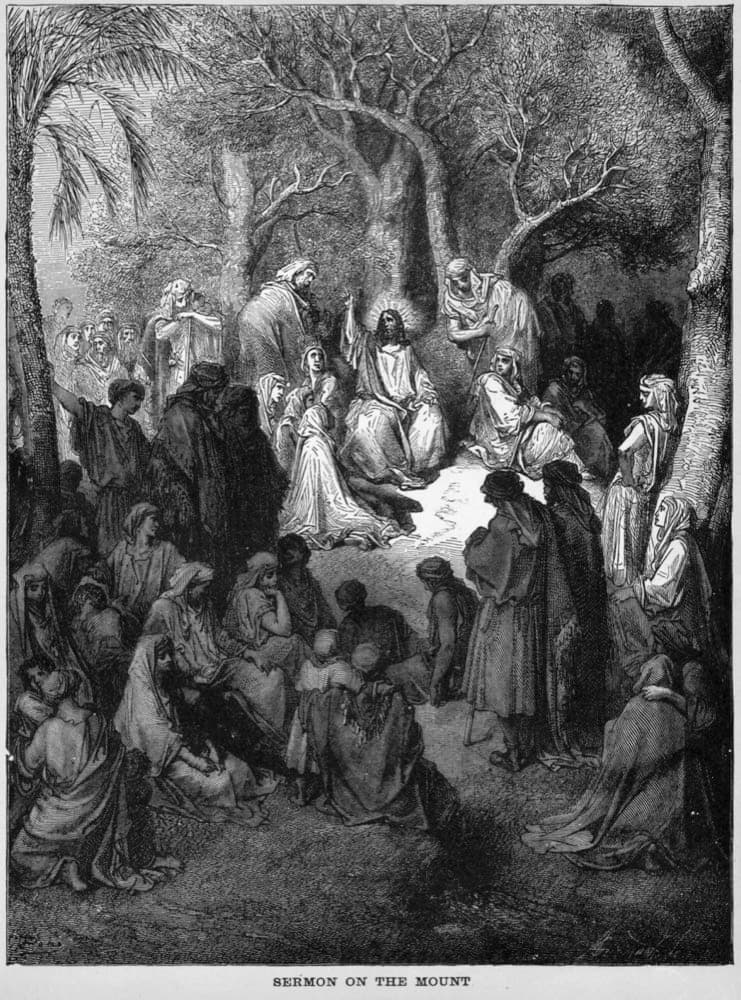
The Sermon on the Mount
God feeds people in the places where food is impossible
Bread in the wilderness
Manna falls in a desert. A widow's jar does not empty during a famine. An angel bakes a cake on hot stones for a prophet who has asked to die. Five loaves feed five thousand, and then Christ says the thing all of it was for: I am the bread of life. The pattern ends in an ordinance you can receive this Sunday.
26 min10 appearances
The pattern, in one sentence
God provides food in places that cannot produce it, gives it daily rather than in stores, uses the feeding to make a claim about who He is, and finally hands the bread over as a covenant rather than a meal.
What counts as an instance
Stated before the evidence, so that the evidence is able to fail.
The place cannot produce food
A desert, a famine, a mountainside with no village near, a boat, a prison. Every instance happens where the ordinary supply has failed or never existed.
The supply is daily, not stockpiled
Manna bred worms when hoarded. The widow's meal is enough for today and refills tomorrow. The prayer says give us this day our daily bread. The pattern refuses to let anyone get ahead.
There is always a small human contribution
A boy's five loaves, a widow's last handful, a jar of oil. Not enough to matter, and never omitted. The miracle multiplies something rather than creating from nothing.
The feeding becomes a claim
Every major instance turns into teaching about who is doing the feeding. The bread is never only bread, and by John 6 the point is explicit.
The appearances
10 in the canonAnd when the children of Israel saw it, they said one to another, It is manna: for they wist not what it was.
What recurs
Food in a place with none, given daily, with hoarding forbidden.
What is new here
The foundational instance, and it lasts forty years — the longest sustained miracle in scripture.
The name is a question. The Hebrew man hu means 'what is it?', which is what they said when they saw it, and the name stuck. Verse 20 records what happened to those who kept it overnight: it bred worms and stank. Six days a week the rule held; on the sixth it doubled and kept, which made the sabbath a fact about the food supply.
Where it lands
Known in the breaking of bread
The pattern's arc runs from feeding to teaching to identifying. In the wilderness bread keeps people alive; in Galilee it becomes an argument about who is feeding them; in an upper room it becomes a covenant; and on the road to Emmaus it becomes recognition. Two men who had listened to Him expound all the scriptures and had not known Him knew Him the moment He broke bread. That is why the ordinance is weekly and physical rather than annual and contemplative — the pattern's last discovery is that this is how He is recognised.
Daily, and not a day more
The strangest rule in the pattern, and the reason for it.
4…and the people shall go out and gather a certain rate every day, that I may prove them, whether they will walk in my law, or no.
19And Moses said, Let no man leave of it till the morning.
20Notwithstanding they hearkened not unto Moses; but some of them left of it until the morning, and it bred worms, and stank.
Verse 4 gives the purpose before the miracle: a certain rate every day, 'that I may prove them'. The daily limit is not a logistical constraint on God. It is the test, and the test is whether a people who have been slaves can be taught to depend on someone daily rather than to secure themselves.
Then the sabbath exception, which proves it. On the sixth day it doubled and did not spoil. The only time hoarding was permitted was the time God commanded it, which means the rot was never a property of the manna.
Principle
God supplies at the rate that keeps the relationship live, and treats the desire to get ahead of Him as the thing to be trained out.
The angel who brought a meal
1 Kings 19, and what God does with a prophet who has asked to die.
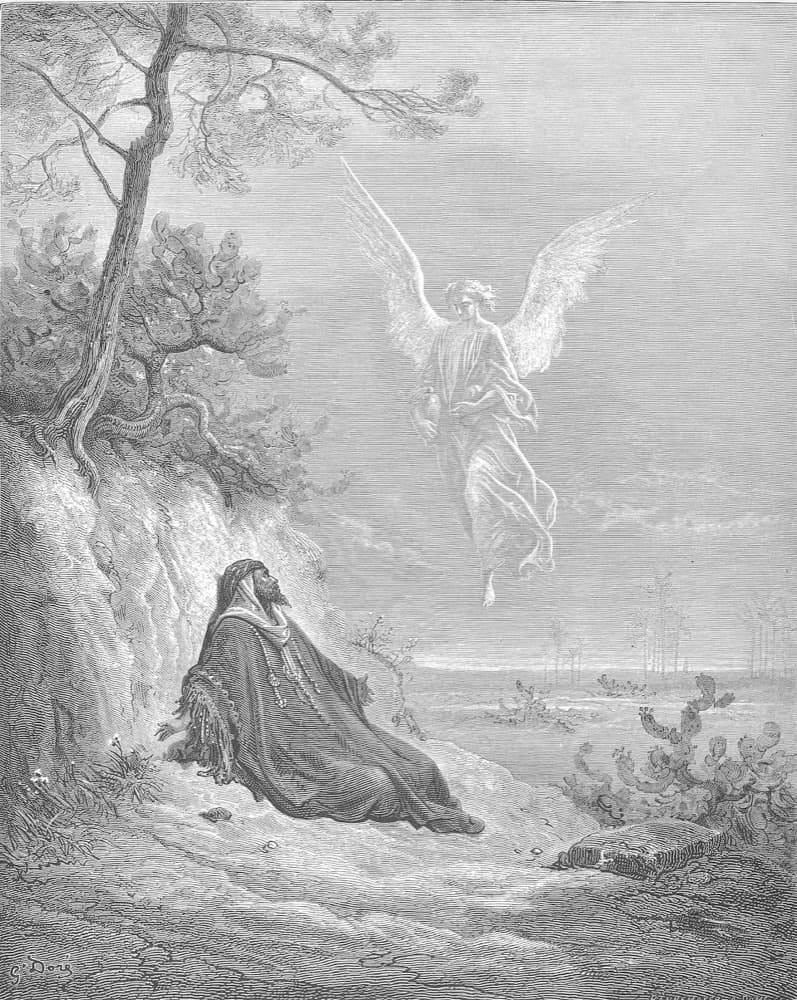
The angel wakes Elijah under the juniper tree.
4…and he requested for himself that he might die; and said, It is enough; now, O Lord, take away my life; for I am not better than my fathers.
5And as he lay and slept under a juniper tree, behold, then an angel touched him, and said unto him, Arise and eat.
7And the angel of the Lord came again the second time, and touched him, and said, Arise and eat; because the journey is too great for thee.
8And he arose, and did eat and drink, and went in the strength of that meat forty days and forty nights unto Horeb the mount of God.
There is no correction in this passage. Elijah has just won the most spectacular contest in the Old Testament and has run for his life and asked to die, and heaven's response is a cake baked on coals, a jar of water, and permission to go back to sleep. Twice.
Verse 7 is the sentence to keep. 'The journey is too great for thee' — which is an agreement, not a rebuke. The angel does not say the journey is manageable or that Elijah is stronger than he feels. It says he is right, and hands him breakfast, and the food carries him forty days.
To consider
- 01God's first response to a prophet's despair was food and sleep, and the doctrine came later on a mountain. Does that ordering suggest anything about how to help someone?
- 02The meal was enough for forty days. What does that imply about the relationship between what God gives and what it accomplishes?
John 6: the day the crowd left
The feeding, the argument, and the cost of the claim.
The chapter is a single argument in four moves, and reading it in pieces destroys it. He feeds five thousand from a boy's lunch. They follow Him across the lake. He tells them plainly why they came — not for the miracle but for the meal. They ask for a sign and helpfully suggest one: our fathers ate manna in the desert.
32…Moses gave you not that bread from heaven; but my Father giveth you the true bread from heaven.
35And Jesus said unto them, I am the bread of life: he that cometh to me shall never hunger; and he that believeth on me shall never thirst.
49Your fathers did eat manna in the wilderness, and are dead.
51I am the living bread which came down from heaven: if any man eat of this bread, he shall live for ever…
Verse 49 is brutal and necessary. The manna was real, it lasted forty years, and every person who ate it died anyway. He is not disparaging the miracle; He is dating it. The whole pattern up to that point had been provisional, and He is saying so to the people most attached to it.
And it costs Him the crowd. John 6:66: 'From that time many of his disciples went back, and walked no more with him.' The chapter that contains the most generous miracle in the Gospels ends with the largest recorded departure — because the bread was easier to accept than what the bread meant.
Handed over
The pattern's conversion into something anyone can receive weekly.
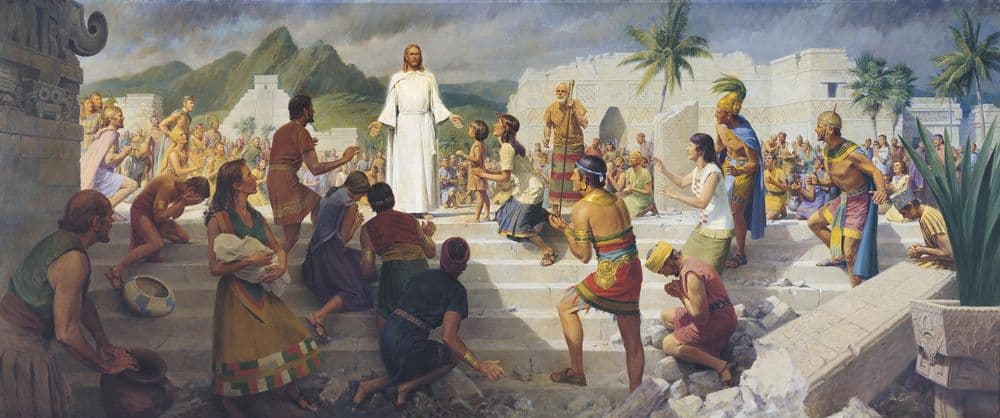
At Bountiful the multiplication and the sacrament are one act. · 3 Ne. 11:8–41
6Now, there had been no bread, neither wine, brought by the disciples, neither by the multitude;
7But he truly gave unto them bread to eat, and also wine to drink.
8And he said unto them: He that eateth this bread eateth of my body to his soul; and he that drinketh of this wine drinketh of my blood to his soul; and his soul shall never hunger nor thirst, but shall be filled.
In the Old World the feeding of the multitude and the Last Supper are separate events a year apart, and it takes John 6 to connect them. In the New World they are the same afternoon. Nobody brought anything, He supplied it, and He gave it as the sacrament in one motion — which is the plainest statement anywhere that the loaves and the emblems were always one subject.
The line from manna to the sacrament tray
- Exodus 16:14–15Bread that appears where none can grow, given daily and not hoarded.
- Exodus 25:30The bread of the presence — twelve loaves standing before God continually.
- John 6:48–51The claim: the manna was provisional, and He is the thing it was standing in for.
- Matthew 26:26The emblem instituted at Passover, a meal about deliverance.
- 3 Nephi 18:1–7The ordinance given to the Nephites with the reason: that ye may witness that ye do always remember me.
- Moroni 4:3The prayer, which asks not for worthiness but for willingness — and asks weekly.
The pattern's whole movement is downward in scale and upward in availability. It begins with a nation fed for forty years by a miracle nobody could miss, and ends with a fragment of bread on a tray, passed along a row by a fourteen-year-old, to a person who is hungry in a way manna was never going to fix.
What the pattern holds
God provides in the place where provision is impossible, rather than moving His people somewhere provision is easy.
The daily limit is the test, not a constraint — and the sabbath exception proves the rot was never a property of the manna.
Every feeding miracle multiplies a small human contribution rather than creating out of nothing.
Five loaves, twenty loaves, a last handful of meal. Never enough to matter, and never omitted.
God's first response to exhaustion may be food and sleep, and the doctrine may wait.
The bread's final function is not nourishment but recognition — He is known in the breaking of it.
What this will not carry
- Bethlehem meaning 'house of bread' is a real fact about Hebrew and not an argument scripture makes. It is a pleasing observation, not evidence.
- The pattern is about God feeding people, not about prosperity. Every instance is subsistence in a crisis — a handful of meal, a cake on coals, bread and fish. Nothing here promises abundance.
- John 6 is also read sacramentally by other Christian traditions in ways that carry doctrinal weight Latter-day Saints do not accept. Reading the chapter as pointing to the sacrament is common ground; the theology of what happens in the ordinance is not.
- Elisha's hundred men and the widow's cruse are genuine instances but small ones. They are included because the pattern's shape shows most clearly in the minor cases, not to inflate the count.
Check your reading
4 questions01What does the word “manna” mean?
02Why, according to Exodus 16:4, was manna given only a day at a time?
03What does the angel say to Elijah under the juniper tree?
04What is unusual about the sacrament in 3 Nephi 20?
Where to go next
Sources
- “Manna” — Bible Dictionary, churchofjesuschrist.org
- “Sacrament” — Guide to the Scriptures, churchofjesuschrist.org
- New Testament Student Manual — Church Educational System, on John 6