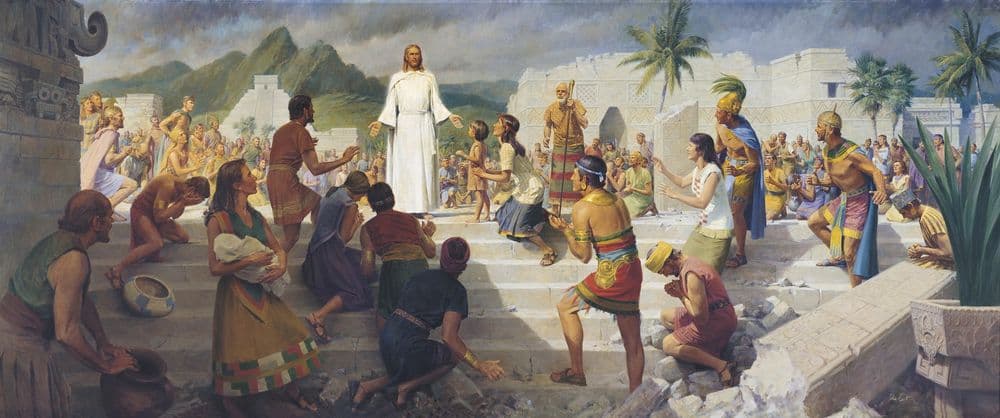
Jesus Teaching in the Western Hemisphere · 3 Ne. 11:8–41
Book of Mormon
One by One
The Savior's appearance at Bountiful
3 Nephi 1145 min5 sections
The chapter the whole book is built toward. A voice that cannot be understood until it is heard a third time, a descent, an invitation to touch, and then — before anything else — the manner of baptism and a prohibition on contention.
- Author
- Mormon, quoting the record of the Nephite Twelve
- Date
- c. AD 34, following the destruction at the Savior's death
- Place
- The temple in the land Bountiful
- Audience
- About 2,500 survivors — men, women and children (3 Nephi 17:25)
- Genre
- Theophany, followed by ordination and doctrinal instruction
By the end you should be able to
- Describe what the crowd had to do before they could understand the voice.
- Explain why the phrase "one by one" is a doctrinal statement and not merely a logistical one.
- Identify the first two things the Savior establishes after being touched, and why the order is significant.
- State what 3 Nephi 11:29 claims about contention, including the part that stings.
A small voice, heard the third time
3And it came to pass that while they were thus conversing one with another, they heard a voice as if it came out of heaven; and they cast their eyes round about, for they understood not the voice which they heard; and it was not a harsh voice, neither was it a loud voice; nevertheless, and notwithstanding it being a small voice it did pierce them that did hear to the center, insomuch that there was no part of their frame that it did not cause to quake; yea, it did pierce them to the very soul, and did cause their hearts to burn.
4And it came to pass that again they heard the voice, and they understood it not.
5And again the third time they did hear the voice, and did open their ears to hear it; and their eyes were towards the sound thereof; and they did look steadfastly towards heaven, from whence the sound came.
Three hearings, and the change between the second and the third is entirely on the hearers' side: they "did open their ears" and looked steadfastly toward the sound. Nothing in the text says the voice grew louder. Understanding arrived when attention did.
King James renders it “"a still small voice" (1 Kings 19:12)”
Elijah's experience at Horeb uses a famously strange Hebrew phrase — literally something like the sound of a fine silence — and it comes after wind, earthquake and fire, in none of which the Lord was. The Nephite record's "small voice" that pierces to the centre belongs to the same tradition: divine communication that is unmistakable precisely because it is not loud.
7Behold my Beloved Son, in whom I am well pleased, in whom I have glorified my name—hear ye him.
Compare Matthew 3:17; 17:5; Joseph Smith—History 1:17.
The Father's words here are almost identical to those at the Jordan, on the Mount of Transfiguration, and in the Sacred Grove. In all four the Father's role is the same: He introduces the Son and then directs attention away from Himself. "Hear ye him" is, in the Latter-day Saint canon, the Father's characteristic sentence.
"Going forth one by one"
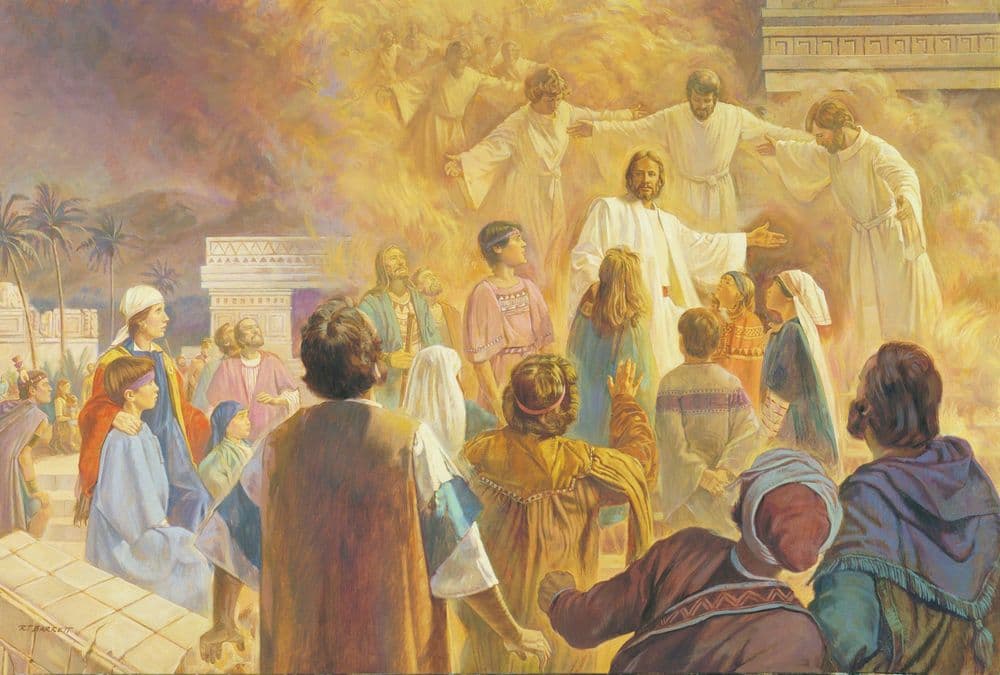
About twenty-five hundred people, one at a time. Later He blesses the children individually — the part the record says could not be written. · 3 Ne. 17:11–25
14Arise and come forth unto me, that ye may thrust your hands into my side, and also that ye may feel the prints of the nails in my hands and in my feet, that ye may know that I am the God of Israel, and the God of the whole earth, and have been slain for the sins of the world.
15And it came to pass that the multitude went forth, and thrust their hands into his side, and did feel the prints of the nails in his hands and in his feet; and this they did do, going forth one by one until they had all gone forth, and did see with their eyes and did feel with their hands, and did know of a surety and bear record, that it was he, of whom it was written by the prophets, that should come.
Two and a half thousand people. If each person took only a few seconds, the procession lasted hours — and the resurrected Lord of the whole earth stood still for all of it. The detail is not sentimental. It is a statement about how this Church's God deals with people, and it is repeated in the chapters that follow: He blesses the children one by one (3 Nephi 17:21), and heals the sick brought to Him individually.
Note also what He invites them to verify. Not His glory — His wounds. The evidence offered to a multitude who had just survived a cataclysm is the mark of what it cost.
“The resurrected Christ retained the marks of the Crucifixion in His hands, feet, and side. He is the Wounded Healer.”
Points to ponder
- 01The crowd is invited to know "of a surety" through their own senses. What does that suggest about how God prefers testimony to be obtained?
- 02He waited through 2,500 people. What does your prayer life assume about His patience?
The first thing He establishes
Before sermons, before miracles: authority, and the exact words of an ordinance.
21And the Lord said unto him: I give unto you power that ye shall baptize this people when I am again ascended into heaven.
23Verily I say unto you, that whoso repenteth of his sins through your words, and desireth to be baptized in my name, on this wise shall ye baptize them—Behold, ye shall go down and stand in the water, and in my name shall ye baptize them.
25Having authority given me of Jesus Christ, I baptize you in the name of the Father, and of the Son, and of the Holy Ghost. Amen.
26And then shall ye immerse them in the water, and come forth again out of the water.
27And after this manner shall ye baptize in my name; for behold, verily I say unto you, that the Father, and the Son, and the Holy Ghost are one; and I am one in the Father, and the Father in me, and the Father and I are one.
The words in verse 25 are still the words used in every baptism performed in the Church (D&C 20:73 gives them in nearly identical form). Verse 26 specifies immersion. This is a Church that treats the form of an ordinance as revealed rather than customary, and 3 Nephi 11 is where that instinct comes from.
Verse 27 is also worth noticing carefully. In the same breath as the baptismal formula, the Savior states the unity of the Father, Son and Holy Ghost — and states it in the language of oneness of purpose and indwelling rather than of shared substance. Latter-day Saint teaching on the Godhead reads verses like this together with 3 Nephi 11:7 (where the Father speaks of the Son from heaven while the Son stands on earth) and John 17:21–23.
"No disputations among you"
28And according as I have commanded you thus shall ye baptize. And there shall be no disputations among you, as there have hitherto been; neither shall there be disputations among you concerning the points of my doctrine, as there have hitherto been.
29For verily, verily, I say unto you, he that hath the spirit of contention is not of me, but is of the devil, who is the father of contention, and he stirreth up the hearts of men to contend with anger, one with another.
30Behold, this is not my doctrine, to stir up the hearts of men with anger, one against another; but this is my doctrine, that such things should be done away.
The sting in verse 29 is that it does not say contention about false doctrine is of the devil. It says the spirit of contention is — including, explicitly, contention "concerning the points of my doctrine." A person can be right about the doctrine and wrong in the spirit, and the verse addresses exactly that case.
President Russell M. Nelson took this passage as the text of his April 2023 conference address "Peacemakers Needed," observing that contention is a choice and that anger is never persuasion. It is a hard teaching in an age built to reward the opposite.
“Contention is a choice. Peacemaking is a choice.”
The rock, and the doctrine
37And again I say unto you, ye must repent, and become as a little child, and be baptized in my name, or ye can in nowise receive these things.
38And again I say unto you, ye must repent, and be baptized in my name, and become as a little child, or ye can in nowise inherit the kingdom of God.
39Verily, verily, I say unto you, that this is my doctrine, and whoso buildeth upon this buildeth upon my rock, and the gates of hell shall not prevail against them.
40And whoso shall declare more or less than this, and thus establish it for my doctrine, the same cometh of evil, and is not built upon my rock, but buildeth upon a sandy foundation; and the gates of hell standeth open to receive such when the floods come and the winds beat upon them.
Verse 40 sets a boundary in both directions: more or less. Adding to the doctrine of Christ is as dangerous as subtracting from it — a caution against both the impulse to elaborate and the impulse to simplify away. 2 Nephi 31 gives the same doctrine as a sequence, and the unit on it in the Jesus Christ course works through that chapter.
What this lesson holds
Revelation is often not repeated louder; it is heard when attention changes.
The Savior ministers to individuals, even when a multitude is present.
Ordinances have a revealed form, and authority must be conferred.
3 Nephi 11:21–27 · D&C 20:73 · Hebrews 5:4 · Articles of Faith 1:5
The spirit of contention is of the devil — including contention about doctrine.
Check your reading
5 questions01What changed between the second and third time the people heard the voice?
02What does the Savior invite the multitude to verify?
03What is the first thing the Savior establishes after the multitude has touched Him?
043 Nephi 11:29 says the spirit of contention is of the devil. What kind of contention does verse 28 specifically include?
05What does 3 Nephi 11:40 warn against?
Where to go next
Sources
- 3 Nephi 11 — The primary text.
- Russell M. Nelson, "Peacemakers Needed" — General Conference, April 2023
- Book of Mormon Student Manual — Church Educational System, chapters on 3 Nephi 11