Patterns / Type of Christ
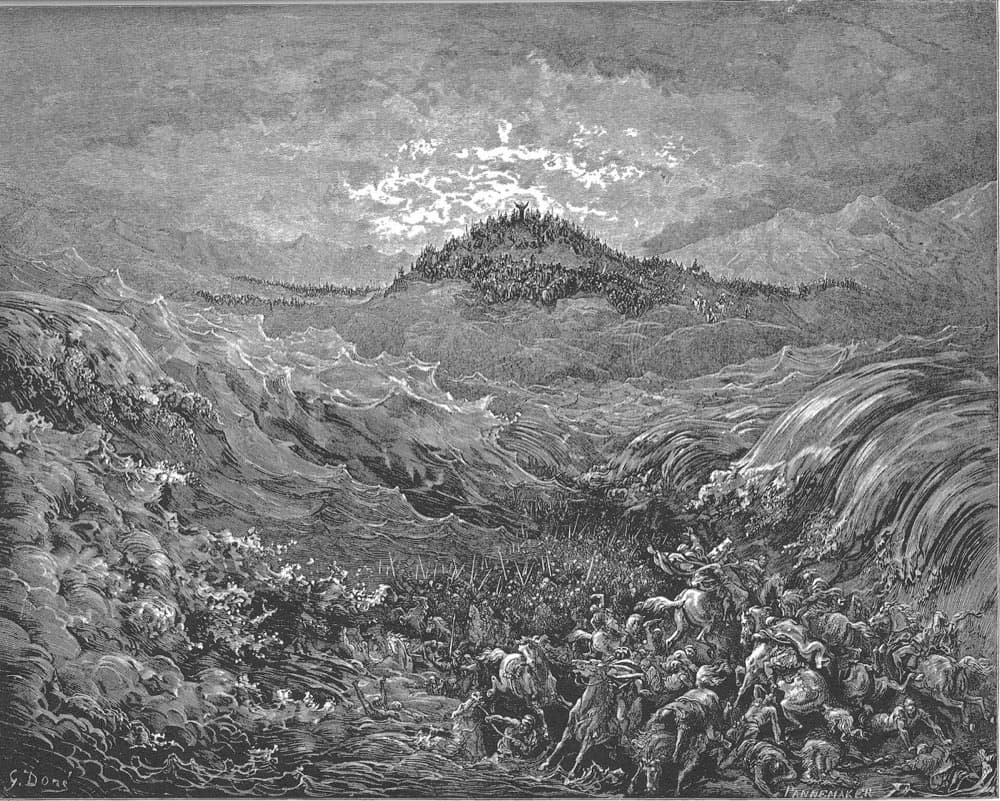
The Egyptians Drown in the Sea
Every deliverance in scripture runs through a sea
Through the water
Twice the New Testament stops mid-argument to say that an Old Testament crossing was a baptism — Peter of the flood, Paul of the Red Sea. That is the canon handing over its own interpretive key. Follow it and a single shape appears everywhere: a people who cannot stay, water that should kill them, a passage through it that does not, and a different world on the far side.
30 min9 appearances
The pattern, in one sentence
God brings His people out of a doomed place by taking them through water that should have drowned them, and what comes out the other side is counted as a new creation.
What counts as an instance
Stated before the evidence, so that the evidence is able to fail.
The old place cannot be stayed in
Every crossing begins with a situation that has become unlivable — a corrupted earth, slavery, a land about to be destroyed, a life that cannot continue as it is. Nobody in this pattern crosses water for scenery.
The water is genuinely lethal
A flood, a sea, a river in flood stage, a deep that swallows barges. The point is not that water is refreshing; it is that this water kills, and the people going into it know so.
The passage is God's doing, not the traveller's
Nobody in this pattern swims. An ark is commanded, a sea is divided, a river stands up, barges are driven by a wind that does not stop. Human competence is conspicuously absent.
The far side is a different order of life
A washed earth, a free nation, a promised land, a church. What emerges is not the same group relocated; it is a group with a new status, and usually a new name and a new covenant.
The appearances
9 in the canonEight souls were saved by water. The like figure whereunto even baptism doth also now save us.
What recurs
A world that cannot continue, water over it, and a remnant carried through.
What is new here
The first instance, and the one Peter names outright. Note his phrasing — saved *by* water, not from it.
Peter's Greek is antitupon, the answering impression of a seal — the flood is the die and baptism is the stamp. It is the most explicit typological statement about an ordinance anywhere in the New Testament, and it makes the flood a story about salvation rather than only about judgement.
Where it lands
The pattern, made an ordinance
Every crossing in the canon is a one-off act of God on behalf of a group in an emergency. The last step in the pattern is its conversion into something repeatable: a font, a covenant, two witnesses, a form of words, and any person at all. What was done once for Noah's household and once for a nation at a sea is now available on a Saturday morning to anybody who asks — and the scripture that explains it says the font is shaped like a grave on purpose.
Two verses that hand over the key
This pattern is not inferred. It is stated, twice, by apostles arguing about something else.
Peter and Paul each make the identification in passing, while making a different point — which is the strongest kind of evidence, because neither is trying to prove it. They assume their readers already accept it.
1 Peter 3:20–21
“…when once the longsuffering of God waited in the days of Noah, while the ark was a preparing, wherein few, that is, eight souls were saved by water.”
“The like figure whereunto even baptism doth also now save us.”
1 Corinthians 10:1–2
“…all our fathers were under the cloud, and all passed through the sea;”
“And were all baptized unto Moses in the cloud and in the sea.”
The word Peter chose
King James renders it “like figure”
A technical term from the world of seals and dies. The tupos is the carved stamp; the antitupon is the impression it leaves in wax. Peter is not saying baptism resembles the flood — he is saying the flood was the die and baptism is the mark it was cut to make. The relationship runs from the older event to the newer one, and it is deliberate on God's part.
Principle
When an apostle reads an Old Testament event as an ordinance and expects no argument, the reading is part of the canon rather than an ornament on it.
The water is supposed to kill you
The most misread element of the pattern, and the one that carries the doctrine.
Water in this pattern is not a symbol of cleansing first. It is a symbol of death first and cleansing second, and getting that order wrong makes nonsense of Romans 6. The flood drowned the world. The Red Sea closed on an army. Jordan was over its banks. The Jaredite barges spent nearly a year being buried in it.
6And it came to pass that they were many times buried in the depths of the sea, because of the mountain waves which broke upon them, and also the great and terrible tempests which were caused by the fierceness of the wind.
7And it came to pass that when they were buried in the deep there was no water that could hurt them, their vessels being tight like unto a dish…
8And it came to pass that the wind did never cease to blow towards the promised land while they were upon the waters; and thus they were driven forth before the wind.
Verse 8 is the sentence that reorganises the whole account. The wind driving them under was the wind driving them home. There is no second, gentler wind in the story. Anyone reading this while in the middle of something will see what it is for.
4Therefore we are buried with him by baptism into death: that like as Christ was raised up from the dead by the glory of the Father, even so we also should walk in newness of life.
5For if we have been planted together in the likeness of his death, we shall be also in the likeness of his resurrection.
Two crossings, forty years apart
The sea opened before Israel moved. The river did not.
Exodus 14 — leaving
Israel is trapped; there is no other route.
Moses stretches out his hand and the sea divides first.
They cross into a wilderness.
Egypt's army follows and is drowned.
The generation that crossed dies before the land.
Joshua 3 — arriving
Israel could have camped; the river is a choice.
The waters stand only when the priests' feet touch them.
They cross into the promised land.
Twelve stones are taken up as a memorial.
The generation that crossed inherits.
The difference in sequence is the difference between a rescue and a covenant. At the sea, God acts and Israel walks through the result; at the river, Israel acts and God responds to the wet feet. Forty years in the wilderness is, among other things, how a people is trained from the first to the second.
The route, with both crossings on it — out through one water, in through another.
To consider
- 01Where in the covenant path does God open the way first, and where does He wait for your feet to be in the water?
- 02Joshua had twelve stones taken out of the riverbed and set up where the people camped. What is the modern equivalent of a memorial you have to walk past?
The waters of Mormon
The moment the pattern becomes a covenant with terms.
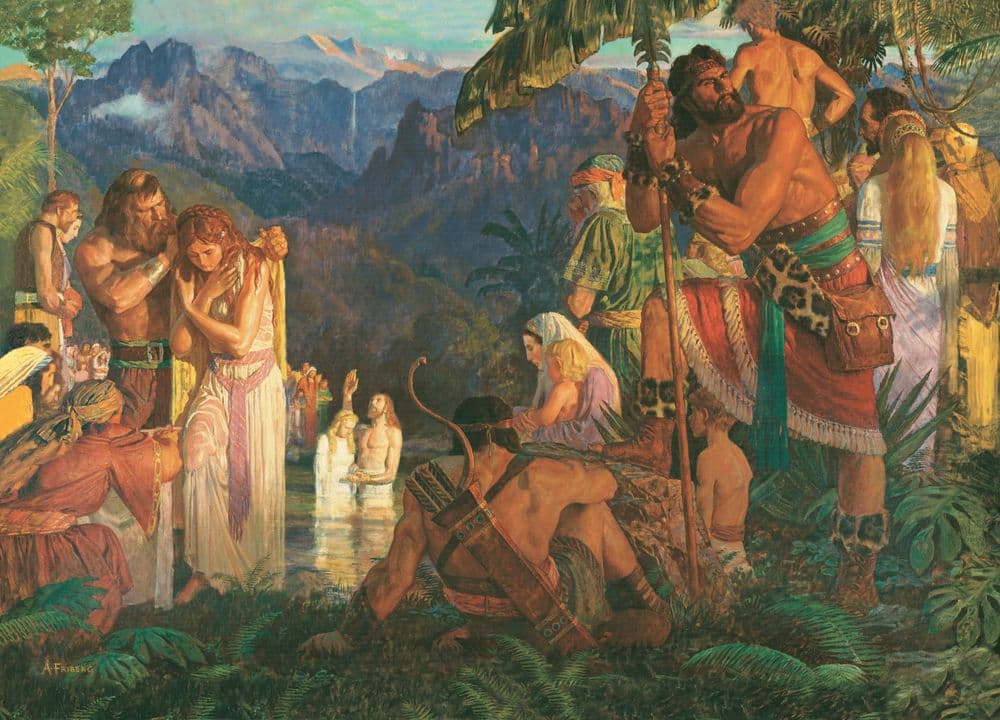
Alma baptizes at the waters of Mormon. · Mosiah 18:7–17
8…as ye are desirous to come into the fold of God, and to be called his people, and are willing to bear one another's burdens, that they may be light;
9Yea, and are willing to mourn with those that mourn; yea, and comfort those that stand in need of comfort, and to stand as witnesses of God at all times and in all things, and in all places…
10…if this be the desire of your hearts, what have you against being baptized in the name of the Lord, as a witness before him that ye have entered into a covenant with him…
Every earlier crossing in the pattern produced a people. This one states in advance what being that people entails, and the list is almost entirely about other people: carry their loads, grieve with them, comfort them, be a witness where they can see you. The vertical covenant is one clause; the horizontal one is three.
Mosiah 18:30 has the line that people remember, and it is worth noticing what it praises: 'how beautiful are they to the eyes of them who there came to the knowledge of their Redeemer.' A hidden fountain in a thicket, chosen because the king's men were looking for them. The pattern's most complete instance happens in a place picked for concealment.
What is on the other side
The pattern's consistent claim about status.
| Instance | Went in as | Came out as |
|---|---|---|
| The flood | A family in a condemned world | The whole human race, under a new covenant and a sign |
| The Red Sea | Slaves belonging to Pharaoh | A nation, three months from Sinai |
| Jordan | Wanderers | Landholders |
| Naaman | A leper and a foreigner | Clean, and a worshipper of Israel's God |
| The barges | Refugees from Babel | A people in a promised land, choosing a king |
| Waters of Mormon | Listeners in a thicket | A church, with a covenant of mutual burden |
| Baptism | A person | A member of the household of God, with a new name on them |
The consistency of the third column is the argument. Nothing in this pattern produces a cleaner version of the same status. Every crossing changes what the people on the far side legally are — which is what an ordinance is for, and why baptism is a gate rather than a gesture.
Baptism as the gate, with the weekly return through the sacrament marked.
One last note, easy to miss. Moses 6:59 gives the reason the ordinance takes this form and not another: we were born into this world by water, and blood, and the spirit — and so we are born into the next one the same way. Baptism is not a metaphor borrowed from the sea. It is a birth, arranged to happen twice.
What the pattern holds
Water in scripture signifies death before it signifies washing, and the ordinance is unintelligible in the other order.
God's method of rescue is consistently to take His people through the thing that should destroy them rather than around it.
There is no instance of the water being removed. It is divided, survived, or entered — never avoided.
The wind that buries is the wind that carries.
Ether 6:8 refuses to distinguish the storm from the transport, and does so in a book compiled by a man who had lost everything.
Every crossing produces a people with a new legal status, which is why baptism is called a gate and not a symbol.
What this will not carry
- Water is common in scripture and not every occurrence is this pattern. The wells of Genesis, the pool of Bethesda and the sea of Galilee are doing other work; the marker that keeps this study honest is that the water must be lethal and the passage must change the travellers' status.
- Peter says eight souls were saved by water, not that the flood was chiefly about salvation. Judgement is genuinely the surface of that narrative, and a study that erases it is doing the text a disservice.
- 1 Corinthians 10 is a warning passage. Paul's point is that Israel had the ordinance and still fell, which cuts directly against using this pattern to argue that baptism guarantees anything.
- Naaman's seven dippings are not a form of the ordinance and should not be read as one. The instance belongs here for the shape of the obedience, not the mechanics.
Check your reading
4 questions01What does Peter call baptism in relation to the flood?
02In Joshua 3, when did the Jordan stop flowing?
03What does Ether 6:8 say about the wind that drove the Jaredite barges under?
04At the waters of Mormon, what did Alma state as the terms of the covenant before baptizing anyone?
Where to go next
Sources
- “Baptism, Baptize” — Guide to the Scriptures, churchofjesuschrist.org
- Doctrine and Covenants 128 — Joseph Smith on the font as a similitude of the grave
- New Testament Student Manual — Church Educational System, on 1 Corinthians 10 and 1 Peter 3