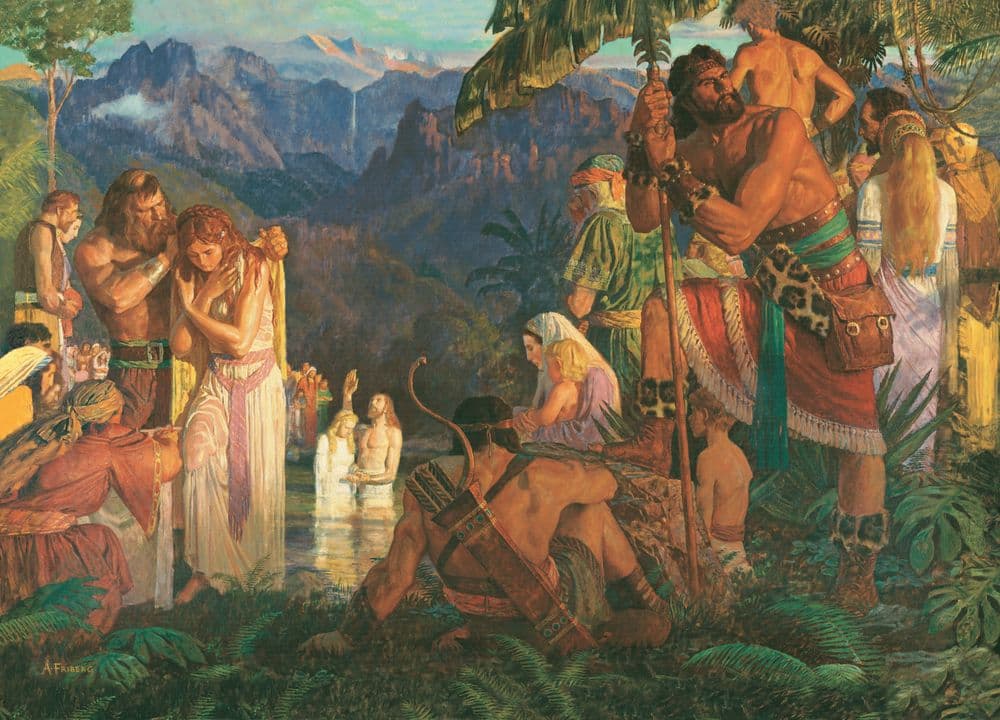
Alma Baptizes in the Waters of Mormon · Mosiah 18:7–17
New Testament
Born of Water and of the Spirit
Nicodemus, at night
John 3; Mosiah 27; Alma 540 min4 sections
A member of the Sanhedrin comes after dark with a compliment and is answered with a demand. The Greek word at the centre of the conversation means two things at once, and the ambiguity is the teaching.
- Author
- John
- Date
- Early in the Savior's ministry, at a Passover in Jerusalem
- Place
- Jerusalem, by night
- Audience
- Nicodemus, "a ruler of the Jews" and a Pharisee
- Language
- Koine Greek
- Genre
- Dialogue, sliding into discourse
By the end you should be able to
- Explain the double meaning of anōthen and why it produces Nicodemus's confusion.
- State what Latter-day Saint doctrine understands by "born of water and of the Spirit."
- Trace Nicodemus's later appearances and what they suggest.
- Use Alma 5 as a self-examination rather than as a proof text.
A word that means two things
1There was a man of the Pharisees, named Nicodemus, a ruler of the Jews:
2The same came to Jesus by night, and said unto him, Rabbi, we know that thou art a teacher come from God: for no man can do these miracles that thou doest, except God be with him.
3Jesus answered and said unto him, Verily, verily, I say unto thee, Except a man be born again, he cannot see the kingdom of God.
4Nicodemus saith unto him, How can a man be born when he is old? can he enter the second time into his mother's womb, and be born?
5Jesus answered, Verily, verily, I say unto thee, Except a man be born of water and of the Spirit, he cannot enter into the kingdom of God.
Nicodemus opens with a careful, respectful compliment — we know you are a teacher come from God. Jesus does not accept the frame. Before any discussion of teaching or miracles, He states a precondition for seeing the kingdom at all, and it is not something a rabbi can accomplish by being learned.
Water, and Spirit
Christian traditions divide over verse 5. Some read "water" as natural birth, some as the word of God, some as baptism. Latter-day Saint doctrine reads it as baptism by immersion followed by the gift of the Holy Ghost — two ordinances, in that order, both required — and the Restoration's other scriptures make the reading explicit rather than inferential.
The Restoration's cross-references
- 2 Nephi 31:13–17Nephi walks through the doctrine as a sequence: faith, repentance, baptism by water, then baptism by fire and the Holy Ghost.
- 3 Nephi 11:33–35Belief, baptism, and the Holy Ghost, named together by the Savior.
- Moses 6:59–60The clearest single statement: born of water, and of the Spirit, and cleansed by blood — "even the blood of mine Only Begotten."
- Articles of Faith 1:4The four first principles and ordinances, in order.
- D&C 20:37The requirements for baptism, including a broken heart and contrite spirit.
Moses 6:59–60 is worth reading beside John 3 because it draws the parallel Jesus leaves implicit: mortal birth involves water, blood and spirit, and so does the second birth. The analogy is not decorative.
Paul reads immersion as burial and resurrection (Romans 6:3–5), which makes it the right ordinance for a doctrine about being born again: you go under as one person and come up as another. Sprinkling cannot carry that image, and the New Testament never uses its word (rhantizō) for baptism.
Full lexicon entry →
The serpent, and the verse everybody knows
14And as Moses lifted up the serpent in the wilderness, even so must the Son of man be lifted up:
15That whosoever believeth in him should not perish, but have eternal life.
16For God so loved the world, that he gave his only begotten Son, that whosoever believeth in him should not perish, but have everlasting life.
17For God sent not his Son into the world to condemn the world; but that the world through him might be saved.
The serpent reference is to Numbers 21:8–9: Israel, bitten by fiery serpents, is told to look at a bronze serpent on a pole and live. Nephi and Alma both notice the same detail — that many refused to look, and died, because the remedy was too simple (1 Nephi 17:41; Alma 33:19–20). Alma's phrase for it is exact: "the labor which they had to perform was to look."
"God so loved" in verse 16 is houtōs — thus, in this manner. The sentence is not measuring the quantity of God's love but describing its form: this is how He loved, by giving. And the Greek for "only begotten" is the monogenēs of the prologue.
Have ye experienced this mighty change?
The Book of Mormon supplies what John 3 does not: a description of what the second birth feels like from inside, and a set of questions for checking. Mosiah 27 gives the narrative case, and Alma 5 turns it into an examination.
24For, said he, I have repented of my sins, and have been redeemed of the Lord; behold I am born of the Spirit.
25And the Lord said unto me: Marvel not that all mankind, yea, men and women, all nations, kindreds, tongues and people, must be born again; yea, born of God, changed from their carnal and fallen state, to a state of righteousness, being redeemed of God, becoming his sons and daughters;
26And thus they become new creatures; and unless they do this, they can in nowise inherit the kingdom of God.
14And now behold, I ask of you, my brethren of the church, have ye spiritually been born of God? Have ye received his image in your countenances? Have ye experienced this mighty change in your hearts?
26And now behold, I say unto you, my brethren, if ye have experienced a change of heart, and if ye have felt to sing the song of redeeming love, I would ask, can ye feel so now?
Verse 26 is the question that keeps Alma 5 from being a one-time test. He is addressing "my brethren of the church" — people already converted — and asking whether the change is present tense. Latter-day Saint teaching consistently treats being born again as a process to be renewed rather than an event to be dated, which is one of the practical functions of the weekly sacrament.
As for Nicodemus: he appears twice more. In John 7:50–51 he objects, cautiously, when the Sanhedrin condemns Jesus without a hearing. And in John 19:39 he brings about a hundred pounds of myrrh and aloes to the burial — an enormous, public, unmistakable quantity, in daylight. The man who came at night is last seen carrying spices in the open.
What this lesson holds
Entering the kingdom requires a second birth — of water and of the Spirit.
The workings of the Spirit are recognisable without being predictable.
The remedy is refused most often for being too simple.
John 3:14–15 · Numbers 21:8–9 · Alma 33:19–20 · 1 Nephi 17:41
Being born of God is a change to be maintained, not an event to be dated.
Check your reading
5 questions01The Greek word anōthen in John 3:3 means —
02How does Latter-day Saint doctrine read "born of water and of the Spirit"?
03Why does John 3:8 use the word pneuma twice?
04In Alma 5:26, what does Alma ask people who have already been converted?
05Where does Nicodemus appear last?
Where to go next
Sources
- John 3; Mosiah 27; Alma 5; Moses 6 — The primary texts.
- Gospel Topics, "Born Again"
- New Testament Student Manual — Church Educational System, chapter on John 3