Library / Jesus Christ and the Everlasting Gospel
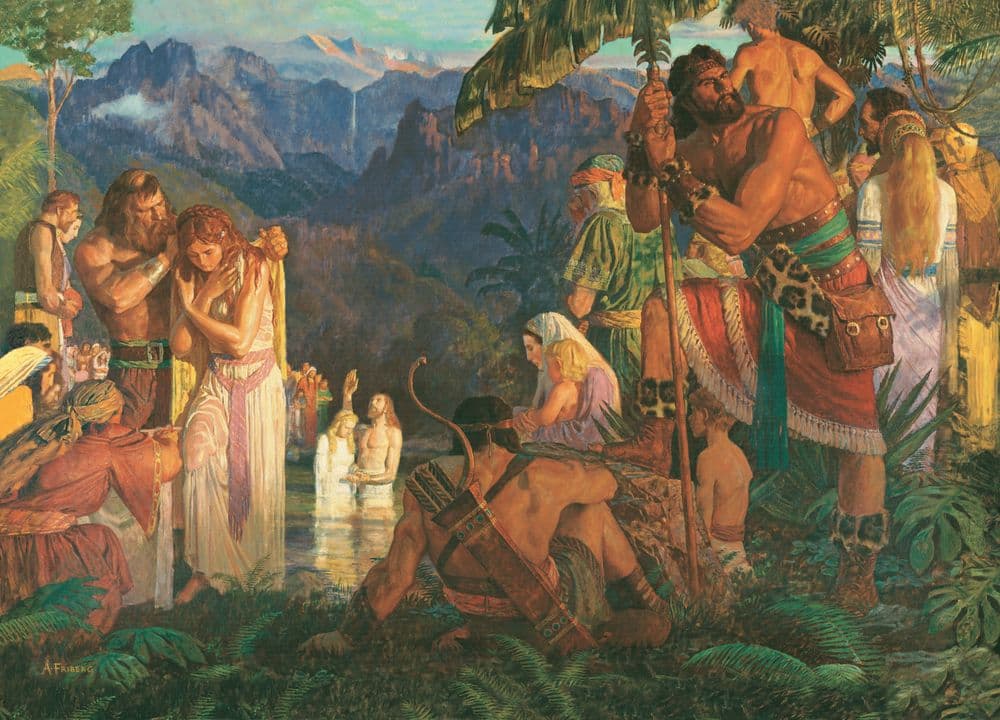
Alma Baptizes in the Waters of Mormon · Mosiah 18:7–17
Across the standard works
The Doctrine of Christ
2 Nephi 31–32 and 3 Nephi 27, where the gospel is stated in the plainest terms the canon contains
2 Nephi 31–32; 3 Nephi 11:31–41; 3 Nephi 27:13–2245 min4 sections
Twice the canon stops and says, in effect: this is the doctrine, and anything more or less than this is not of me. Nephi says it at the end of his record and the Savior says it Himself at Bountiful. Between them they define the gospel as five things, in an order, with an endpoint.
- Author
- Nephi, closing his record; and the resurrected Christ at Bountiful
- Date
- c. 559–545 BC for 2 Nephi 31; AD 34 for 3 Nephi
- Place
- The land of Nephi; the temple at Bountiful
- Audience
- Nephi's people, and the twelve Nephite disciples
- Genre
- Farewell instruction; and direct discourse from the risen Lord
By the end you should be able to
- List the five elements of the doctrine of Christ in order, and say why the order matters.
- Explain what Nephi means by 'the gate' and what lies on the other side of it.
- State the warnings attached in 2 Nephi 31:12–14 and 3 Nephi 11:40.
- Say what 'endure to the end' actually asks for, from 2 Nephi 31:20's own vocabulary.
Nephi's statement
An old man, near the end of his plates, deciding what he cannot leave out.
Alma at the waters of Mormon — the baptismal covenant stated in terms of what is owed to other people. · Mosiah 18:7–17
Faith, repentance, baptism, the gift of the Holy Ghost, the temple, and enduring — with the gate marked, and the weekly loop back through the sacrament.
2 Nephi 31 opens with Nephi saying he has written few of the words of Isaiah because his soul delights in plainness, and that he must speak concerning the doctrine of Christ. What follows is the most compressed statement of the gospel in scripture: an argument built on a single question — why would a sinless man need baptism? — and answered in a way that turns the whole chapter into a pattern.
5And now, if the Lamb of God, he being holy, should have need to be baptized by water, to fulfil all righteousness, O then, how much more need have we, being unholy, to be baptized, yea, even by water!
6And now, I would ask of you, my beloved brethren, wherein the Lamb of God did fulfil all righteousness in being baptized by water?
7Know ye not that he was holy? But notwithstanding he being holy, he showeth unto the children of men that, according to the flesh he humbleth himself before the Father, and witnesseth unto the Father that he would be obedient unto him in keeping his commandments.
9And again, it showeth unto the children of men the straitness of the path, and the narrowness of the gate, by which they should enter, he having set the example before them.
10And he said unto the children of men: Follow thou me. Wherefore, my beloved brethren, can we follow Jesus save we shall be willing to keep the commandments of the Father?
| What it is | Where he states it | |
|---|---|---|
| 1 | Faith in Jesus Christ | 2 Nephi 31:19 — 'unshaken faith in him, relying wholly upon the merits of him who is mighty to save' |
| 2 | Repentance | 2 Nephi 31:11 — 'Repent, ye, repent ye, and be baptized in the name of my Beloved Son' |
| 3 | Baptism by water | 2 Nephi 31:13 — 'follow the Son, with full purpose of heart, acting no hypocrisy and no deception before God' |
| 4 | The gift of the Holy Ghost | 2 Nephi 31:13 — 'then can ye speak with the tongue of angels' |
| 5 | Enduring to the end | 2 Nephi 31:20 — 'press forward with a steadfastness in Christ' |
Principle
Baptism is a gate, not a destination: it is where the path begins, and the path is the point.
Nephi says so directly in verse 17–18 — 'the gate by which ye should enter is repentance and baptism by water; and then cometh a remission of your sins by fire and by the Holy Ghost. And then are ye in this strait and narrow path.' Everything before verse 18 is entry; everything after it is the walk.
The two warnings
Both statements of the doctrine come with a clause about hypocrisy and a clause about addition.
13Wherefore, my beloved brethren, I know that if ye shall follow the Son, with full purpose of heart, acting no hypocrisy and no deception before God, but with real intent, repenting of your sins, witnessing unto the Father that ye are willing to take upon you the name of Christ, by baptism… then shall ye receive the Holy Ghost.
14But, behold, my beloved brethren, thus came the voice of the Son unto me, saying: After ye have repented of your sins, and witnessed unto the Father that ye are willing to keep my commandments, by the baptism of water, and have received the baptism of fire and of the Holy Ghost… if ye shall deny me, it would have been better for you that ye had not known me.
'Full purpose of heart, acting no hypocrisy and no deception before God, but with real intent.' Four phrases, all saying the same thing from different angles, which is how a writer signals that the point is not incidental. An ordinance performed without the intent is not treated here as partially effective.
39Verily, verily, I say unto you, that this is my doctrine, and whoso buildeth upon this buildeth upon my rock, and the gates of hell shall not prevail against them.
40And whoso shall declare more or less than this, and establish it for my doctrine, the same cometh of evil, and is not built upon my rock, but he buildeth upon a sandy foundation, and the gates of hell stand open to receive such when the floods come and the winds beat upon them.
Nephi (2 Nephi 31)
Faith in Christ
Repentance
Baptism by water
The baptism of fire and of the Holy Ghost
Press forward, enduring to the end
'This is the way; and there is none other way'
Christ (3 Nephi 27, 11)
Believe in me
Repent of all your sins
Be baptized in my name
Be sanctified by the reception of the Holy Ghost
Endure to the end
'This is my doctrine… whoso shall declare more or less than this… cometh of evil'
"This is my gospel"
At Bountiful the Savior defines the word Himself, and the definition is unexpected.
13Behold I have given unto you my gospel, and this is the gospel which I have given unto you—that I came into the world to do the will of my Father, because my Father sent me.
14And my Father sent me that I might be lifted up upon the cross; and after that I had been lifted up upon the cross, that I might draw all men unto me…
16And it shall come to pass, that whoso repenteth and is baptized in my name shall be filled; and if he endureth to the end, behold, him will I hold guiltless before my Father at that day when I shall stand to judge the world.
20Now this is the commandment: Repent, all ye ends of the earth, and come unto me and be baptized in my name, that ye may be sanctified by the reception of the Holy Ghost, that ye may stand spotless before me at the last day.
21Verily, verily, I say unto you, this is my gospel; and ye know the things that ye must do in my church.
The definition in verse 13 is a surprise. Asked what His gospel is, He does not begin with what people must do; He begins with what He did, and why. The requirements in verses 16 and 20 follow from that, and are stated as a response rather than as a transaction.
The word being defined
Principle
The gospel is first an announcement about what Christ did, and only then a set of requirements — and the requirements are the shape of a response to the announcement.
3 Nephi 27:13–14 defines 'my gospel' as the mission of the Son, and verses 16 and 20 attach what people are to do in light of it. Reversing that order — treating the gospel as a list of requirements with Christ attached — is the most common way of getting it exactly backwards.
What enduring actually asks
The most passive-sounding element of the doctrine, described with four active verbs.
19And now, my beloved brethren, after ye have gotten into this strait and narrow path, I would ask if all is done? Behold, I say unto you, Nay… ye must press forward with a steadfastness in Christ, having a perfect brightness of hope, and a love of God and of all men.
20Wherefore, if ye shall press forward, feasting upon the word of Christ, and endure to the end, behold, thus saith the Father: Ye shall have eternal life.
- Press forward — a verb of effort against resistance, not of holding still.
- With a steadfastness in Christ — the steadiness is located in Him, not in the person's own resolve.
- Having a perfect brightness of hope — 'perfect' here is completeness rather than flawlessness; hope with nothing missing from it.
- And a love of God and of all men — the outward half, without which the rest is private and inert.
- Feasting upon the word of Christ — not reading, not studying: feasting, which assumes a table, an appetite and time.
Enduring to the end sounds like the element that asks the least and in fact asks the most, because it is the only one that has to be done every day for the rest of a life. Nephi describes it entirely in active verbs, which is the corrective to hearing it as gritting one's teeth.
3Angels speak by the power of the Holy Ghost; wherefore, they speak the words of Christ. Wherefore, I said unto you, feast upon the words of Christ; for behold, the words of Christ will tell you all things what ye should do.
5For behold, again I say unto you that if ye will enter in by the way, and receive the Holy Ghost, it will show unto you all things what ye should do.
To consider
- 01Nephi asks, after baptism, 'is all done?' What would change about a week if the answer were genuinely no?
- 02The warning is against declaring more or less. Which direction is your own tradition more prone to?
- 03'Feast' rather than 'read.' What does a feast require that a meal does not?
What this lesson holds
The doctrine of Christ is faith, repentance, baptism, the gift of the Holy Ghost, and enduring to the end — stated in that order, twice, by Nephi and by Christ Himself.
Anyone declaring more or less than this doctrine and establishing it as Christ's is building on sand — the warning cuts against addition as sharply as against subtraction.
The gospel is defined by Christ as what He came to do, with the requirements following as a response to it.
Enduring to the end is described entirely in active verbs: press forward, hope, love, feast.
Check your reading
5 questions01Why does Nephi say Christ was baptized?
02What is 'the gate' in 2 Nephi 31?
03What does 'strait' mean in 'strait and narrow'?
04What does Christ warn against in 3 Nephi 11:40?
05How does Christ define His gospel at Bountiful?
Where to go next
Sources
- 2 Nephi 31–32 — The primary text.
- 3 Nephi 11:31–41; 27:13–22 — The Savior's own statement.
- Book of Mormon Student Manual
- Guide to the Scriptures, "Gospel"