Library / Jesus Christ and the Everlasting Gospel
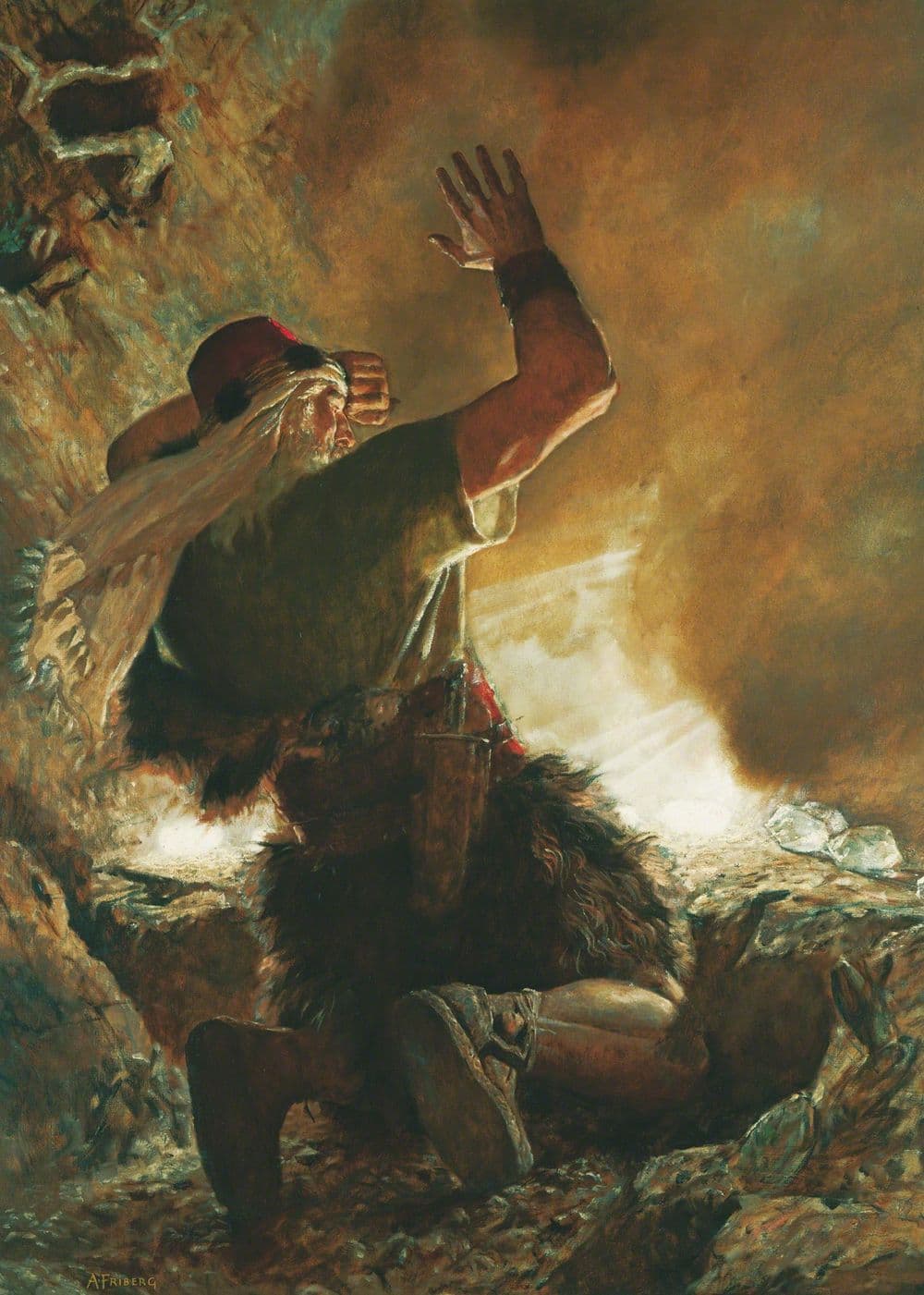
The Brother of Jared Sees the Finger of the Lord · Ether 3:1–16
Across the standard works
By Every Name
The titles of Christ, and what each one is for
Isaiah 9:6; Mosiah 3:8; Revelation 1:8; John 8:58; Alma 5:4845 min4 sections
Scripture never settles on one name for the Savior, and the variation is not decoration. Each title states a relationship, a function or a claim — and several of them are the sharpest doctrinal statements in the canon, hiding in plain sight as terms of address.
- Audience
- Anyone who has said the name in prayer without asking what it means
- Language
- Hebrew, Aramaic, Greek and English
- Genre
- Doctrinal study, drawing on all five volumes
By the end you should be able to
- Explain what 'Christ' and 'Messiah' actually mean, and why they are the same word.
- State what the title 'Son of Man' claims, and why it is not a statement of humility.
- Distinguish Firstborn, Only Begotten and Son of God, and say what each one is doing.
- Use the names as a diagnostic: which relationship does a given passage need?
The anointed one
Two languages, one word, and an office older than the person who filled it.
The same title, in Hebrew and Greek
Anointing in Israel did three things at once: it set a person apart, it conferred authority, and it marked them as belonging to God rather than to themselves. All three are still in the word when it is applied to Jesus — and all three are why 'Christ' functions as a confession rather than a label. Peter's answer at Caesarea Philippi is not information; it is a claim about office.
15He saith unto them, But whom say ye that I am?
16And Simon Peter answered and said, Thou art the Christ, the Son of the living God.
17And Jesus answered and said unto him, Blessed art thou, Simon Bar-jona: for flesh and blood hath not revealed it unto thee, but my Father which is in heaven.
The names that claim divinity
Four titles that a first-century audience heard as blasphemy, and did not misunderstand.
| Title | Where | The claim |
|---|---|---|
| I AM | John 8:58; Exodus 3:14; D&C 29:1 | The divine name of the burning bush, used of Himself in the present tense against Abraham's past. His hearers picked up stones, which tells you exactly how they understood it. |
| Jehovah | Moroni 10:34; D&C 110:3; Isaiah 12:2 | The God of the Old Testament, identified in Latter-day Saint usage as the premortal Christ. 3 Nephi 15:5 has Him say it Himself: 'I am he that gave the law.' |
| Immanuel | Isaiah 7:14; Matthew 1:23; 2 Nephi 17:14 | 'God with us' — the name is a sentence. Matthew translates it for his readers rather than leaving it, because the translation is the point. |
| Alpha and Omega | Revelation 1:8; D&C 19:1; 3 Nephi 9:18 | First and last letters of the Greek alphabet: the whole of something, and the beginning and end of it. In Revelation the speaker is 'the Lord, which is, and which was, and which is to come, the Almighty.' |
The Greek of John 8:58
Ordinary Greek for 'I am' — but the Septuagint uses exactly this phrase to render the divine name at Exodus 3:14, and John uses it absolutely, with no predicate, seven times in his Gospel. 'Before Abraham was, I am' is not bad grammar; it is a deliberate collision of tenses, and the crowd's response in the next verse shows it landed.
Full lexicon entry →
Firstborn, Only Begotten, Son of God
Three titles that look interchangeable and are not.
Firstborn
Colossians 1:15; D&C 93:21
Firstborn of the Father's spirit children — first in the premortal order.
Also carries the legal weight of birthright: the firstborn inherits and represents.
Only Begotten
John 3:16; Moses 1:6; 2 Nephi 25:12
Unique in the flesh — the only one whose mortal body came of a mortal mother and an immortal Father.
Greek monogenēs: one of a kind, in relationship as much as in origin.
Son of God
Matthew 16:16; Mosiah 15:2
The relationship itself, without specifying which sense.
Used by both Peter in confession and devils in recognition — knowing the title is not the same as having the relationship.
Abinadi's treatment in Mosiah 15 is the most demanding passage in the canon on this subject, and the most often misread. He calls Christ 'the Father and the Son' — the Father 'because he was conceived by the power of God,' and the Son 'because of the flesh' — which is a statement about two roles held by one person, not a collapse of the Father and the Son into one being. The First Presidency addressed the passage directly in 1916, and the doctrine of D&C 130:22 stands: they are separate, embodied persons.
The title that names the work
Principle
The titles are functions. Which one scripture reaches for tells you what is being asked of Him in that passage.
Advocate appears where judgment is in view; Redeemer where debt or captivity is; Shepherd where people are lost; Immanuel where distance is the problem; Lamb where sacrifice is. Reading a passage well often begins with noticing which name it uses and asking why that one.
Taking the name
The covenant is stated as a name, which is a strange way to state a covenant.
7And now, because of the covenant which ye have made ye shall be called the children of Christ, his sons, and his daughters; for behold, this day he hath spiritually begotten you; for ye say that your hearts are changed through faith on his name; therefore, ye are born of him and have become his sons and his daughters.
8And under this head ye are made free, and there is no other head whereby ye can be made free. There is no other name given whereby salvation cometh; therefore, I would that ye should take upon you the name of Christ, all you that have entered into the covenant with God that ye should be obedient unto the end of your lives.
9And it shall come to pass that whosoever doeth this shall be found at the right hand of God, for he shall know the name by which he is called; for he shall be called by the name of Christ.
King Benjamin's people take a name rather than sign an agreement, and the sacrament prayer keeps the formula: willing to take upon them the name of thy Son. In a culture where a name carried lineage, obligation and belonging, taking one was the most complete form of commitment available — closer to adoption than to endorsement.
King James renders it “adoption”
Roman adoption transferred a person completely: old debts cancelled, new family's name taken, full inheritance rights conferred, and the adoption could not be undone. Paul uses this word rather than a Jewish one because his readers knew exactly how final it was.
Full lexicon entry →
Where the names collect
- Isaiah 9:6Five titles in a single verse, in the style of Judean royal throne names — and overshooting any king Judah ever had.
- Mosiah 3:8King Benjamin's angel: Jesus Christ, the Son of God, the Father of heaven and earth, the Creator of all things — four in one sentence, given a century before the birth.
- Alma 5:48Alma's own confession, and one of the most direct in scripture: 'the Son of God… full of grace, and mercy, and truth.'
- D&C 93:8–9Christ as the Word, the messenger of salvation, the light and the Redeemer of the world — the Restoration's echo of John's prologue.
- Revelation 19:11–16The last vision: Faithful and True, the Word of God, King of kings and Lord of lords — and a name written that no man knew but He himself.
To consider
- 01Which name do you use when you pray, and which relationship does that name assume?
- 02The gōʾēl had to be a relative. What does that require of the Incarnation?
- 03King Benjamin's people took a name rather than made a promise. What is the difference?
What this lesson holds
'Christ' is a title, not a surname: it means the Anointed One, and using it is a confession of office.
The Jehovah of the Old Testament is the premortal Christ, and He says so Himself.
The redeemer had to be a kinsman, which is why the Incarnation is part of the Atonement rather than a preface to it.
Taking His name is the form the covenant takes, and it is renewed every week in the sacrament prayer.
Check your reading
5 questions01What does "Christ" mean?
02Why did Jesus's hearers take up stones after John 8:58?
03What does the title "Son of Man" claim?
04What was a gōʾēl in Israelite law?
05What does King Benjamin's covenant consist of?
Where to go next
Sources
- Bible Dictionary, "Christ"
- Bible Dictionary, "Jehovah"
- "The Father and the Son: A Doctrinal Exposition by the First Presidency and the Twelve" — 30 June 1916 — the authoritative treatment of Mosiah 15 and the senses of 'Father'
- Guide to the Scriptures, "Jesus Christ"