Topics / Godhead
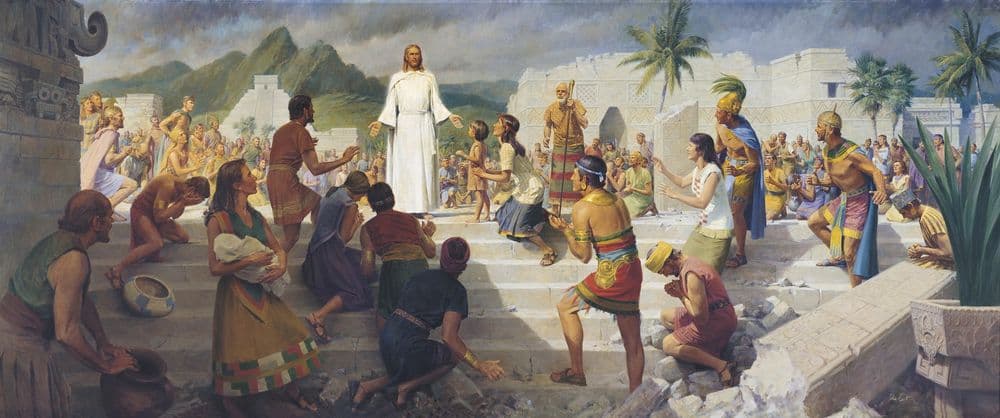
Jesus Teaching in the Western Hemisphere · 3 Ne. 11:8–41
Who He is, what He did, and what He is doing now
Jesus Christ
The centre of the whole canon. Premortal Jehovah, Creator under the Father, the Only Begotten in the flesh, the atoning sacrifice, the risen Lord, the head of His Church, and the coming Judge — the same person throughout, in seven roles.
22 min2 sections
Seven roles, one person
| Role | Where | What it establishes |
|---|---|---|
| Premortal Jehovah | Ether 3:14–16; 3 Nephi 15:5; John 8:58 | The God of the Old Testament is the premortal Christ, and He says so Himself. |
| Creator under the Father | Moses 1:32–33; John 1:3; Colossians 1:16 | Worlds without number, made by Him and through Him. |
| The Only Begotten in the flesh | Luke 1:31–35; 1 Nephi 11:18–21; 2 Nephi 25:12 | A mortal mother and an immortal Father — which is what makes both death and its defeat possible. |
| The atoning sacrifice | Mosiah 3:7; Luke 22:44; D&C 19:16–19; Isaiah 53 | The garden and the cross, and a suffering He describes in the first person. |
| The risen Lord | Luke 24:36–43; 3 Nephi 11:8–17; 1 Corinthians 15:5–8 | A physical resurrection, verified by hundreds of people with their hands. |
| Head of His Church | Ephesians 1:22; 3 Nephi 27:8; D&C 1:30 | It is called by His name, and He directs it. |
| Advocate and Judge | 1 John 2:1; D&C 45:3–5; John 5:22 | The same person pleads the case and renders the verdict — which is either the strangest fact about the judgment or the most consoling. |
22And now, after the many testimonies which have been given of him, this is the testimony, last of all, which we give of him: That he lives!
23For we saw him, even on the right hand of God; and we heard the voice bearing record that he is the Only Begotten of the Father—
24That by him, and through him, and of him, the worlds are and were created, and the inhabitants thereof are begotten sons and daughters unto God.
What He is doing now
It is easy to hold Christ entirely in the past tense — He came, He suffered, He rose. Scripture describes a continuing present: He advocates, He directs, He invites, and He is coming. D&C 45:3–5 puts the advocacy into direct speech, and the plea is worth reading slowly, because of what it does not say.
3Listen to him who is the advocate with the Father, who is pleading your cause before him—
4Saying: Father, behold the sufferings and death of him who did no sin, in whom thou wast well pleased; behold the blood of thy Son which was shed, the blood of him whom thou gavest that thyself might be glorified;
5Wherefore, Father, spare these my brethren that believe on my name, that they may come unto me and have everlasting life.
The plea is not that the accused is innocent. It rests entirely on what He did, not on what they did — which is the difference between an advocate and a character witness.
Principle
Christ's work is not finished; He is presently advocating, directing His Church, and inviting people to come to Him.
What this topic holds
The Jehovah of the Old Testament, the Jesus of the Gospels and the risen Lord of Bountiful are one person in successive roles.
The advocacy before the Father rests on what Christ did, not on what the accused did.
Check your reading
3 questions01What does 3 Nephi 15:5 have Christ say about the law of Moses?
02On what does the Advocate's plea in D&C 45 rest?
03What does D&C 76:22 call the testimony given there?
Where to go next
Sources
- Guide to the Scriptures, "Jesus Christ"
- "The Living Christ: The Testimony of the Apostles" — 1 January 2000
- D&C 76:22–24; D&C 45:3–5 — The primary texts.