Patterns / Type of Christ
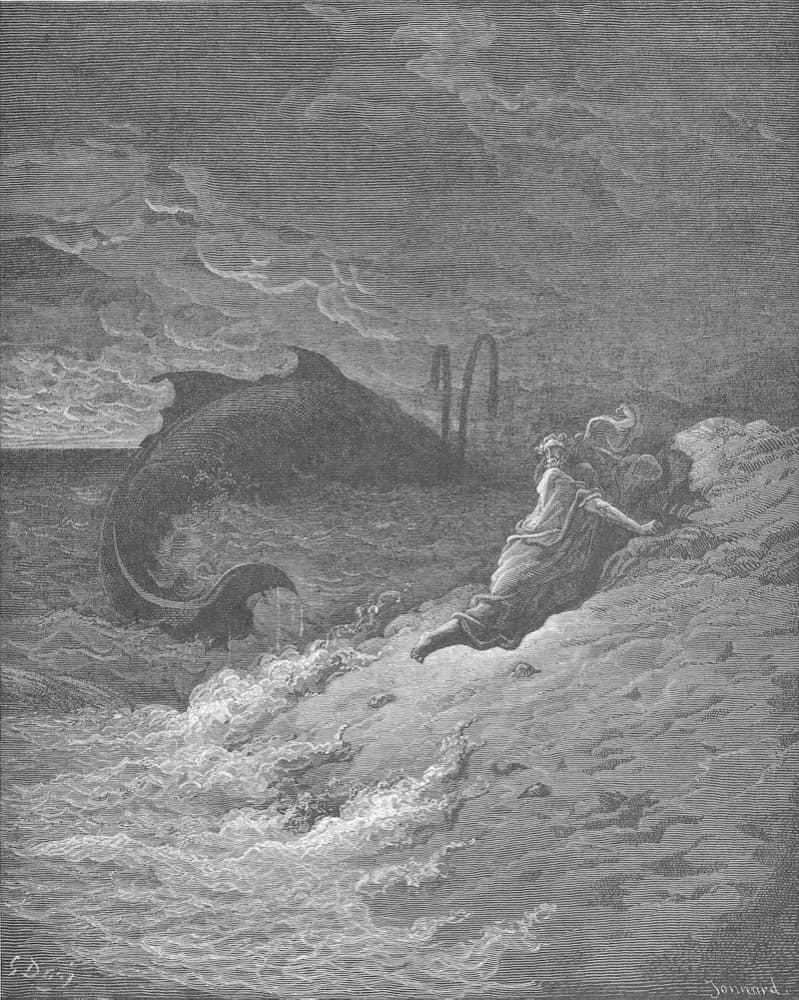
Jonah Is Spewed Forth by the Whale
God's standard interval between loss and return
The third day
Three days is not a round number in scripture; it is a specific interval with a specific function. Something is given up, an interval passes in the dark, and on the third day it comes back changed. Christ Himself names the pattern and points at Jonah as its type — which is the canon's own permission to read the rest of it this way.
28 min11 appearances
The pattern, in one sentence
When scripture marks three days, something has been surrendered as lost, an interval of darkness or silence follows, and on the third day it is restored in a form better than the one that went in.
What counts as an instance
Stated before the evidence, so that the evidence is able to fail.
The text counts the days
Scripture is not usually interested in durations. Where it stops to say 'the third day' or 'three days and three nights', the number is doing work — and it is almost always in a passage about something lost and returned.
Something is genuinely given up
Not delayed. Isaac is dead to Abraham from the moment he sets out. Jonah is in the deep. Alma is unconscious. The interval only counts if the loss was real to the person inside it.
The interval is dark, silent or underground
A fish's belly, a tomb, three days without light in Egypt and in the land Bountiful, a young man's body lying as if dead. The middle of the pattern is always a place with nothing in it.
What comes back is not what went in
Isaac returns under a covenant. Jonah preaches to a city he had refused. Alma comes back born of God. The third day is not a reset; it is a change of state.
The appearances
11 in the canonThen on the third day Abraham lifted up his eyes, and saw the place afar off.
What recurs
A son given up as lost, three days, and a return.
What is new here
The earliest instance, and the one the New Testament names as a figure: Abraham 'received him in a figure' — Hebrews 11:19.
The three days are the point of the story that is easiest to skip. From the moment God speaks, Isaac is a dead man in his father's mind; the walk to Moriah is three days long, and Abraham has all of it to think. Hebrews 11:19 says Abraham accounted that God was able to raise him from the dead, 'from whence also he received him in a figure' — the Greek is parabolē, a likeness. The New Testament reads this as a resurrection type.
Where it lands
The interval, kept
Every earlier instance is a promise with a small guarantee attached: the third day has a record of returning what was lost. The resurrection is the instance that pays all of them at once, and it is the only one where nothing is given back — where what comes out is not restored to a former life but raised into one nothing had gone into before. 'Thus it is written, and thus it behoved Christ to suffer, and to rise from the dead the third day.' Written, He says. It had been written, in narrative, since Moriah.
Three days on the road to Moriah
The instance where the interval is a father's, not a son's.
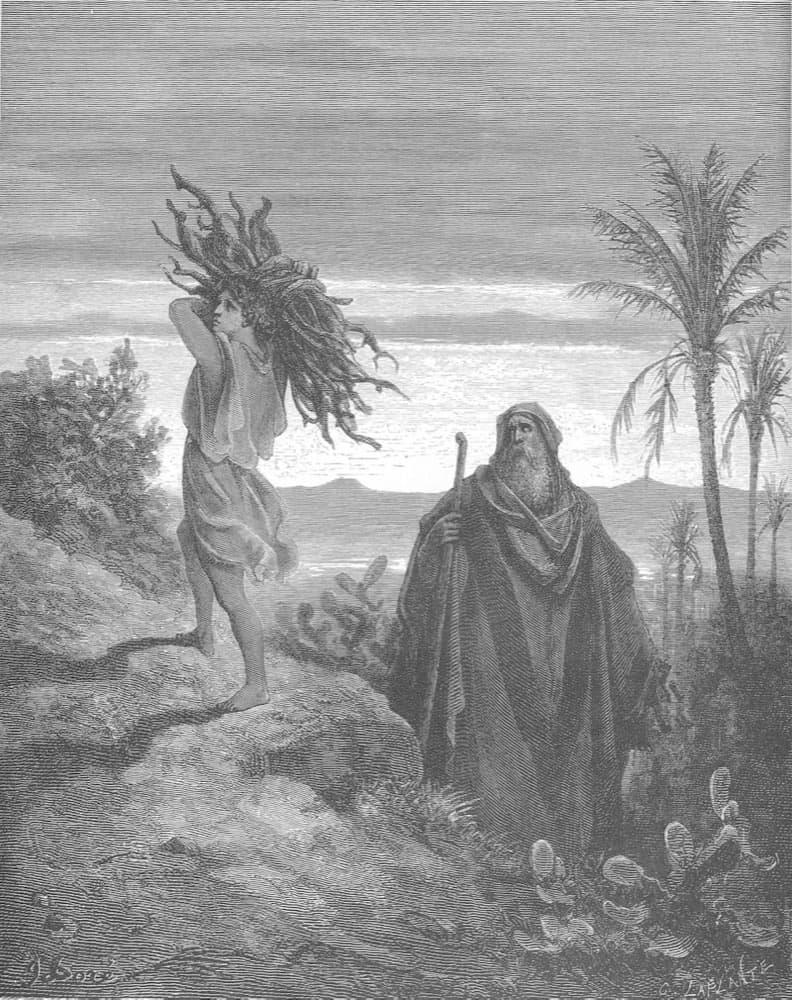
Abraham and Isaac on the third day.
Genesis 22 gives the interval one clause and no commentary: 'Then on the third day Abraham lifted up his eyes.' Everything the story is worth happens in the silence before that sentence. Three days is roughly fifty miles of walking with a boy who does not know, and time enough to change your mind a hundred times.
4Then on the third day Abraham lifted up his eyes, and saw the place afar off.
5And Abraham said unto his young men, Abide ye here with the ass; and I and the lad will go yonder and worship, and come again to you.
8And Abraham said, My son, God will provide himself a lamb for a burnt offering: so they went both of them together.
Verse 5 is the sentence to sit with. 'I and the lad will go yonder and worship, and come again to you.' He says both of them will come back. Hebrews 11:19 takes that at face value: Abraham had concluded that God could raise the dead, and was proceeding on it. The three days were where that conclusion was reached.
What happens in the middle
The interval itself, which is the part of the pattern nobody wants.
Every instance has a shape: loss, interval, return. Sermons live on the first and third. The pattern's actual teaching is in the second, and it is uniformly unpleasant. There is no scriptural instance in which the three days are comfortable, instructive at the time, or shortened for good behaviour.
| Who | Where the three days are spent | What it felt like |
|---|---|---|
| Abraham | Walking toward Moriah | Silence; the text records no conversation until verse 7 |
| Jonah | The belly of the fish | “Out of the belly of hell cried I” — Jonah 2:2 |
| Egypt | Darkness that could be felt | “They saw not one another… for three days” — Exodus 10:23 |
| Alma | Unconscious, racked with torment | “The pains of a damned soul” — Alma 36:16 |
| The Nephites | Vapour of darkness, no fire possible | Howling and weeping — 3 Nephi 8:23 |
| Mary and Joseph | Searching Jerusalem | “Thy father and I have sought thee sorrowing” — Luke 2:48 |
| Saul | Blind, fasting in a house on Straight Street | Three days without sight, meat or drink |
Notice what is not in that column: any indication that the person inside the interval knew how long it would be. Jonah did not know it was three days. Alma did not. The Nephites in the dark had been told a sign would come but not that it would end on a specific morning. The interval is only three days from the outside.
Principle
The pattern gives no promise that the interval will be brief, only that it is bounded — and the boundary is visible to God and not to the person inside it.
This is the pastoral content of the whole study, and it is the reason the pattern is worth teaching rather than merely admiring.
To consider
- 01Alma's three days were interior and invisible; his body simply lay there. What does that suggest about what other people can see of an interval you are in?
- 02In every instance the return comes without warning to the person waiting. Does that change how you would counsel someone in the middle of one?
Alma 36: the pattern used deliberately
A man who knew the formula and applied it to his own conversion.
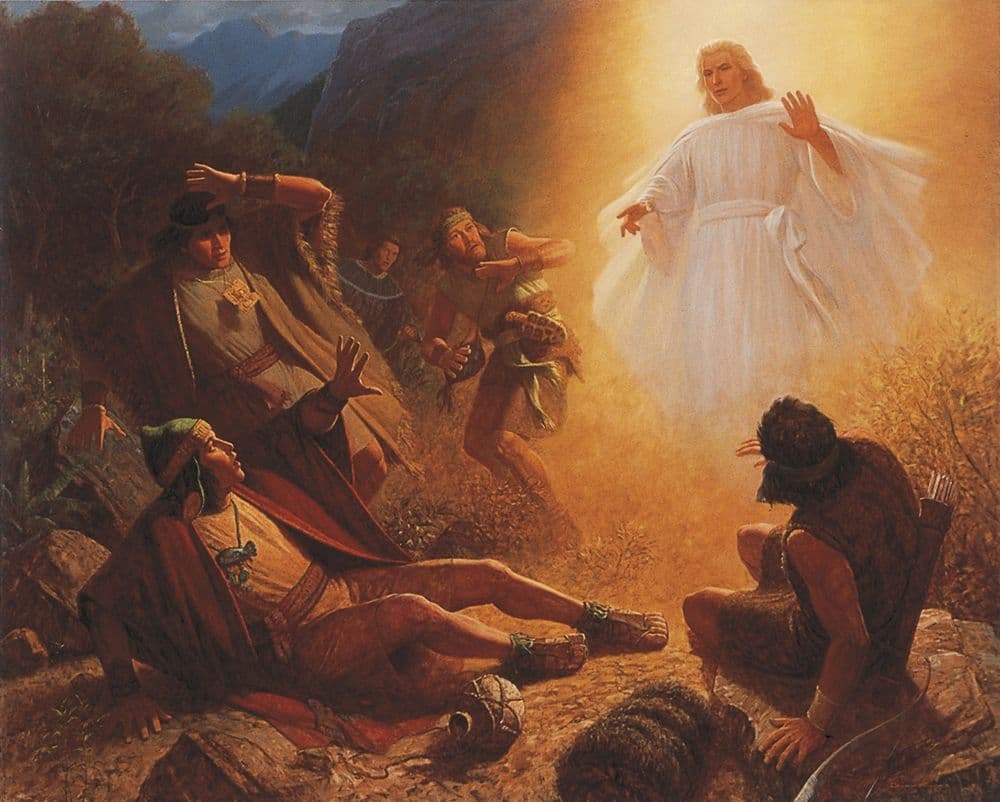
Alma the Younger, struck down. · Mosiah 27:8–37
Alma is not merely reporting a duration. He uses Jonah's exact phrase — 'three days and three nights' — in a chapter he has built as a chiasm, and the centre of that chiasm is the moment he calls on the name of Christ. The form and the interval are making the same claim: what happened to him was a death and a resurrection.
Alma 36 turns at the exact verse where he calls on Christ, and the relief arrives there.
16And now, for three days and for three nights was I racked, even with the pains of a damned soul.
18O Jesus, thou Son of God, have mercy on me, who am in the gall of bitterness, and am encircled about by the everlasting chains of death.
20And oh, what joy, and what marvelous light I did behold; yea, my soul was filled with joy as exceeding as was my pain!
Verse 20 contains the pattern's arithmetic in one line: the joy is 'as exceeding as was my pain'. Not greater by consolation, not smaller by residue — the same magnitude, inverted. That is what the third day does to what went into it.
Why three
An honest look at the question, including the parts we cannot answer.
Scripture never explains the number, and any study that pretends otherwise is inventing. What can be said is what the canon does with it, and there are three defensible observations.
- It is long enough to be real. Ancient Near Eastern thought did not treat a death as settled instantly; three days puts the loss past any possibility of mistake. The point of the interval is that nobody can call it a swoon.
- It is short enough to be an interval rather than an ending. Forty days is a period of trial and preparation in scripture; three days is a gap between two states of the same thing.
- It became a formula, and formulas can be quoted. Hosea uses it as a known idea seven centuries early; Christ quotes Jonah; Alma quotes the formula; Paul says 'according to the scriptures' as though everyone knew which ones. The number is part of how the promise was transmitted.
One closing observation. In every instance before the resurrection, the third day gives back what was lost. In the resurrection it does not: what comes out of the tomb is not what went in, and cannot die again. The pattern spends two thousand years teaching that God returns what is surrendered, and then, once, exceeds its own terms — which is the difference between a promise kept and a promise outgrown.
What the pattern holds
The third day is scripture's standing interval between a real loss and a restoration that improves on what was lost.
Christ authorised this reading Himself, and pointed at the interval rather than the story around it.
Asked for a sign, He offered Jonah's three days and nothing else.
Nobody inside the interval is told how long it is.
The three days are a fact about God's timing, not a promise delivered to the person waiting. That is precisely why the pattern is worth knowing in advance.
The same interval can be light or dark depending on who is standing in it.
Egypt was in darkness that could be felt while Israel had light in their dwellings, in the same three days.
The resurrection does not merely fulfil the pattern; it exceeds it. Everything else returned; He was raised.
What this will not carry
- Not every three in scripture belongs here. Three is a common number in any narrative literature, and a study that collects all of them collects noise.
- The arithmetic of Friday to Sunday is a real question with a good answer — inclusive reckoning — but no part of this pattern should be made to depend on the count of hours.
- Hosea 6:2 is not a dated prophecy of the resurrection. It is a statement about Israel that uses an interval its hearers already recognised, which is why it is evidence for the pattern rather than for a timetable.
- Luke 2:41–49 is included as a quiet foreshadow, not as a claim that Luke intended it. Treat it as the softest instance in the set.
Check your reading
4 questions01When asked for a sign, which Old Testament episode did Christ name?
02What does Hebrews say Abraham concluded on the road to Moriah?
03Which phrase does Alma use of his own conversion that Jonah's account also uses?
04During the three days of darkness in Egypt, what was true of Israel?
Where to go next
Sources
- “Jonah” — Bible Dictionary, churchofjesuschrist.org
- New Testament Student Manual — Church Educational System, on Matthew 12:38–42
- John W. Welch, “Chiasmus in the Book of Mormon” — BYU Studies 10, no. 1 (1969) — on the structure of Alma 36
- Jacob 4:5 — The Book of Mormon's own statement of the Isaac typology