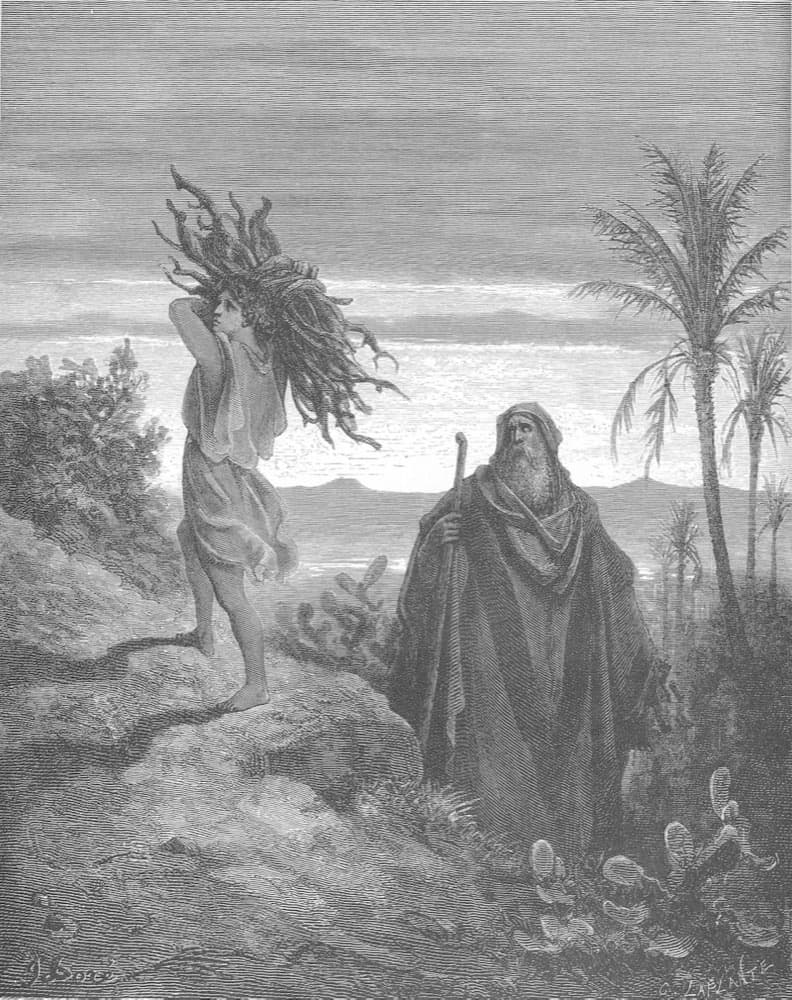
The Testing of Abraham's Faith
Old Testament
The Covenant That Holds the Canon Together
Abraham, and the promise made to him
Genesis 12; 15; 17; 22; Abraham 1–255 min5 sections
Land, seed, and blessing — three promises made to one childless man, renewed across four chapters, and still being carried out. Everything from Sinai to the modern gathering of Israel is a working-out of this covenant.
- Author
- Genesis, attributed to Moses; the Book of Abraham published by Joseph Smith in 1842
- Date
- Traditionally c. 2000–1800 BC for Abraham
- Place
- Ur of the Chaldees, Haran, Canaan, Egypt
- Language
- Biblical Hebrew
- Genre
- Patriarchal narrative with covenant ceremonies embedded in it
By the end you should be able to
- Name the three strands of the Abrahamic covenant and cite where each is given.
- Explain what the ceremony of Genesis 15 meant, and who walks between the pieces.
- State what Abraham 2:9–11 adds to the Genesis account.
- Describe how a person who is not descended from Abraham comes to be "accounted his seed."
Get thee out
Ur to Haran to Canaan, and down into Egypt during the famine — the arc of the fertile crescent, which is why the journey goes north before it goes west.
1Now the Lord had said unto Abram, Get thee out of thy country, and from thy kindred, and from thy father's house, unto a land that I will shew thee:
2And I will make of thee a great nation, and I will bless thee, and make thy name great; and thou shalt be a blessing:
3And I will bless them that bless thee, and curse him that curseth thee: and in thee shall all families of the earth be blessed.
Three things are asked and three are promised, and the last promise is the one that keeps the covenant from being tribal: in thee shall all families of the earth be blessed. From the first sentence, the election of one family is for the sake of everyone else.
| Strand | First given | Renewed | Worked out |
|---|---|---|---|
| Land | Genesis 12:7 | Genesis 15:18; 17:8 | Joshua; the return from exile; latter-day gathering places |
| Seed | Genesis 12:2; 15:5 | Genesis 17:6; 22:17 | Isaac, Jacob, the twelve tribes — and by adoption, the Church |
| Blessing and priesthood | Genesis 12:3 | Abraham 2:9–11 | The gospel carried to all nations; temple ordinances |
The Book of Abraham supplies the third strand explicitly, in language Genesis only implies. Abraham 2:9–11 promises that Abraham's seed will "bear this ministry and Priesthood unto all nations," and that as many as receive the gospel "shall be called after thy name, and shall be accounted thy seed." The blessing is portable, and it is transmitted by covenant as well as by descent.
Cutting a covenant
The strangest ceremony in Genesis, and the doctrine hidden inside it.
5And he brought him forth abroad, and said, Look now toward heaven, and tell the stars, if thou be able to number them: and he said unto him, So shall thy seed be.
6And he believed in the Lord; and he counted it to him for righteousness.
9And he said unto him, Take me an heifer of three years old, and a she goat of three years old, and a ram of three years old, and a turtledove, and a young pigeon.
10And he took unto him all these, and divided them in the midst, and laid each piece one against another...
17And it came to pass, that, when the sun went down, and it was dark, behold a smoking furnace, and a burning lamp that passed between those pieces.
18In the same day the Lord made a covenant with Abram...
Now notice who walks between the pieces. Abram does not. A smoking furnace and a burning lamp — God's own presence — pass through while Abram is in a deep sleep. In a ceremony whose entire meaning is "may this happen to me if I break faith," God takes the self-maledictory oath alone.
That is why the Abrahamic covenant can be called everlasting without qualification (Genesis 17:7). Its continuation does not depend on the reliability of the weaker party. Individual heirs can forfeit their blessings; the covenant itself does not lapse.
New names, and a sign
1And when Abram was ninety years old and nine, the Lord appeared to Abram, and said unto him, I am the Almighty God; walk before me, and be thou perfect.
5Neither shall thy name any more be called Abram, but thy name shall be Abraham; for a father of many nations have I made thee.
7And I will establish my covenant between me and thee and thy seed after thee in their generations for an everlasting covenant, to be a God unto thee, and to thy seed after thee.
15And God said unto Abraham, As for Sarai thy wife, thou shalt not call her name Sarai, but Sarah shall her name be.
The sign given here is circumcision (Genesis 17:10–14) — a mark in the flesh, on the organ of generation, in the covenant about posterity. Moroni 8:8 records the Lord declaring the law of circumcision done away in Christ, and the Restoration reads baptism as the covenant sign that replaces it (see also Acts 15; Galatians 5:6).
Moriah
The angel stays his hand. Jacob 4:5 says the whole scene was given as a similitude.
2And he said, Take now thy son, thine only son Isaac, whom thou lovest, and get thee into the land of Moriah; and offer him there for a burnt offering upon one of the mountains which I will tell thee of.
7...Behold the fire and the wood: but where is the lamb for a burnt offering?
8And Abraham said, My son, God will provide himself a lamb for a burnt offering: so they went both of them together.
12...for now I know that thou fearest God, seeing thou hast not withheld thy son, thine only son from me.
Jacob, in the Book of Mormon, gives the interpretation directly: the command to offer Isaac was "a similitude of God and his Only Begotten Son" (Jacob 4:5). The parallels are exact enough to be uncomfortable — an only son, a three-day journey, wood carried by the son up the hill, a father who does not withhold.
And one difference. On Moriah the knife is stopped and a ram is provided. On Calvary nothing intervened. Abraham's ordeal is a rehearsal that stops short of the thing it rehearses, which is the point of verse 8: "God will provide himself a lamb."
How the covenant reaches us
9And I will make of thee a great nation, and I will bless thee above measure, and make thy name great among all nations, and thou shalt be a blessing unto thy seed after thee, that in their hands they shall bear this ministry and Priesthood unto all nations;
10And I will bless them through thy name; for as many as receive this Gospel shall be called after thy name, and shall be accounted thy seed, and shall rise up and bless thee, as their father;
11...and in thee (that is, in thy Priesthood) and in thy seed (that is, thy Priesthood)... shall all the families of the earth be blessed, even with the blessings of the Gospel, which are the blessings of salvation, even of life eternal.
Verse 10 is the mechanism. Those who receive the gospel are accounted Abraham's seed — the New Testament's language of adoption (Galatians 3:29; Romans 8:15–17) stated as covenant law. Latter-day Saints take this literally enough that patriarchal blessings declare lineage, and understand it broadly enough that lineage declared by adoption carries every blessing that lineage by descent does.
The gathering of Israel in the last days is the same covenant still running. D&C 110:12 records Elias committing "the dispensation of the gospel of Abraham" in the Kirtland Temple, and President Russell M. Nelson has repeatedly described the gathering of scattered Israel as the greatest work on earth today — missionary work, temple work and family history all being parts of one gathering.
What this lesson holds
The Abrahamic covenant promises land, posterity, and a blessing to all nations — and the third is the reason for the first two.
God bound Himself to the covenant unilaterally.
Those who receive the gospel are accounted the seed of Abraham, whether by descent or by adoption.
The offering of Isaac was given as a similitude of the Father and the Son.
Check your reading
5 questions01What are the three strands of the Abrahamic covenant?
02In Genesis 15, who passes between the divided animals?
03The Hebrew idiom for making a covenant is —
04How does Abraham 2:10 say the covenant reaches those not descended from Abraham?
05What does the Book of Mormon say the command to offer Isaac was?
Where to go next
Sources
- Genesis 12; 15; 17; 22; Abraham 1–2 — The primary texts.
- Bible Dictionary, "Abraham, Covenant of"
- Russell M. Nelson, "The Gathering of Scattered Israel" — General Conference, October 2006
- Gospel Topics Essay, "Translation and Historicity of the Book of Abraham" — For the historical questions surrounding the Book of Abraham papyri