Topics / Covenants and Ordinances
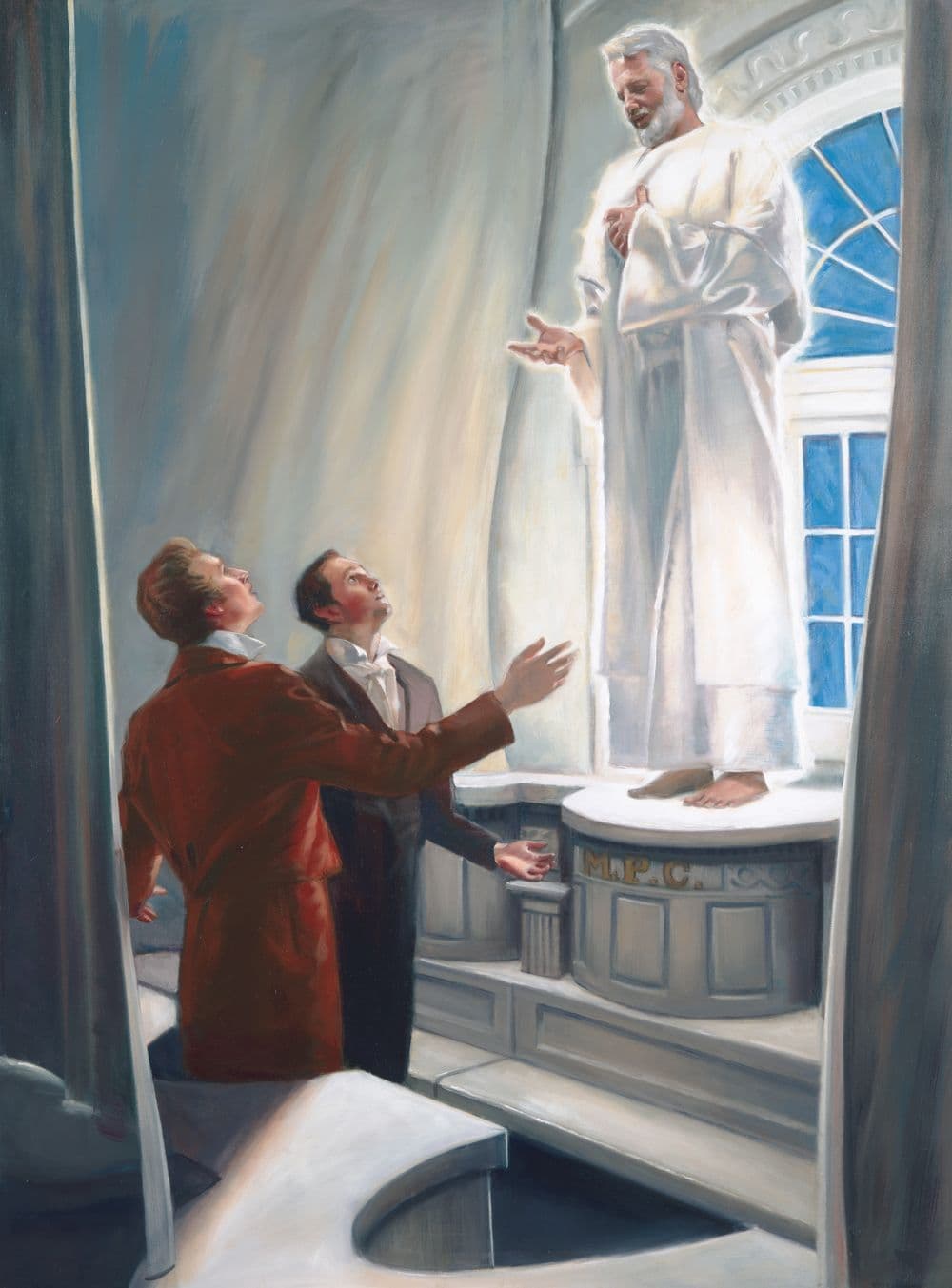
Elijah Appearing in the Kirtland Temple · Mal. 4:5–6
Why the Church builds them, and what happens inside
Temples
A temple is not a bigger chapel. It is a building for ordinances that cannot be performed anywhere else, and its floor plan is the plan of salvation rendered in architecture — which is why the doctrine is public even though the ceremony is not.
22 min2 sections
Why a building
A sequence of thresholds: court, holy place, holy of holies — each entered by fewer people, through more preparation. The veil is the last of them.
20Therefore, in the ordinances thereof, the power of godliness is manifest.
21And without the ordinances thereof, and the authority of the priesthood, the power of godliness is not manifest unto men in the flesh;
22For without this no man can see the face of God, even the Father, and live.
The claim is not that temples are inspiring places but that certain things can only happen in them. D&C 124:25–41 commands the Nauvoo Temple and states that baptisms for the dead belong in a house built to the Lord's name — a restriction the Lord imposes and then explains.
| Ordinance | For | Points to |
|---|---|---|
| Baptism and confirmation for the dead | The dead, by proxy | 1 Corinthians 15:29; D&C 128 |
| Initiatory ordinances | The living, and by proxy the dead | Exodus 29:4–7; Psalm 133:2 |
| The endowment | Instruction and covenant | D&C 105:11–12; D&C 110:9 |
| Marriage sealing | Husband and wife, for eternity | D&C 132:19; Matthew 16:19 |
| Sealing of children to parents | Families across generations | Malachi 4:5–6; D&C 2 |
Sacred, not secret
12That all people who shall enter upon the threshold of the Lord's house may feel thy power, and feel constrained to acknowledge that thou hast sanctified it, and that it is thy house, a place of thy holiness.
13And do thou grant, Holy Father, that all those who shall worship in this house may be taught words of wisdom out of the best books, and that they may seek learning even by study and also by faith, as thou hast said.
The dedicatory prayer of the Kirtland Temple, which D&C 109:2 says was given by revelation.
Principle
The temple exists so that ordinances requiring priesthood authority and a consecrated place can be performed for the living and for the dead.
What this topic holds
Certain ordinances may be performed only in a house built and dedicated to the Lord.
Temple work for the dead is an offer that the dead may accept or refuse, because agency survives death.
Check your reading
3 questions01What does D&C 84:20 say is manifest in the ordinances?
02Why does the Church say the temple ceremony is 'sacred, not secret'?
03What did the Lord say must be done in a house built to His name?
Where to go next
Sources
- Gospel Topics, "Temples"
- Gospel Topics, "Temple Endowment"
- D&C 109; D&C 124; D&C 128 — The primary texts.