Patterns / Covenant sign
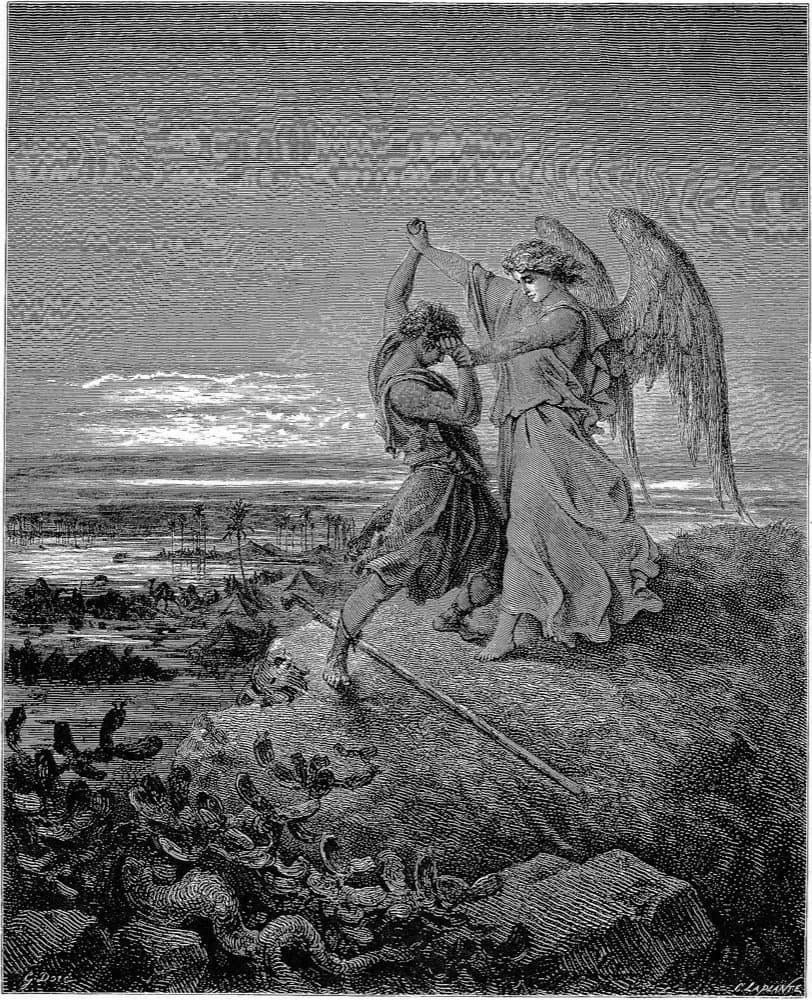
Jacob Wrestles with the Angel
What God calls you after the covenant
The new name
God renames people at the exact moment He covenants with them, and the new name is never a description of who they are — it is a statement of what they are being made into. Abram becomes a father of nations before he has a son. Jacob becomes Israel while limping. The pattern runs from Genesis to Revelation and ends with a name written on a white stone that nobody else knows.
27 min9 appearances
The pattern, in one sentence
At the point of covenant God gives a new name that describes a future rather than a present, the name is written rather than merely spoken, and living up to it is the covenant's whole content.
What counts as an instance
Stated before the evidence, so that the evidence is able to fail.
The name changes at the covenant, not before it
Abram is renamed in the chapter where circumcision is instituted. Jacob is renamed at the ford after the wrestle. Mosiah 5 gives the name after the people have covenanted. The timing is the same every time and it is not incidental.
The name describes what is not yet true
Abraham means father of a multitude and he is ninety-nine with one son by a servant. Peter means rock and he will deny Christ three times. The name is prophetic, and living into it is the assignment.
It is written down
In a book, on a stone, in the heart, on a pillar of the temple. Scripture is consistently interested in the new name being recorded somewhere rather than only pronounced.
It replaces an identity that had been earned
Jacob means supplanter and he had earned it twice over. Saul was named for a king of his own tribe. The old name is usually accurate — which is what makes the exchange significant.
The appearances
9 in the canonNeither shall thy name any more be called Abram, but thy name shall be Abraham; for a father of many nations have I made thee.
What recurs
The covenant is established, and the name changes in the same breath.
What is new here
Both husband and wife are renamed, and both new names describe a posterity neither of them has.
The tense in verse 5 is the striking part: not 'I will make thee' but 'a father of many nations have I made thee' — said to a man of ninety-nine whose only son is Ishmael. God names the outcome and then spends twenty-five years and a miracle producing it. Abraham 1:2 shows what he had wanted; the name is the answer.
Where it lands
Called by a name that has to be kept
Benjamin's people receive the name and are immediately told the terms: remember to retain it written always in their hearts, so that they are not found on the left hand of God but hear and know the voice by which they will be called. The pattern's end is not the giving of the name. It is the keeping of it — and the sacrament prayer, which asks weekly that we may be willing to take upon us the name of the Son, exists because the name has to be taken up again and again rather than acquired once.
Names that are not descriptions
The pattern's central feature, and the thing that makes it more than an ancient custom.
Renaming at a change of status was not unusual in the ancient world; kings did it to vassals, and Pharaoh does it to Joseph in Genesis 41:45. What distinguishes the biblical instances is the direction the names point. They do not summarise the person's history. They announce a future that has not begun.
| Old name | New name | Situation at the time |
|---|---|---|
| Abram — exalted father | Abraham — father of a multitude | Ninety-nine years old, no son by Sarah |
| Sarai | Sarah — princess | Ninety, and had laughed at the promise |
| Jacob — supplanter | Israel — he prevails with God | Limping, and about to meet the brother he cheated |
| Simon | Cephas / Peter — rock | A fisherman on his first day, three years from the denial |
| “The people of King Benjamin” | The children of Christ | Having just fallen to the earth in view of their own nothingness |
Every row is a gap between the name and the facts. That gap is not a flaw in the pattern; it is the pattern. The new name is the shape of a promise, and the covenant is the agreement to grow into it.
Principle
God names people for what He intends to make of them, and then holds to the name while the person catches up.
The ford of Jabbok
The instance where the exchange is hardest, and the details are exact.
Jacob wrestles until the breaking of the day.
26And he said, Let me go, for the day breaketh. And he said, I will not let thee go, except thou bless me.
27And he said unto him, What is thy name? And he said, Jacob.
28And he said, Thy name shall be called no more Jacob, but Israel: for as a prince hast thou power with God and with men, and hast prevailed.
30And Jacob called the name of the place Peniel: for I have seen God face to face, and my life is preserved.
Verse 27 is one of the most pointed questions in the Old Testament. Jacob is asked his name — by someone who plainly knows it — and the last time Jacob was asked that question, by his blind father in Genesis 27:19, he answered 'I am Esau thy firstborn'. He lied his way into a blessing once. Here he is asked again, at night, holding on, and he says: Jacob. Supplanter. The truth.
The blessing follows immediately. The confession of the old name is the condition of receiving the new one, and there is no version of this scene in which he keeps both.
To consider
- 01Jacob had to say his real name out loud before he was given a different one. What is the modern form of that?
- 02He left the encounter limping and blessed at the same time. Does the pattern anywhere separate the two?
Mosiah 5: the name explained
The one place in scripture where the doctrine is set out rather than narrated.
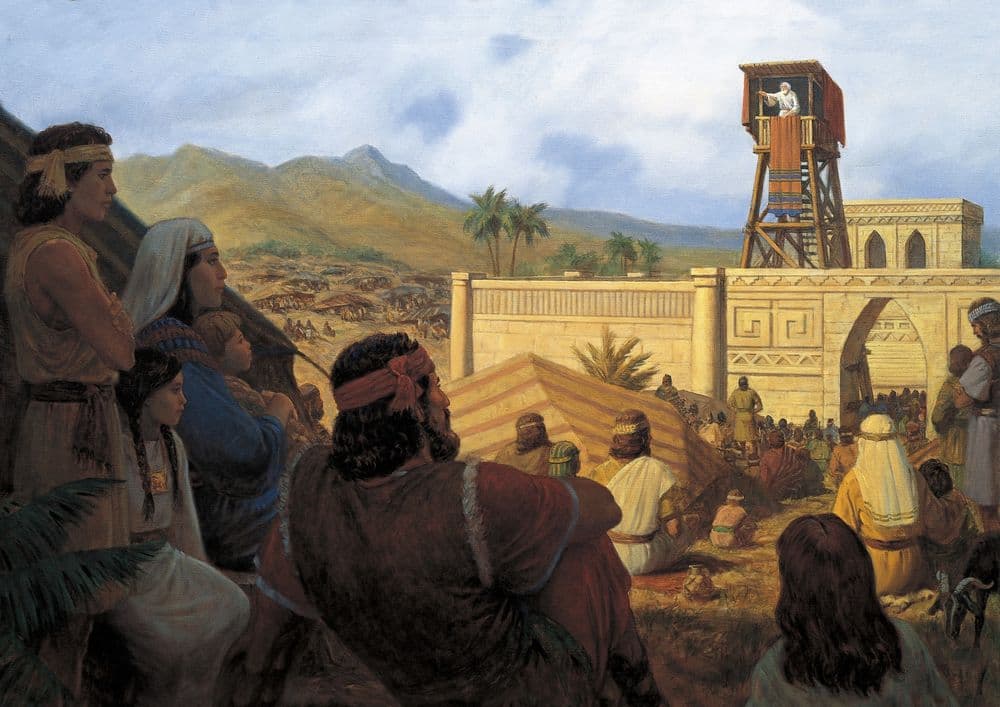
Benjamin addresses his people from the tower. · Mosiah 1:9–11, 18
7And now, because of the covenant which ye have made ye shall be called the children of Christ, his sons, and his daughters; for behold, this day he hath spiritually begotten you…
8…there is no other name given whereby salvation cometh; therefore, I would that ye should take upon you the name of Christ, all you that have entered into the covenant with God…
11…I would that ye should remember to retain the name written always in your hearts, that ye are not found on the left hand of God…
12I say unto you, I would that ye should remember to retain the name written in your hearts, that ye hear and know the voice by which ye shall be called…
Four things are stated here that the narrative instances only imply. The name follows the covenant. The name is a family relation, not a title. The name is written, and written in the heart rather than on a document. And the purpose given in verse 12 is recognition: so that you will know the voice when it uses your name.
That last clause reframes the whole pattern. The new name is not primarily so that God can identify you. It is so that you can identify Him.
Principle
The new name is retained by remembering it and lost by transgression — which makes it a relationship rather than a possession.
Taken up weekly
Why the sacrament prayer says willing rather than able.
3…that they are willing to take upon them the name of thy Son, and always remember him, and keep his commandments which he hath given them; that they may always have his Spirit to be with them.
The prayer is precise. It does not say the congregation has taken the name, or is worthy of it, or will keep it. It says willing — and it says so every week, which is an admission built into the ordinance that the name needs picking up again.
The weekly return through the sacrament, marked on the path.
Where the name shows up in the ordinances
- 3 Nephi 27:5–9The Church itself must be called by His name, and Christ gives the reason: whatever you call a thing determines whose it is.
- Moroni 4:3; 5:2The sacrament prayers — willing to take upon them the name, and always remember him.
- D&C 20:37Baptism, with the name taken on as part of the qualification for it.
- D&C 130:10–11The white stone and the new name, identified as a key word.
- Revelation 3:12Three names written on the overcomer, who is made a pillar in the temple.
And a closing thought about the private name in Revelation 2:17 — known only to the one who receives it. Every other name in this pattern is public: Abraham is called Abraham by everybody, Israel names a nation. The last one is not. Whatever else the sequence is doing, it ends with something said between two parties and nobody else, which is where covenants have always actually lived.
What the pattern holds
A new name in scripture is given at the covenant and describes a future rather than a present.
Confessing the old name accurately is part of receiving the new one.
Jacob is asked his name and answers honestly, having once obtained a blessing by answering dishonestly.
The name is retained by remembering and forfeited by transgression, which makes it a live relationship rather than a permanent title.
The purpose of the name, stated by Benjamin, is that you will recognise the voice that uses it.
What this will not carry
- Renaming at a change of status was ordinary ancient practice, and not every name change in scripture belongs to this pattern — Pharaoh renames Joseph and Nebuchadnezzar renames Daniel, and neither is a covenant act by God.
- The temple's new name is sacred and not discussed publicly, and this study deliberately does not. Everything here is from published scripture.
- Saul and Paul is the weakest instance in the set — both names were likely his from birth. It is included for the shape rather than as evidence.
- Reading Peter's name as a claim about church authority in Matthew 16:18 is a separate argument with its own literature. This study is about the naming, not the rock.
Check your reading
4 questions01What question is Jacob asked immediately before he is renamed Israel?
02How old was Abram when God renamed him “father of a multitude”?
03Why does King Benjamin say the name should be retained written in their hearts?
04What does D&C 130:11 say the new name on the white stone is?
Where to go next
Sources
- “Name” — Guide to the Scriptures, churchofjesuschrist.org
- Mosiah 5 — Book of Mormon Student Manual, Church Educational System
- Doctrine and Covenants 130:10–11 — Joseph Smith on the white stone of Revelation 2:17