Patterns / Recurring symbol
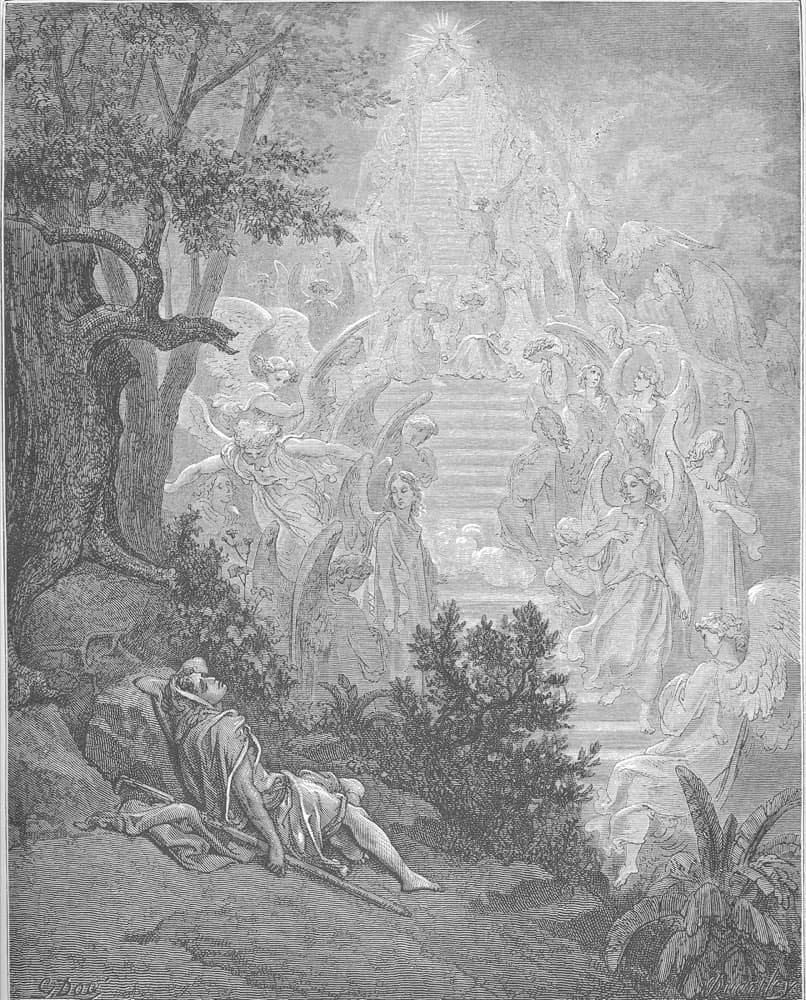
Jacob's Dream
God builds with what the builders threw away
The stone
Stone is the least promising substance in scripture. It is what hard hearts are made of, what the law was written on, what people are killed with. And it is what God keeps choosing: a pillow becomes a house of God, a struck rock gives water, sixteen dark stones give light, a rejected block becomes the cornerstone, and a stone cut without hands fills the earth.
29 min10 appearances
The pattern, in one sentence
God repeatedly takes stone — inert, useless, or actively rejected — and makes it the foundation, the light, the witness or the head of the corner, and the point of the reversal is always that the choice was not the obvious one.
What counts as an instance
Stated before the evidence, so that the evidence is able to fail.
The stone starts out worthless
A pillow, a rock in a desert, a block the builders discarded, sixteen dark lumps molten out of a mountain. In every instance the material is unremarkable before God touches it.
It is chosen rather than shaped
Daniel's stone is cut out without hands. The altar law in Exodus 20:25 forbids a tool on the stones. God's preference runs against improvement.
It ends up structural or illuminating
A foundation, a cornerstone, a temple pillar, a source of water or light. The stone always ends up carrying something or showing something.
Somebody rejects it first
The builders refuse it, Israel murmurs at it, the Jews stumble on it. Rejection is not incidental to the pattern; Psalm 118 and Jacob 4 both treat it as the mechanism.
The appearances
10 in the canonAnd Jacob rose up early in the morning, and took the stone that he had put for his pillows, and set it up for a pillar… And this stone, which I have set for a pillar, shall be God's house.
What recurs
An ordinary stone becomes the marker of a holy place.
What is new here
The stone is a pillow first. He sleeps on it, sees a ladder to heaven with angels on it, and stands the same rock upright in the morning.
Bethel means house of God, and Jacob names it after saying the stone itself shall be God's house. The first temple in the patriarchal narratives is one rock stood on its end and anointed with oil, which tells you what a temple is minimally made of.
Where it lands
A dark stone made to shine
Of all the stones in scripture, the sixteen on Mount Shelem are the ones that carry the pattern furthest. They are cut from a mountain, transparent but dark, and useless for the purpose they were brought for — until they are touched. Two of them become the interpreters, and D&C 17:1 says those same stones were given to Joseph Smith to translate by. A rock that could not make its own light became the instrument by which a nineteenth-century farm boy read a four-thousand-year-old record about it. That is the pattern's own account of itself.
The reversal, stated plainly
Why stone is the least likely material and therefore the chosen one.
Scripture's ordinary uses of stone are negative. A hard heart is a stony heart. Idols are stone. Execution is by stone. The law that condemns is cut in stone. Stone in the Bible is what will not yield, will not grow, and will not give.
What stone usually means
“I will take away the stony heart out of your flesh.” — Ezekiel 36:26
Gods of “wood and stone” — Deuteronomy 4:28
“They took up stones to cast at him.” — John 8:59
The law, graven in stone — 2 Corinthians 3:7
What God does with it
A pillow becomes God's house — Genesis 28:22
A struck rock gives water — Exodus 17:6
Dark stones give light — Ether 3:6
A rejected block becomes the corner — Psalm 118:22
The two columns are the study. Read the left and stone is the emblem of everything unresponsive; read the right and it is the foundation, the light, and the head of the corner. The pattern is not that stone is a good symbol. It is that God prefers to work with what has nothing going for it.
Principle
God's chosen material is consistently the one that has been discarded, and the rejection is part of how it becomes structural.
Without hands
A small phrase in Exodus and Daniel that turns out to be a rule.
25And if thou wilt make me an altar of stone, thou shalt not build it of hewn stone: for if thou lift up thy tool upon it, thou hast polluted it.
The instruction is counterintuitive. Dressed stone is better stone by every construction standard available in 1400 BC, and the temple Solomon later builds is made of it. But the altar — the place of sacrifice specifically — is to be undressed, and the reason given is that a tool pollutes it. 1 Kings 6:7 preserves a related scruple: the temple stones were prepared at the quarry so that no tool was heard in the house while it was in building.
34Thou sawest till that a stone was cut out without hands, which smote the image upon his feet that were of iron and clay, and brake them to pieces.
44And in the days of these kings shall the God of heaven set up a kingdom, which shall never be destroyed… and it shall stand for ever.
'Without hands' is the same principle in prophecy. The kingdom in Daniel's dream is not built; it is cut out, and it moves on its own. Every other object in the vision is manufactured — an image of gold, silver, brass, iron and clay, each material the pride of a civilisation. The one thing nobody made is the one thing left standing.
Helaman 5:12, read carefully
The verse everyone memorises, and the clause everyone skips.
12And now, my sons, remember, remember that it is upon the rock of our Redeemer, who is Christ, the Son of God, that ye must build your foundation; that when the devil shall send forth his mighty winds, yea, his shafts in the whirlwind, yea, when all his hail and his mighty storm shall beat upon you, it shall have no power over you to drag you down to the gulf of misery and endless wo, because of the rock upon which ye are built, which is a sure foundation, a foundation whereon if men build they cannot fall.
Count the weather. Mighty winds, shafts in the whirlwind, hail, mighty storm — four escalating clauses, and every one of them arrives. Helaman does not promise his sons a smaller storm or an exemption from it. He promises that it will have no power to drag them down, which is a claim about direction rather than about force.
The context makes it sharper. Helaman is naming his sons Nephi and Lehi after their first ancestors so that they will remember, and within a few chapters both of them are in a Lamanite prison encircled by fire. The verse was written by a father who could see what was coming.
To consider
- 01Helaman's promise concedes the storm entirely. Does the way you usually hear this verse quoted keep that concession?
- 02Matthew 7:24–27 has both houses face the same rain, floods and winds. What does the parable say the difference is, and what does it not say?
Stones that give light
The pattern's strangest branch, from Mount Shelem to Palmyra.
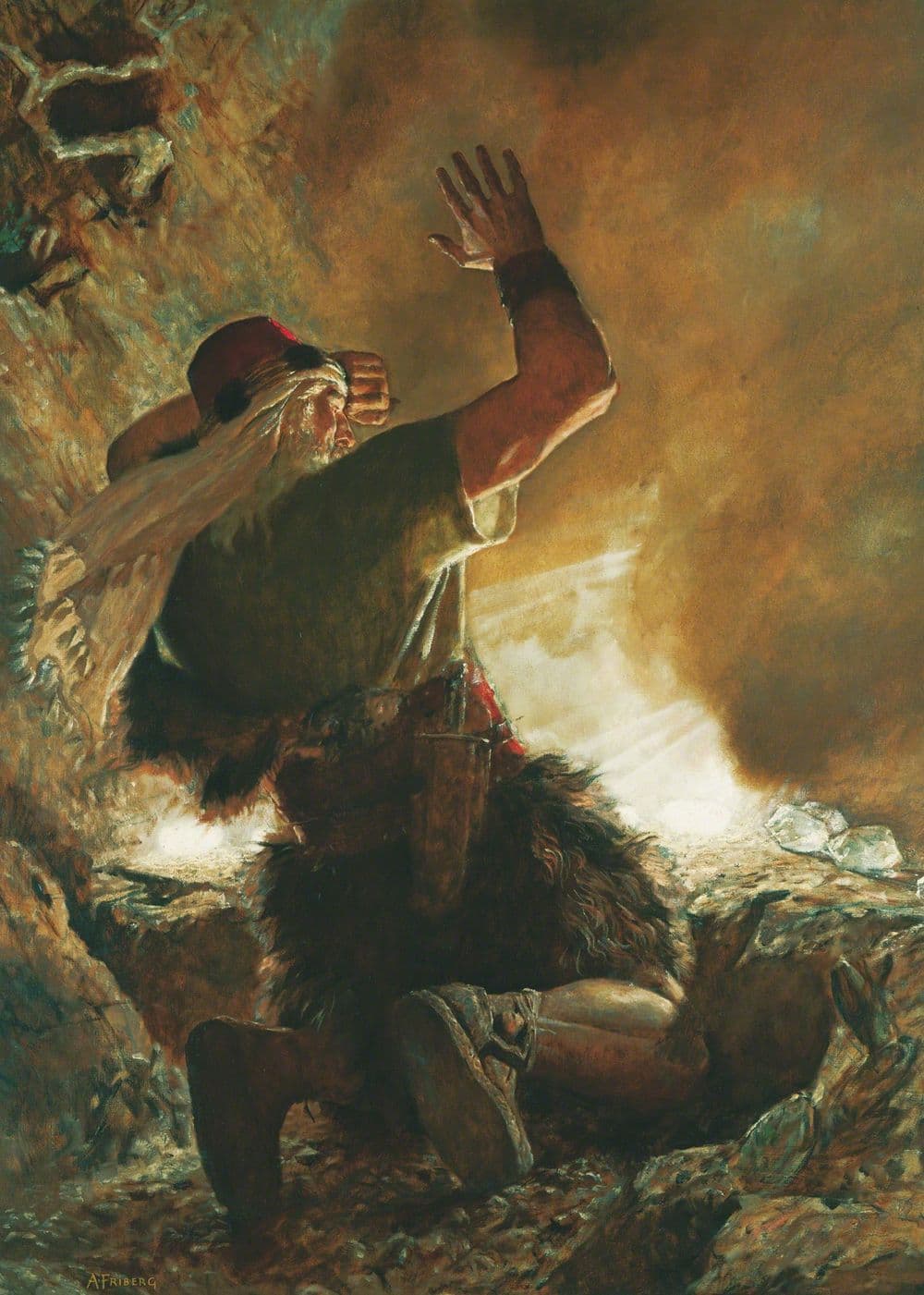
The sixteen stones, touched one by one. · Ether 3:1–16
The brother of Jared solves an engineering problem the wrong way round. Told that fire is impossible and windows will shatter, he does not ask for a different vessel; he molts sixteen stones out of a rock, carries them up a mountain, and asks God to touch them so they will shine. Rock does not shine. That is the whole point of the request.
4…touch these stones, O Lord, with thy finger, and prepare them that they may shine forth in darkness; and they shall shine forth unto us in the vessels which we have prepared, that we may have light while we shall cross the sea.
And then two of those stones do a second job. Ether 3:23–24 has the Lord give him two stones and tell him to seal them up with the record, 'for behold, the language which ye shall write I have confounded' — and D&C 17:1 identifies them as the ones given to Joseph Smith. The stone that could not make its own light became the instrument for reading a record written in a language nobody else could.
The luminous stones, gathered
- Ether 3:1–6Sixteen stones, transparent but dark, touched one by one.
- Ether 3:23–28Two of them sealed up with the record as interpreters.
- Exodus 28:30The Urim and Thummim in the breastplate of judgement, on Aaron's heart.
- D&C 17:1The three witnesses promised a view of the same stones, named as those given to the brother of Jared.
- D&C 130:10–11A white stone given to each who enters the celestial kingdom, and a new name on it.
Put the branch together and it makes a single claim, repeated in four dispensations. A stone has no light of its own and never acquires any. It is touched, and it shines for as long as that lasts, and everyone who looks at it sees by a light that was never in the rock. It is difficult to think of a more exact figure for what a person is supposed to be.
What the pattern holds
God builds with rejected material, and the rejection is part of the mechanism rather than an obstacle to it.
What God chooses is not to be improved by human tooling — the altar unhewn, the kingdom cut out without hands.
The sure foundation is a promise about direction under load, not about the absence of load.
Helaman lists four kinds of storm and concedes every one of them before making his claim.
A stone shines only while it is touched, and the light is never its own — which is the pattern's figure for a disciple.
What this will not carry
- Stone is common in scripture and much of it is ordinary masonry. The markers here — worthless first, chosen unshaped, structural or luminous after, rejected by someone — are what keep the study from swallowing every wall in the Old Testament.
- Numbers 20:8–12 as a typological failure, where Moses struck a rock that should only be struck once, is a widely taught reading and a plausible one. The text gives the offence as failing to sanctify God before the people, and does not itself make the typological argument.
- The identification of Daniel's stone with the restored Church comes from D&C 65:2, a revelation, rather than from Daniel. Teaching it as the plain meaning of Daniel 2 overstates the case.
- Matthew 16:18 — “upon this rock I will build my church” — is a contested passage with a long history of argument. It is deliberately left out of this study, which is about the material and not about the keys.
Check your reading
4 questions01In Daniel 2, what detail is given about how the stone was formed?
02What did the brother of Jared ask God to do with the sixteen stones?
03According to Exodus 20:25, what pollutes an altar of stone?
04What does Helaman 5:12 promise about the devil's storms?
Where to go next
Sources
- “Rock”, “Cornerstone” — Guide to the Scriptures, churchofjesuschrist.org
- “Urim and Thummim” — Bible Dictionary, churchofjesuschrist.org
- “Book of Mormon Translation” — Gospel Topics Essays, on the interpreters and seer stones
- Doctrine and Covenants 65 — The stone of Daniel 2, applied by revelation