Library / Foundations of the Restoration
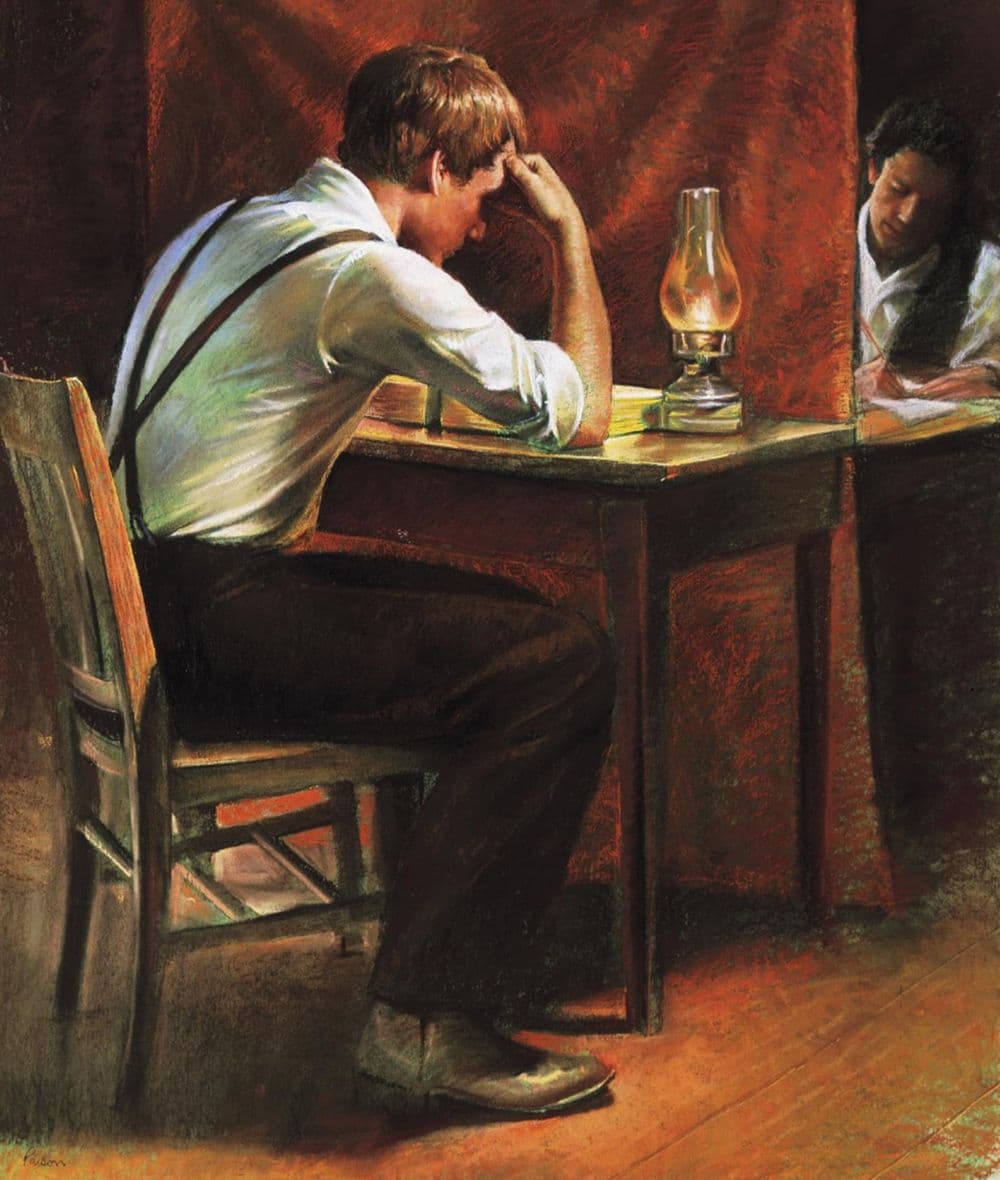
Joseph Smith Translating the Book of Mormon · JS—H 1:34–35, 71
Book of Mormon
The Coming Forth of the Book of Mormon
How it was produced, who saw it, and what the honest questions are
Title Page of the Book of Mormon; 2 Nephi 27; D&C 3; D&C 17; Ether 5:2–450 min4 sections
Sixty-five working days, a young man with three years of formal schooling, eleven witnesses who had every reason to recant and did not, and a set of questions about the translation process that the Church now answers publicly. This lesson covers all of it, including the parts that are uncomfortable.
- Author
- Joseph Smith, with Oliver Cowdery, Martin Harris and Emma Smith as principal scribes
- Date
- 1827–1830; the bulk of the translation between 7 April and late June 1829
- Place
- Harmony, Pennsylvania, and the Whitmer farm in Fayette, New York
- Audience
- Everyone since, per the title page: Jew and Gentile
- Genre
- Documentary history
By the end you should be able to
- Describe the translation process as the primary sources actually describe it.
- Explain what happened to the 116 pages and what D&C 3 and D&C 10 say about it.
- Distinguish the Three Witnesses from the Eight, and say what each group testified to.
- State the strongest objections fairly, and say what can and cannot be established historically.
How it was actually produced
The sources are more specific, and stranger, than the illustrations.
Which record each part of the Book of Mormon comes from, where Mormon's abridgement begins, and what the 116 pages would have contained.
The familiar painting shows Joseph Smith at a table with the plates open in front of him, tracing characters with a finger. No participant describes it that way. What the eyewitnesses describe is a seer stone placed in a hat, Joseph's face in the hat to block the light, and the plates sometimes not in the room at all — covered on the table, or in the woods.
| Instrument | What it was | Where it is described |
|---|---|---|
| The interpreters | Two stones in silver bows, found with the plates; the term 'Urim and Thummim' was applied to them later, by W. W. Phelps and others. | Joseph Smith—History 1:35; Mosiah 8:13; Ether 3:23–24 |
| The seer stone | A brown stone Joseph had found years earlier and used before the translation began. Most of the extant text was dictated using it, according to Emma Smith, David Whitmer and others. | Gospel Topics essay 'Book of Mormon Translation'; the stone itself was photographed and published by the Church in 2015 |
| The plates | Present during the work but frequently covered, and not consulted the way one consults an open book. | Emma Smith's 1879 interview in the Saints' Herald; David Whitmer's accounts |
7Behold, you have not understood; you have supposed that I would give it unto you, when you took no thought save it was to ask me.
8But, behold, I say unto you, that you must study it out in your mind; then you must ask me if it be right, and if it is right I will cause that your bosom shall burn within you; therefore, you shall feel that it is right.
9But if it be not right you shall have no such feelings, but you shall have a stupor of thought that shall cause you to forget the thing which is wrong.
Given to Oliver Cowdery after his own attempt at translating failed — which tells you the process required something of the translator.
The pace is the detail hardest to explain on any theory. Oliver Cowdery arrived on 5 April 1829 and began scribing on the 7th; the manuscript was finished by the end of June. That is roughly sixty-five working days for about 270,000 words — some 4,000 words a day, dictated once, with no notes, no outline and essentially no revision to the original manuscript.
The 116 pages
The first crisis, and the revelation that came out of it.
In summer 1828 Martin Harris, who had mortgaged his farm to fund the printing and whose wife was understandably sceptical, asked three times to borrow the manuscript to show his family. Twice the answer was no. The third time it was yes, on strict conditions. The pages were lost, and have never been found.
1The works, and the designs, and the purposes of God cannot be frustrated, neither can they come to naught.
3Remember, remember that it is not the work of God that is frustrated, but the work of men;
4For although a man may have many revelations, and have power to do many mighty works, yet if he boasts in his own strength, and sets at naught the counsels of God, and follows after the dictates of his own will and carnal desires, he must fall and incur the vengeance of a just God upon him.
6And behold, how oft you have transgressed the commandments and the laws of God, and have gone on in the persuasions of men.
7For, behold, you should not have feared man more than God.
This is the first revelation printed in the Doctrine and Covenants after the preface, and it is a rebuke of the prophet. That is worth pausing on: the Church canonised the document in which its founder is told he feared man more than God, and preserved it in the front of the book.
Eleven men
Two groups, two kinds of experience, and one fact about all of them.
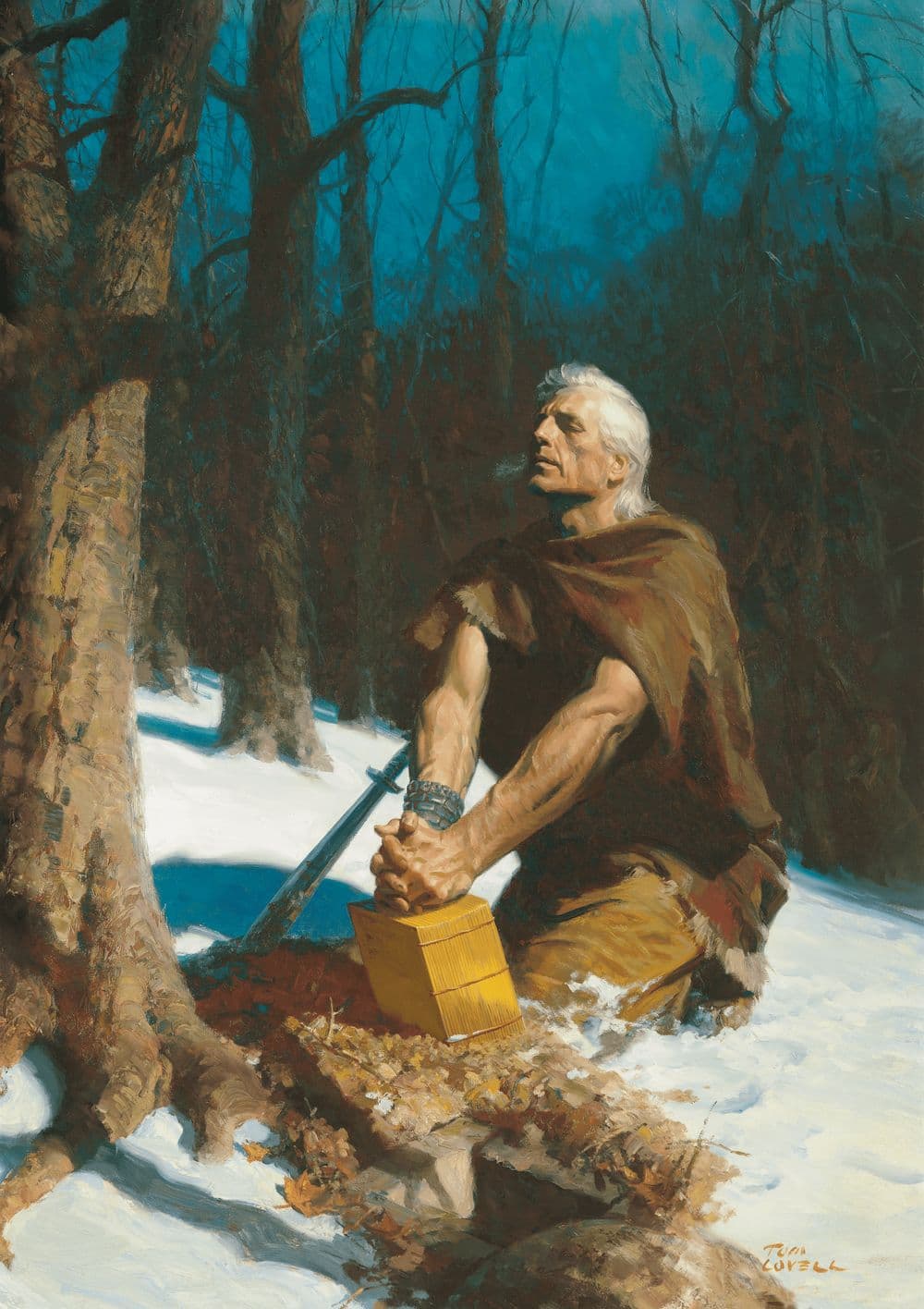
Moroni buries the record. Fourteen centuries later eleven men would say they had seen it. · Morm. 6:6
The Three: Oliver Cowdery, David Whitmer, Martin Harris
June 1829, in the woods near the Whitmer farm.
An angel showed them the plates; they heard a voice from heaven.
'We declare with words of soberness, that an angel of God came down from heaven, and he brought and laid before our eyes.'
A visionary experience, and they described it as such.
The Eight: Whitmers, Smiths, Hiram Page
Shortly afterward, in an ordinary setting.
No angel, no voice.
'Joseph Smith, Jun., the translator of this work, has shown unto us the plates… which have the appearance of gold… we did handle with our hands.'
A physical examination, and they described it as such.
The distinction between the two groups is deliberate and useful. The Three describe a vision with an angel; the Eight describe hefting and turning the leaves of a physical object in daylight. A fabricator producing testimonies would more likely have made them match.
1Behold, I say unto you, that you must rely upon my word, which if you do with full purpose of heart, you shall have a view of the plates, and also of the breastplate, the sword of Laban, the Urim and Thummim…
5And ye shall testify that you have seen them, even as my servant Joseph Smith, Jun., has seen them; for it is by my power that he has seen them, and it is because he had faith.
6And he has translated the book, even that part which I have commanded him, and as your Lord and your God liveth it is true.
What the book asks you to do
The title page states the purpose; Moroni states the method.
—Which is to show unto the remnant of the House of Israel what great things the Lord hath done for their fathers; and that they may know the covenants of the Lord, that they are not cast off forever—And also to the convincing of the Jew and Gentile that JESUS is the CHRIST, the ETERNAL God, manifesting himself unto all nations.
Joseph Smith stated that the title page was a translation of the last leaf of the plates, not his own composition.
Three purposes, in order: to show Israel's descendants what God did for their ancestors, to teach the covenants, and to convince Jew and Gentile that Jesus is the Christ. Notice what is not on the list — the book does not present itself as a history of the Americas, and reading it as one imports a purpose it never claims.
3Behold, I would exhort you that when ye shall read these things… that ye would remember how merciful the Lord hath been unto the children of men, from the creation of Adam even down until the time that ye shall receive these things, and ponder it in your hearts.
4And when ye shall receive these things, I would exhort you that ye would ask God, the Eternal Father, in the name of Christ, if these things are not true; and if ye shall ask with a sincere heart, with real intent, having faith in Christ, he will manifest the truth of it unto you, by the power of the Holy Ghost.
5And by the power of the Holy Ghost ye may know the truth of all things.
Principle
The book proposes a test that historical work cannot perform, and does not ask anyone to stop doing historical work in order to perform it.
Moroni asks for reading, remembering, pondering, and then asking — in that order, with study first. The method is neither anti-intellectual nor a substitute for evidence; it is a claim that some questions are answered by a different faculty, offered to people who have already done the reading.
Where the coming forth was foretold
- Isaiah 29:11–14The sealed book and the learned man who cannot read it — applied in 2 Nephi 27 to the Anthon episode, and to 'a marvellous work and a wonder.'
- Ezekiel 37:15–17The stick of Judah and the stick of Joseph becoming one in the hand.
- 2 Nephi 27:12–14Three witnesses, and 'a few according to the will of God' — written before the witnesses existed.
- Ether 5:2–4Moroni to the future translator: 'unto three shall they be shown by the power of God.'
To consider
- 01The first revelation in the Doctrine and Covenants after the preface is a rebuke of Joseph Smith. Why keep it in the front of the book?
- 02The Three and the Eight describe different kinds of experience. Which testimony do you find harder to explain away, and why?
- 03The title page names three purposes. Which of them do you actually read the book for?
What this lesson holds
The translation was accomplished 'by the gift and power of God,' by a method the sources describe plainly and the Church now publishes openly.
The loss of the 116 pages produced a canonised rebuke of the prophet and a prepared alternative in the small plates.
Eleven witnesses testified in two distinct modes — vision and physical handling — and none of the eleven ever denied it, including those who left the Church.
The Testimony of Three Witnesses · The Testimony of Eight Witnesses · D&C 17:5–6
The book proposes its own test, and the test requires study before it requires prayer.
Check your reading
5 questions01How do eyewitnesses describe the translation process?
02Roughly how long did the bulk of the translation take?
03What does D&C 3 do?
04What is the difference between the Three Witnesses and the Eight?
05What does the title page name as the book's purposes?
Where to go next
Sources
- Gospel Topics Essay, "Book of Mormon Translation" — The Church's own account of the instruments and the process
- The Joseph Smith Papers, Documents and Revelations volumes — The original and printer's manuscripts, and the witness testimonies
- Gospel Topics Essay, "Book of Mormon and DNA Studies" — On what the book does and does not claim about ancient populations
- Saints, Volume 1: The Standard of Truth