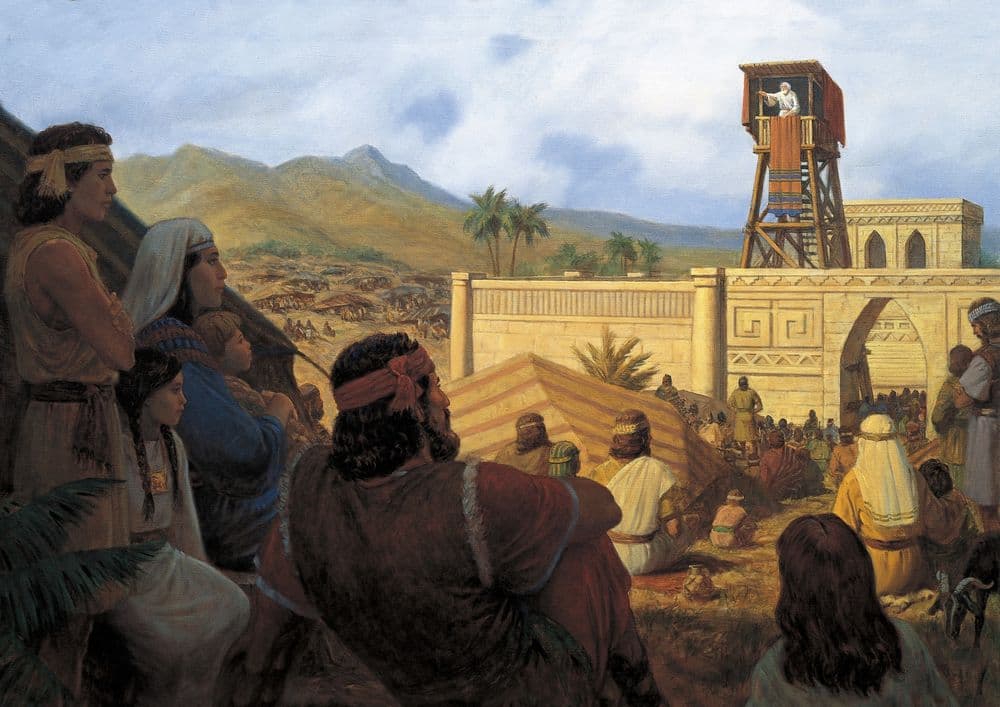
King Benjamin Addresses His People · Mosiah 1:9–11, 18
Book of Mormon
The Natural Man and the New Name
King Benjamin's address at the temple
Mosiah 2–555 min5 sections
A dying king gathers a nation to the temple, tells them what service is, what the natural man is, and what it costs to keep a remission of sins — and then gives them a name to bear.
- Author
- Mormon's abridgement of the record of Zeniff's people and the plates of Mosiah
- Date
- c. 124 BC
- Place
- The temple in the land of Zarahemla
- Audience
- The whole population of Zarahemla, gathered by families
- Genre
- Royal covenant address and coronation, with an angelic message embedded in it
By the end you should be able to
- Describe the festival setting of the address and why the details of the gathering are not incidental.
- State what Mosiah 3:19 actually claims about the natural man, including the conditional clause most quotations drop.
- Explain the relationship Benjamin draws between service, indebtedness, and the impossibility of ever being ahead.
- Trace how a remission of sins is retained rather than merely received.
Tents toward the temple
The staging of the sermon carries as much doctrine as its sentences.
5And it came to pass that when they came up to the temple, they pitched their tents round about, every man according to his family, consisting of his wife, and his sons, and his daughters, and their sons, and their daughters, from the eldest down to the youngest, every family being separate one from another.
6And they pitched their tents round about the temple, every man having his tent with the door thereof towards the temple, that thereby they might remain in their tents and hear the words which king Benjamin should speak unto them.
Families, not individuals. Tents, not houses. Doors facing the temple. A tower built because the crowd cannot all hear. Every one of those details would have been familiar to an Israelite: this is the shape of a pilgrimage festival.
The sacrifices in Mosiah 2:3 are offered "according to the law of Moses," which is a small but important reminder that these are Israelites keeping Israelite religion, six centuries before Christ's coming and yet knowingly pointed toward Him (Mosiah 3:14–15).
"Ye are only in the service of your God"
The most-quoted line in the address, and the argument that surrounds it.
17And behold, I tell you these things that ye may learn wisdom; that ye may learn that when ye are in the service of your fellow beings ye are only in the service of your God.
20I say unto you, my brethren, that if you should render all the thanks and praise which your whole soul has power to possess, to that God who has created you, and has kept and preserved you, and has caused that ye should rejoice, and has granted that ye should live in peace one with another—
21I say unto you that if ye should serve him who has created you from the beginning, and is preserving you from day to day, by lending you breath, that ye may live and move and do according to your own will, and even supporting you from one moment to another—I say, if ye should serve him with all your whole souls yet ye would be unprofitable servants.
Verse 17 is usually quoted alone and heard as a warm sentiment about volunteering. In place, it is the conclusion of a harder argument. Benjamin has just pointed out that he has laboured with his own hands rather than taxing the people, so that they would not be burdened — and then says that even so, he has no claim on them, and neither does anyone have a claim on God.
King James renders it “Luke 17:10”
Benjamin's phrase in Mosiah 2:21 is verbatim the Savior's in Luke 17:10, spoken at the end of the parable of the servant who ploughs all day and then prepares supper. Achreios means without profit, yielding no surplus — the accounting is not that we are worthless but that we can never get ahead of what we owe. Benjamin's point in verse 24 is exactly this: the moment you obey, God "doth immediately bless you," so the debt is instantly renewed.
This is one of the places where the Book of Mormon is quietly severe. There is no arrangement in which a person becomes God's creditor. And Benjamin's conclusion is not despair but the removal of a certain kind of religious accounting — you are not building up credit, so you may as well simply love and serve.
The natural man
The verse everyone knows, with the clause most quotations omit.
19For the natural man is an enemy to God, and has been from the fall of Adam, and will be, forever and ever, unless he yields to the enticings of the Holy Spirit, and putteth off the natural man and becometh a saint through the atonement of Christ the Lord, and becometh as a child, submissive, meek, humble, patient, full of love, willing to submit to all things which the Lord seeth fit to inflict upon him, even as a child doth submit to his father.
The sentence has a hinge in the middle: unless. Quoted up to "forever and ever" it reads as a doctrine of total depravity. Read whole, it is a conditional with an escape clause built in, and the clause names three things — yielding, putting off, and becoming — in that order.
Two words behind the phrase
The list that follows — submissive, meek, humble, patient, full of love — is a description of a child, and Benjamin says so twice. Latter-day Saint readers sometimes find "willing to submit to all things which the Lord seeth fit to inflict" difficult. It is worth reading it alongside verse 2's promise in 2 Nephi that afflictions are consecrated for our gain, and alongside the fact that the speaker is a king who refused to tax his own people.
The angel's description of Gethsemane
7And lo, he shall suffer temptations, and pain of body, hunger, thirst, and fatigue, even more than man can suffer, except it be unto death; for behold, blood cometh from every pore, so great shall be his anguish for the wickedness and the abominations of his people.
Spoken by an angel to Benjamin roughly 124 years before the events described.
Compare Luke 22:44 and D&C 19:18. Three witnesses, from three different centuries and three different records, describe the same physical detail. The unit on Gethsemane in the New Testament course examines the Greek of Luke's account and the textual question surrounding it.
"Are we not all beggars?"
Benjamin turns the doctrine into an economic obligation, immediately.
16And also, ye yourselves will succor those that stand in need of your succor; ye will administer of your substance unto him that standeth in need; and ye will not suffer that the beggar putteth up his petition to you in vain, and turn him out to perish.
17Perhaps thou shalt say: The man has brought upon himself his misery; therefore I will stay my hand, and will not give unto him of my food, nor impart unto him of my substance that he may not suffer, for his punishments are just—
18But I say unto you, O man, whosoever doeth this the same hath great cause to repent; and except he repenteth of that which he hath done he perisheth forever, and hath no interest in the kingdom of God.
19For behold, are we not all beggars? Do we not all depend upon the same Being, even God, for all the substance which we have, for both food and raiment, and for gold, and for silver, and for all the riches which we have of every kind?
Verse 17 puts the objection in the reader's own mouth before the reader can make it, and verse 18 answers it without softening. This is among the most direct passages in scripture on the treatment of the poor, and it forecloses the most common excuse for not helping.
Then verse 24 does something rarely noticed: Benjamin turns and addresses those who have nothing to give, tells them to say in their hearts that they would give if they had, and says that if they do, "ye remain guiltless." The obligation is on the disposition, and the disposition is required of everyone.
26And now, for the sake of retaining a remission of your sins from day to day, that ye may walk guiltless before God—I would that ye should impart of your substance to the poor, every man according to that which he hath, such as feeding the hungry, clothing the naked, visiting the sick and administering to their relief, both spiritually and temporally, according to their wants.
27And see that all these things are done in wisdom and order; for it is not requisite that a man should run faster than he has strength. And again, it is expedient that he should be diligent, that thereby he might win the prize; therefore, all things must be done in order.
Verse 26 is the load-bearing sentence of Mosiah 4. A remission of sins is received at baptism; it is retained by imparting to the poor. Benjamin does not offer this as one commendable option among several — it is the stated mechanism.
Verse 27's balance is equally characteristic: diligence and limits in the same breath. "It is not requisite that a man should run faster than he has strength" is a mercy, and it is placed immediately after a demanding commandment, which is where mercies of that kind belong.
The mighty change and the new name
2...the Spirit of the Lord Omnipotent, which has wrought a mighty change in us, or in our hearts, that we have no more disposition to do evil, but to do good continually.
7And now, because of the covenant which ye have made ye shall be called the children of Christ, his sons, and his daughters; for behold, this day he hath spiritually begotten you; for ye say that your hearts are changed through faith on his name; therefore, ye are born of him and have become his sons and his daughters.
8And under this head ye are made free, and there is no other name given whereby salvation cometh; therefore, I would that ye should take upon you the name of Christ, all you that have entered into the covenant with God that ye should be obedient unto the end of your lives.
Note the sequence. The people hear, they believe, they fall to the earth, they cry for mercy and receive it (Mosiah 4:1–3), they are instructed, they covenant — and only then are they given the name. The name is the ratification of a covenant, not a badge of enthusiasm.
Latter-day Saints hold that all people are already God's spirit children. Mosiah 5:7 therefore has to mean something more specific: through covenant, a person becomes a child of Christ, spiritually begotten by Him. Paul's Roman adoption imagery (Romans 8:15–17) works the same way — a legal act that confers inheritance, not a change of species.
Full lexicon entry →
"No more disposition to do evil" describes the direction of a will, not the eradication of temptation. Benjamin's own people needed further teaching immediately, and Alma the Younger later has to ask a congregation of the converted whether they can still feel it (Alma 5:26). The change is real, and it must be renewed — which is precisely what the sacrament prayer, echoing Mosiah 5:8, is for: to take upon them the name of Thy Son.
What this lesson holds
Service to other people is service to God — there is no separate category.
No one can put God in his debt; blessings arrive faster than obedience does.
The natural man is overcome by yielding to the Spirit, not by unaided effort.
A remission of sins is retained by imparting to the poor.
Taking the name of Christ is a covenant act with a name attached, renewed weekly.
Check your reading
5 questions01What clause do most quotations of Mosiah 3:19 leave out?
02According to Mosiah 4:26, why does Benjamin command imparting to the poor?
03Benjamin anticipates the objection "the man has brought upon himself his misery." How does he answer it?
04What is the setting of the address?
05What is given to the people at the end of the covenant in Mosiah 5?
Where to go next
Sources
- Mosiah 2–5 — The primary text.
- John W. Welch and Stephen D. Ricks, eds., King Benjamin's Speech — FARMS, 1998 — the festival-pattern scholarship. Academic, not doctrinal.
- Book of Mormon Student Manual — Church Educational System, chapters on Mosiah 1–5
- Gospel Topics, "Sacrament"