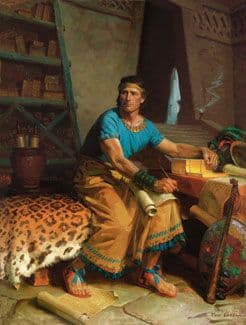
Mormon Abridging the Plates · W of M 1:1–11
Book of Mormon
The Vineyard
Jacob 5, the longest chapter in the Book of Mormon, and the whole history of Israel
Jacob 5–6; Romans 11:16–24; 1 Nephi 10:12–1450 min4 sections
Seventy-seven verses of grafting, digging and pruning, quoted by Jacob from a prophet named Zenos who appears in no Bible. It is the scattering and gathering of Israel told as a single sustained allegory — and the Lord of the vineyard weeps in it twice.
- Author
- Zenos, quoted by Jacob from the brass plates
- Date
- Zenos is pre-exilic and otherwise unknown; Jacob writes c. 544–421 BC
- Place
- The land of Nephi
- Audience
- A people who had themselves just been broken off from Israel
- Language
- Translated from the record
- Genre
- Extended allegory
By the end you should be able to
- Track the four main visits to the vineyard and what happens in each.
- Identify what the tame tree, the wild tree, the branches and the roots stand for.
- Explain why the master's repeated question — “what more could I have done?” — is the centre of the chapter.
- Connect the last pruning to the work the Church understands itself to be doing.
A prophet with no Bible
Where the chapter comes from, and why that matters.
Zenos is quoted or named some two dozen times in the Book of Mormon — by Nephi, Jacob, Alma, Amulek, Nephi son of Helaman, and Mormon — and he appears nowhere in the Hebrew Bible. He was, on the Book of Mormon's own account, a prophet of the northern kingdom whose writings were on the brass plates and did not survive into the canon we inherited.
3For behold, thus saith the Lord, I will liken thee, O house of Israel, like unto a tame olive-tree, which a man took and nourished in his vineyard; and it grew, and waxed old, and began to decay.
What stands for what
The key, before the story.
| In the allegory | In the history |
|---|---|
| The vineyard | The world |
| The tame olive tree | The house of Israel, and the covenant |
| The wild olive tree | The Gentiles |
| The roots | The covenants and promises made to the fathers |
| The branches | Peoples and groups within Israel, and where they end up |
| Grafting in | Being brought into the covenant |
| Branches broken off | The scattering |
| The Lord of the vineyard | The Lord |
| The servant | His prophets and, in the last pruning, His servants generally |
| Pruning, digging, dunging | Everything God does to keep a people alive |
The single most useful thing to hold onto is the roots. Branches move, are broken off, are grafted in and are burned; the roots stay. That is the allegory's way of saying that the covenant is older than any of the peoples who have carried it, and outlasts each of them.
King James renders it “olive”
The olive is the obvious image for this because of how the tree actually behaves. It lives for centuries, it is rejuvenated by hard pruning, it sends up new shoots from an old root when the trunk dies, and grafting a wild scion onto tame stock is standard practice. Every move in the allegory is a real thing an ancient farmer did.
Four visits
The shape of the chapter, so seventy-seven verses stop being a blur.
| Visit | Verses | What happens |
|---|---|---|
| First | 4–14 | The old tree decays. Its main top is pruned; young tender branches are grafted in from a wild tree; natural branches are carried to the nethermost parts of the vineyard and hidden. |
| Second | 15–28 | A long time passes. The grafted branches have brought forth good fruit; so have the transplanted natural branches — except one, in the poorest ground, which surprises everyone by doing well. |
| Third | 29–60 | Another long time. The whole vineyard has become corrupt; every tree bears wild fruit. This is the low point, and the longest section. |
| Fourth | 61–77 | The last pruning: the servants are few, the natural branches are grafted back, the bad is burned gradually rather than at once, and the Lord labours alongside the servants. |
41And it came to pass that the Lord of the vineyard wept, and said unto the servant: What could I have done more for my vineyard?
47But what could I have done more in my vineyard? Have I slackened mine hand, that I have not nourished it? Nay, I have nourished it, and I have digged about it, and I have pruned it, and I have dunged it; and I have stretched forth mine hand almost all the day long…
49And it came to pass that the Lord of the vineyard said unto the servant: Let us go to and hew down the trees of the vineyard and cast them into the fire, that they shall not cumber the ground of my vineyard, for I have done all. What could I have done more for my vineyard?
51And the Lord of the vineyard said unto him: Let us spare it a little longer.
Principle
The centre of the chapter is not a strategy but a question — “what could I have done more?” — asked by someone weeping.
The master proposes burning the vineyard three times, and each time the servant asks him to wait, and each time he agrees. A God who can be asked to spare something a little longer, and does, is the picture this allegory paints.
The last pruning
The part that describes now.
61Wherefore, let us go to and labor with our might this last time, for behold the end draweth nigh, and this is for the last time that I shall prune my vineyard.
70And it came to pass that the Lord of the vineyard sent his servant; and the servant went and did as the Lord had commanded him, and brought other servants; and they were few.
71And the Lord of the vineyard said unto them: Go to, and labor in the vineyard, with your might. For behold, this is the last time that I shall nourish my vineyard… and the season speedily cometh; and if ye labor with your might with me ye shall have joy in the fruit which I shall lay up unto myself against the time which will soon come.
72And it came to pass that the servants did go and labor with their mights; and the Lord of the vineyard labored also with them; and they did obey the commandments of the Lord of the vineyard in all things.
75…for behold, for a long time will I lay up of the fruit of my vineyard unto mine own self against the season, which speedily cometh.
- The servants are few — stated plainly, not apologised for.
- The Lord of the vineyard labours with them. This is the only visit in which He works alongside rather than directing.
- The bad is cleared gradually, 'according as the good shall grow,' so the roots are not overcome by the removal (v. 65–66).
- The natural branches are grafted back into their own tree, and the roots and the tops are made equal (v. 68, 74).
- The promised outcome is joy shared with the servants, not merely a harvest.
Principle
The last pruning is described as gradual, joint work — bad removed only as fast as good grows, with the Lord labouring beside the few.
Where the image goes
- Romans 11:16–24Paul uses the same figure and warns the grafted Gentile branches not to boast against the natural ones.
- 1 Nephi 10:12–14Lehi's version, in miniature — and the source Jacob is expanding.
- Jacob 6:4–7Jacob's own application, immediately after the quotation: 'how merciful is our God unto us.'
- D&C 101:44–62The parable of the nobleman and the olive trees, which reuses the whole grammar.
To consider
- 01The master asks “what could I have done more?” three times. What does it change to hear that question from God rather than about Him?
- 02The bad is cleared only as fast as the good grows. Where in your own life would faster clearing damage the roots?
- 03The servants are few and the Lord works beside them. Which half of that sentence do you usually forget?
What this lesson holds
The roots — the covenants made to the fathers — outlast every branch, which is why scattering is never the end of the story.
The Lord of the vineyard weeps over the vineyard and asks to spare it, repeatedly, before any judgment.
In the final work the servants are few and the Lord labours alongside them, clearing the bad only as fast as the good can grow.
Check your reading
5 questions01Who is Zenos?
02In the allegory, what do the roots represent?
03What question does the Lord of the vineyard repeat?
04What is distinctive about the last pruning?
05What does Paul do with the same image in Romans 11?
Where to go next
Sources
- Jacob 5–6 — The primary text.
- Book of Mormon Student Manual
- Gospel Topics, "Israel"