Patterns / Narrative shape
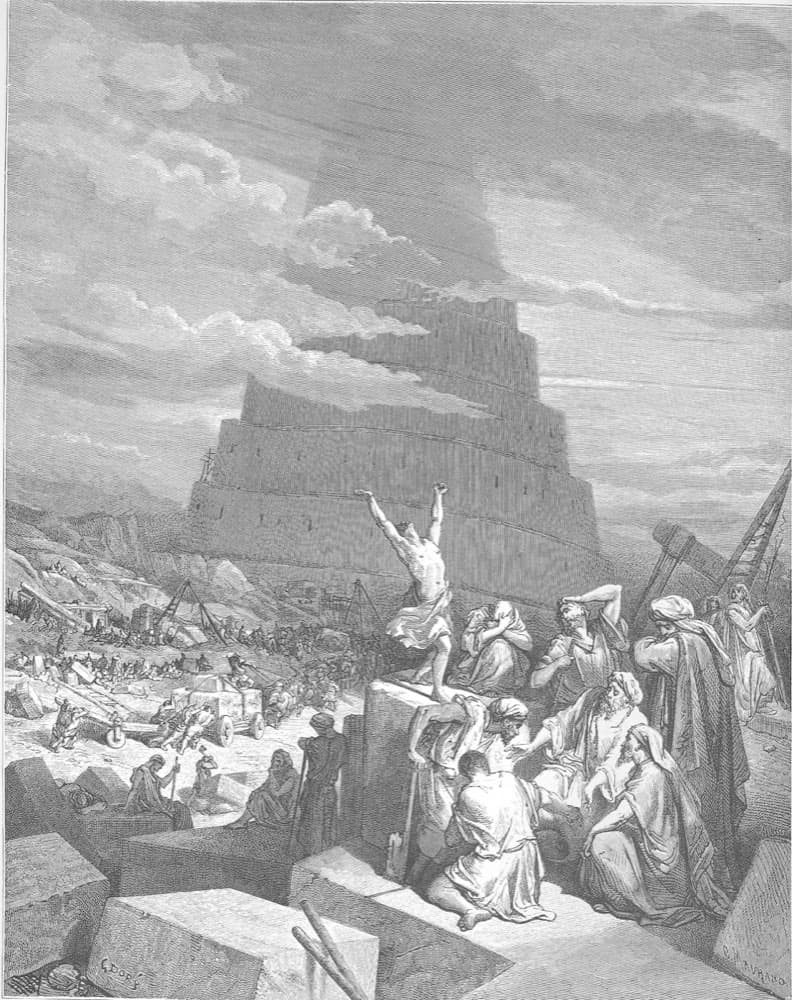
The Tower of Babel
The two motions that run the whole of covenant history
Scattering and gathering
Scripture has exactly two directions of travel for God's people, and they alternate. Babel scatters, Abraham is called out. Israel is carried away, and promised a return in the same law that warned of the exile. Lehi is scattered before he is anything. And the allegory of the olive tree, the longest chapter in the Book of Mormon, is about nothing else — a master who scatters branches deliberately, to save a root.
28 min10 appearances
The pattern, in one sentence
God scatters His people as often in mercy as in judgement, preserves them by the scattering, and gathers them back by covenant rather than by geography — so that the same event is both a punishment and a planting depending on how far out you can see.
What counts as an instance
Stated before the evidence, so that the evidence is able to fail.
The scattering is real dispersal, not a metaphor
Peoples are physically moved: Babel, the ten tribes, Lehi's family, the Church out of Missouri, the Saints from Nauvoo. The pattern is about geography before it is about anything else.
The scattering preserves something
This is the part that inverts the expectation. Branches are hidden in the nethermost parts of the vineyard so the root will not perish, and the Jerusalem church is scattered and takes the gospel with it.
The gathering is promised in the same breath as the scattering
Deuteronomy warns of the exile and promises the return in adjacent chapters. Jacob 5 grafts back what it cut off. No scattering in scripture is announced without its counterpart.
The gathering is by covenant, not by address
The last stage of the pattern relocates nobody. The Church's own teaching is that Israel gathers into the covenant where it already lives — which is what the allegory's grafting language always meant.
The appearances
10 in the canonSo the LORD scattered them abroad from thence upon the face of all the earth: and they left off to build the city.
What recurs
A people scattered, and a project stopped.
What is new here
The first scattering, and it is a judgement on a refusal to scatter — they built the tower explicitly 'lest we be scattered abroad'.
Genesis 11:4 states their motive: a tower, a name, and 'lest we be scattered'. They are scattered for trying not to be. It is worth reading against Genesis 1:28 and 9:1, where filling the earth was the instruction all along — Babel is disobedience corrected by force.
Where it lands
The last labour in the vineyard
The allegory ends with the master and his servants grafting the scattered branches back into their own mother tree, working alongside each other — 'for the last time' — until the fruit is again as it was at the first. It is the pattern's whole answer in one image. Nothing was thrown away. Every branch carried into the nethermost parts of the vineyard was carried there so it could be brought back, and the labour of bringing it back is done by servants working with the owner rather than for him.
The scattering is the planting
The counterintuitive half of the pattern, and the passages that state it.
The obvious reading of a scattering is loss. Israel dispersed among the nations is Israel diluted, and every Old Testament reference to it is framed as a curse. That reading is not wrong. It is incomplete, and the canon supplies the completion in three places that are hard to argue with.
13And these will I place in the nethermost part of my vineyard, whithersoever I will, and it mattereth not unto thee; and I do it that I may preserve unto myself the natural branches of the tree…
22…Counsel me not; I knew that it was a poor spot of ground; wherefore, I said unto thee, I have nourished it this long time, and thou beholdest that it hath brought forth much fruit.
Verse 22 is the answer to a question the servant asks in genuine confusion: why plant good branches in the worst ground you have? The master does not deny that the ground is poor. He says he knew, and points at the fruit. The placement was a choice made with full information, and it worked because of the conditions rather than in spite of them.
1…and at that time there was a great persecution against the church which was at Jerusalem; and they were all scattered abroad throughout the regions of Judaea and Samaria, except the apostles.
4Therefore they that were scattered abroad went every where preaching the word.
Principle
God scatters in order to preserve as often as He scatters in order to punish, and the same event can be both.
Lehi's departure was an escape from destruction; the ten tribes' removal was a judgement that carried the covenant into the world; the Jerusalem church's dispersal was a persecution and a mission at the same time.
Announced together
No scattering in scripture arrives without its gathering attached.
Deuteronomy 28:64
“And the LORD shall scatter thee among all people, from the one end of the earth even unto the other…”
Written before Israel had entered the land.
Deuteronomy 30:3–4
“…then the LORD thy God will turn thy captivity, and have compassion upon thee, and will return and gather thee from all the nations…”
“If any of thine be driven out unto the outmost parts of heaven, from thence will the LORD thy God gather thee.”
Two chapters apart, in the same address, before any of it happened. Israel walked into Canaan carrying a text that described both its exile and its return, which means the exile — when it came seven centuries later — was not evidence that the covenant had failed. It was the covenant document being read aloud on schedule.
The pairing, elsewhere
- 1 Nephi 10:12–14Lehi teaches the breaking off and the grafting in as one doctrine, in the same sentence.
- 3 Nephi 16:4–5Christ tells the Nephites the record of their scattering will be the means of the gathering.
- Jeremiah 31:10“He that scattered Israel will gather him” — the same subject performing both verbs.
- Ezekiel 37:15–22Two sticks, one in the hand: the gathering figured as records rather than as travel.
- Moses 7:61–62Enoch shown righteousness sent down and truth sent forth to gather out the elect.
The allegory, in outline
Jacob 5 is seventy-seven verses long and has a shape you can hold.
The chapter defeats most readers because the branches keep moving. The way through it is to hold onto three facts: the tree is the house of Israel, the root is the covenant, and the master's single objective from beginning to end is stated in verse 11 — that the root will not perish.
| Visit | What the master does | Usually read as |
|---|---|---|
| First — vv. 4–14 | Prunes and digs the decaying tree; grafts in wild branches; hides natural branches in the nethermost parts | Apostasy, the Gentiles brought in, Israel scattered |
| Second — vv. 15–28 | Inspects the transplanted branches; finds good fruit in the poorest ground | The scattered branches preserved, including Lehi's |
| Third — vv. 29–49 | Finds corruption everywhere; the loftiness of the tree has overcome the roots | General apostasy; the master weeps and considers burning it |
| Fourth — vv. 50–77 | Grafts the natural branches back, works with the servants, prunes as the good overcomes the bad | The last-days gathering, and the Restoration |
Two details are worth carrying away. In verse 47 the master asks, 'what could I have done more for my vineyard?' — a question, addressed to a servant, from someone with everything at stake. And in verse 72 the servants work alongside him: 'the Lord of the vineyard laboured also with them.' The gathering is not something done to Israel by a distant owner.
Where the gathering sits in the larger arc — the last labour before the end of the vineyard.
Where the gathering happens now
The shift from emigration to covenant, and why it is the same doctrine.
For most of the nineteenth century the gathering meant a ship and a wagon. Converts sold what they had and came to the Salt Lake valley, and the Church organised the passage. That was a real application of the keys restored in D&C 110:11, and it built what it was meant to build.
The current teaching is that members gather into the covenant where they live, and that the Church is built up in every nation rather than drained into one. It is worth seeing that this is not a reversal. Isaiah's mechanism was an ensign — a standard raised so people can see where to come — and Jacob 5's mechanism is grafting, which is a change of root rather than a change of soil.
1And verily I say unto you, I give unto you a sign, that ye may know the time when these things shall be about to take place—that I shall gather in, from their long dispersion, my people, O house of Israel…
6…that they may be numbered among my people, O house of Israel.
'Numbered among' is covenant language, not census language. It is what happens at baptism and in the temple, and it happens in Lagos and São Paulo and Manila without anybody moving house.
To consider
- 01Every scattering in this pattern preserved something. Is there a dispersal in your own family's history that turns out to have carried something forward?
- 02Isaiah's ensign gathers by being visible rather than by going out and collecting. What does that ask of a congregation?
- 03Matthew 23:37 ends 'and ye would not'. What does it mean that the gathering can be refused?
What the pattern holds
Scattering and gathering are the two motions of covenant history, and the same God performs both.
A scattering can be a preservation, and scripture repeatedly says so about the same events it also calls a judgement.
No dispersal is announced in scripture without its gathering promised alongside it.
Israel entered Canaan carrying a document that described both the exile and the return.
The gathering is grafting rather than relocation — a change of root, not a change of soil.
The gathering is an invitation and can be declined.
“How often would I have gathered… and ye would not” is said over Jerusalem and repeated three times over the Nephites.
What this will not carry
- Saying that a scattering preserved something is a conclusion available afterwards and from a distance. It is not a thing to say to people in the middle of one, and scripture never uses it that way.
- The location of the ten tribes is not a settled matter, and speculation about it has a long and unhelpful history in Latter-day Saint folklore. The scriptures promise a return and do not supply a map.
- Jacob 5 rewards a careful reading and punishes a confident one. The identification of every branch and every graft with a specific historical group is more than the allegory supports; the master's stated objective — preserving the root — is what it is actually about.
- The nineteenth-century emigration and the present teaching to gather in place are both applications of the same keys to different circumstances. Presenting either as the doctrine misrepresents the other.
Check your reading
4 questions01Why did the builders at Babel construct their tower?
02In Jacob 5, how does the master answer the servant's surprise that good branches were planted in poor ground?
03What does Acts 8:4 say the scattered church did?
04According to D&C 110:11, what did Moses commit in the Kirtland Temple?
Where to go next
Sources
- “Israel, Gathering of” — Guide to the Scriptures, churchofjesuschrist.org
- Jacob 5 — Book of Mormon Student Manual, Church Educational System
- Doctrine and Covenants 110 — The keys of the gathering, restored 3 April 1836