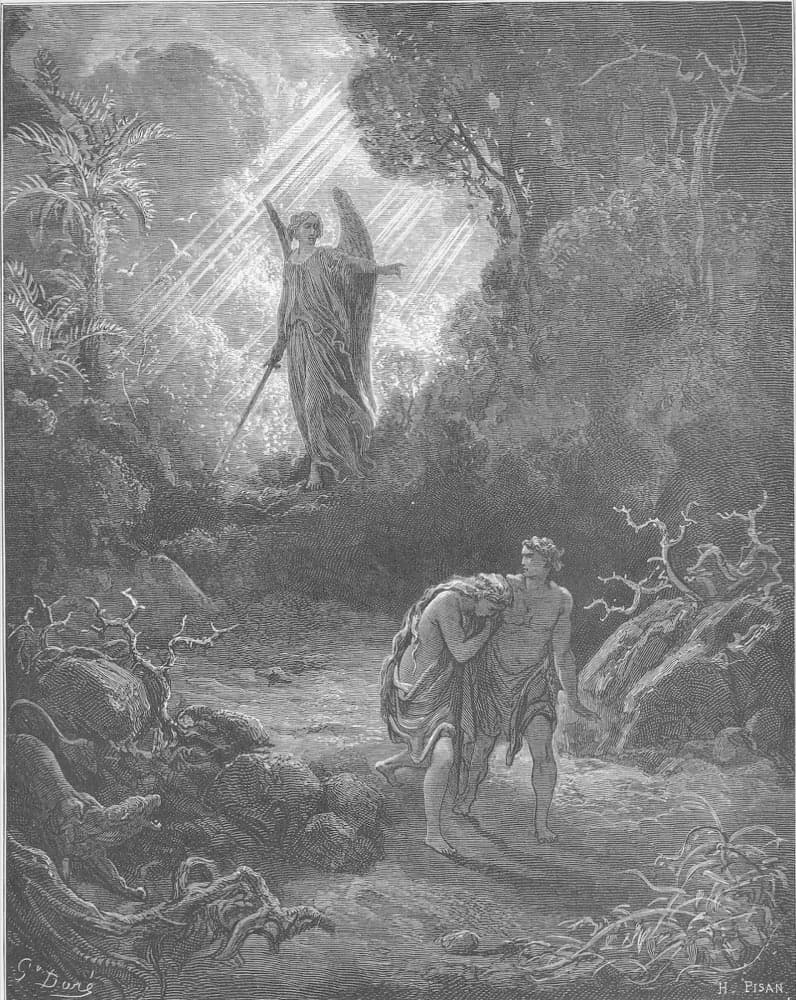
Adam and Eve Driven out of Eden
Book of Mormon
Opposition, Agency, and the Fall
Lehi's last words to Jacob
2 Nephi 250 min5 sections
An old man, dying, explains to a son born in the wilderness why there must be opposition, why Adam's transgression was a step forward, and why freedom is worthless without a Redeemer. One of the densest doctrinal chapters in scripture.
- Author
- Lehi, recorded by Nephi
- Date
- c. 588–570 BC
- Place
- The land of first inheritance, in the New World
- Audience
- Jacob, Lehi's son, born in the wilderness during the family's afflictions
- Genre
- Patriarchal blessing and deathbed discourse
By the end you should be able to
- State Lehi's argument for why opposition is a necessary condition of a moral universe.
- Explain the difference between transgression and sin as Latter-day Saints use the terms, and why the distinction matters for Eve.
- Distinguish things that act from things that are acted upon, and locate yourself in that distinction.
- Show why, on Lehi's account, agency without a Redeemer would be a cruelty rather than a gift.
Spoken to a particular son
The most abstract chapter in the Book of Mormon is addressed to the child who suffered most.
1And now, Jacob, I speak unto you: Thou art my first-born in the days of my tribulation in the wilderness. And behold, in thy childhood thou hast suffered afflictions and much sorrow, because of the rudeness of thy brethren.
2Nevertheless, Jacob, my first-born in the wilderness, thou knowest the greatness of God; and he shall consecrate thine afflictions for thy gain.
Everything that follows is framed by verse 2. Lehi is not lecturing on metaphysics for its own sake; he is explaining to a son who has been hurt why a world in which he could be hurt is the only world in which he could become anything. The doctrine of opposition arrives as pastoral care.
Consecrate
Not "compensate for" and not "explain away." To consecrate afflictions is to take the affliction itself and make it holy — to turn the thing that damaged you into the thing that sanctifies you. The same promise appears in D&C 121:7–8 and in Alma 7:11–12, where Christ takes upon Himself pains and afflictions precisely so that He will know how to succour.
"It must needs be, that there is an opposition in all things"
The argument, stated as strictly as scripture ever states an argument.
11For it must needs be, that there is an opposition in all things. If not so, my first-born in the wilderness, righteousness could not be brought to pass, neither wickedness, neither holiness nor misery, neither good nor bad. Wherefore, all things must needs be a compound in one; wherefore, if it should be one body it must needs remain as dead, having no life neither death, nor corruption nor incorruption, happiness nor misery, neither sense nor insensibility.
Read this slowly. Lehi is not saying that opposition is useful, or character-building, or a regrettable necessity. He is making a stronger claim: that without contraries, the categories themselves collapse. Righteousness is not merely harder to achieve without wickedness — it could not "be brought to pass" at all, because there would be nothing for it to be righteousness instead of.
The phrase "a compound in one" is unusual and easy to skim. Lehi's point is that a universe without contraries would be undifferentiated — a single inert mass, "as dead," having neither life nor death because those words would name nothing. Meaning requires difference.
2 Nephi 2:11
"It must needs be, that there is an opposition in all things."
Without contraries, no category holds.
Genesis 1 (Hebrew)
The creation proceeds by separating: light from darkness, waters from waters, sea from land.
The Hebrew verb is bādal — to divide.
D&C 29:39
"It must needs be that the devil should tempt the children of men, or they could not be agents unto themselves."
The same argument, in a revelation of 1830.
Things to act and things to be acted upon
Lehi's taxonomy of everything that exists.
The Fall introduced two separations. One is undone for everyone without condition; the other requires a response. Most confusion about grace and works comes from applying a statement about one to the other.
14And now, my sons, I speak unto you these things for your profit and learning; for there is a God, and he hath created all things, both the heavens and the earth, and all things that in them are, both things to act and things to be acted upon.
16Wherefore, the Lord God gave unto man that he should act for himself. Wherefore, man could not act for himself save it should be that he was enticed by the one or the other.
Verse 15, omitted here, describes the two trees set in opposition in Eden.
The universe divides into agents and objects. A stone is acted upon. A person acts. And the condition of acting, Lehi says, is enticement from both directions — which means the presence of a real alternative is not a defect in the arrangement but its enabling condition.
This is why Elder David A. Bednar and others have taught that the great question of mortality is whether we will be agents who act or objects who are acted upon. The distinction is not a personality trait; it is a doctrine about what kind of thing a human being is.
The word we get wrong
The scriptures never use the phrase "free agency." What they say is agency (2 Nephi 2:16; Moses 7:32), moral agency (D&C 101:78), and "agents unto themselves" (D&C 58:28). The distinction matters: "free agency" suggests freedom from consequence, whereas scriptural agency is precisely the capacity to act and to be accountable. Elder Dallin H. Oaks made this point directly in his 2010 conference address "Agency or Inspiration?"; the Church's own style now prefers agency and moral agency.
Agency across the canon
- Moses 4:1–4Satan's plan destroys agency; that is the reason for his rebellion.
- D&C 58:27–28Agents unto themselves — do many things of their own free will.
- D&C 93:30–31Intelligence acts for itself; otherwise there is no existence.
- Helaman 14:30–31"Ye are free; ye are permitted to act for yourselves."
"Adam fell that men might be"
The single verse that most distinguishes Latter-day Saint theology from historic Christianity.
Where we were, why we came, and where it goes — with the two veils marked, and the judgment fanning out into three degrees rather than two outcomes.
22And now, behold, if Adam had not transgressed he would not have fallen, but he would have remained in the garden of Eden. And all things which were created must have remained in the same state in which they were after they were created; and they must have remained forever, and had no end.
23And they would have had no children; wherefore they would have remained in a state of innocence, having no joy, for they knew no misery; doing no good, for they knew no sin.
24But behold, all things have been done in the wisdom of him who knoweth all things.
25Adam fell that men might be; and men are, that they might have joy.
Verse 25 is eleven words long and it reverses the standard Christian reading of Genesis 3. In most of historic Christianity the Fall is a catastrophe that God then works around. Here it is a necessary step in a plan that anticipated it — "all things have been done in the wisdom of him who knoweth all things."
Notice what verse 23 actually says: without the Fall there would be no children, no joy, no good done, no sin known. Eden was innocent and static. Not evil — but not going anywhere. What the Fall introduced was not merely mortality; it was the entire moral and generative field in which anything at all can happen.
Transgression and sin
The second Article of Faith says we believe that men will be punished "for their own sins, and not for Adam's transgression" — and the difference in vocabulary is deliberate. Elder Dallin H. Oaks, in his October 1993 address "The Great Plan of Happiness," pointed out that Latter-day Saint scripture consistently uses transgression rather than sin of Adam and Eve's act: a transgression violates a law, but sin adds the element of moral wrong done against knowledge. Eve's choice, on this reading, was made in a situation where two commandments could not both be kept, and where she chose the one that made the plan possible.
“Eve's act was not a sin... it was a transgression of a lower law to keep a higher one.”
Freedom is not enough
Why the chapter cannot end at verse 25.
26And the Messiah cometh in the fulness of time, that he may redeem the children of men from the fall. And because that they are redeemed from the fall they have become free forever, knowing good from evil; to act for themselves and not to be acted upon, save it be by the punishment of the law at the great and last day, according to the commandments which God hath given.
27Wherefore, men are free according to the flesh; and all things are given them which are expedient unto man. And they are free to choose liberty and eternal life, through the great Mediator of all men, or to choose captivity and death, according to the captivity and power of the devil; for he seeketh that all men might be miserable like unto himself.
The logic here is tight and often missed. Lehi has argued that agency requires alternatives, and that the Fall supplied them. But a fallen person choosing freely is choosing while already subject to death and sin — which is not freedom, it is a sentence with options. What restores actual freedom is redemption: "because that they are redeemed from the fall they have become free forever."
The final clause of verse 27 is one of the most penetrating sentences in scripture about the nature of evil: the adversary "seeketh that all men might be miserable like unto himself." Not powerful. Not served. Miserable — like himself. Malice here is company-seeking.
6Wherefore, redemption cometh in and through the Holy Messiah; for he is full of grace and truth.
7Behold, he offereth himself a sacrifice for sin, to answer the ends of the law, unto all those who have a broken heart and a contrite spirit; and unto none else can the ends of the law be answered.
8Wherefore, how great the importance to make these things known unto the inhabitants of the earth, that they may know that there is no flesh that can dwell in the presence of God, save it be through the merits, and mercy, and grace of the Holy One of Israel.
King James renders it “"full of grace and truth" (2 Nephi 2:6; John 1:14)”
The pairing "grace and truth" translates a fixed Hebrew phrase — ḥesed weʾĕmet — that runs from Exodus 34:6 through the Psalms. It is not two virtues listed side by side but one idea: loyal love that can be relied upon. Lehi applies to the Messiah the phrase Israel used of Jehovah, and John applies it to the Word made flesh.
Full lexicon entry →
What this lesson holds
Opposition is not an obstacle to the plan of salvation; it is a condition of it.
Without contraries there is no righteousness to choose and no misery to be delivered from — and, Lehi argues, no meaningful existence at all.
Human beings are agents who act, not objects acted upon.
The Fall was a purposed step forward, foreknown and provided for.
Agency becomes true freedom only through the Redeemer.
Check your reading
5 questions01According to 2 Nephi 2:11, what would follow if there were no opposition in all things?
02Why does Lehi say Adam and Eve would have had no joy if they had remained in Eden?
03Which phrase do the scriptures actually use?
04What does Lehi say the devil seeks?
05On Lehi's account, what makes agency into actual freedom?
Where to go next
Sources
- 2 Nephi 2 — The primary text.
- Dallin H. Oaks, "The Great Plan of Happiness" — General Conference, October 1993 — the transgression/sin distinction
- Gospel Topics, "Agency and Accountability"
- Book of Mormon Student Manual — Church Educational System, chapter on 2 Nephi 2