Library / The Pearl of Great Price
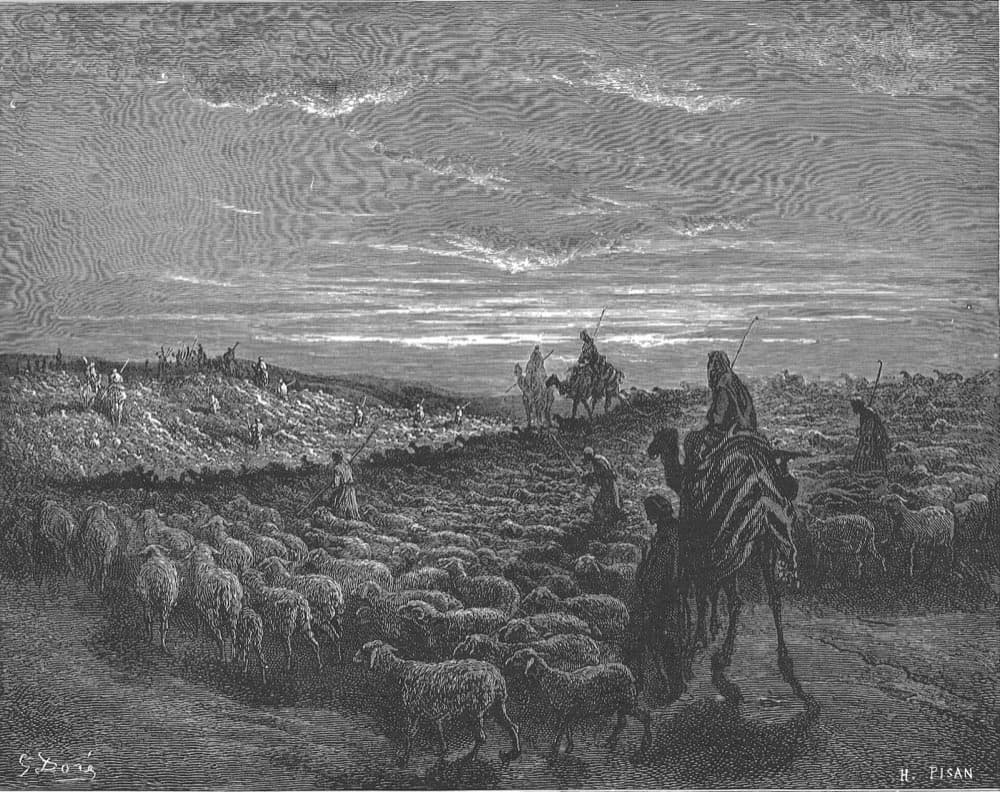
Abraham Goes to the Land of Canaan
Pearl of Great Price
The Intelligences and the Council
Abraham 3, and the two questions it answers
Abraham 3; compare Moses 4:1–4; D&C 93:2950 min4 sections
Abraham is shown the stars, then told that the same ordering applies to spirits, then shown a council at which mortality was proposed and two answers were given. It is the most complete account of premortal existence in scripture, and it comes with a genuinely difficult provenance that this lesson does not skip.
- Author
- Published by Joseph Smith as a translation of an Egyptian papyrus roll
- Date
- Published March 1842 in the Times and Seasons; the narrative is set in Abraham's lifetime, c. 2000–1800 BC
- Place
- Nauvoo, Illinois; the narrative is set in Ur and Egypt
- Audience
- Readers of a Latter-day Saint newspaper, and everyone since
- Language
- English; the source text was Egyptian
- Genre
- Visionary narrative with an astronomical frame
By the end you should be able to
- State what Abraham is shown about stars, and how the text applies that ordering to spirits.
- Distinguish 'intelligence' as used in Abraham 3 from 'intelligence' as used in D&C 93.
- Explain the two estates, and what is at stake in each.
- Describe the Book of Abraham's translation problem accurately, and say what the Church's own essay concludes.
The stars, and the governing ones
An astronomy lesson that turns out not to be about astronomy.
2And I saw the stars, that they were very great, and that one of them was nearest unto the throne of God; and there were many great ones which were near unto it;
3And the Lord said unto me: These are the governing ones; and the name of the great one is Kolob, because it is near unto me, for I am the Lord thy God: I have set this one to govern all those which belong to the same order as that upon which thou standest.
4And the Lord said unto me, by the Urim and Thummim, that Kolob was after the manner of the Lord, according to its times and seasons in the revolutions thereof.
9And thus there shall be the reckoning of the time of one planet above another, until thou come nigh unto Kolob… which Kolob is set nigh unto the throne of God, to govern all those planets which belong to the same order as that upon which thou standest.
For eight verses the chapter reads like cosmology: bodies in order, some greater than others, each with its own reckoning of time, and one nearest the throne. Then in verse 12 God says, in effect, that this was never really an astronomy lesson — 'I will show you these things before ye go into Egypt.' And in verse 18 the whole system is transposed onto something else.
16If two things exist, and there be one above the other, there shall be greater things above them…
18Howbeit that he made the greater star; as, also, if there be two spirits, and one shall be more intelligent than the other, yet these two spirits, notwithstanding one is more intelligent than the other, have no beginning; they existed before, they shall have no end, they shall exist after, for they are gnolaum, or eternal.
19And the Lord said unto me: These two facts do exist, that there are two spirits, one being more intelligent than the other; there shall be another more intelligent than they; I am the Lord thy God, I am more intelligent than they all.
One transliterated word, left untranslated
King James renders it “everlasting; for ever; of old”
Abraham 3:18's 'gnolaum' is generally understood as a rendering of the Hebrew ʿôlām, which the KJV translates 'everlasting.' The Hebrew is less about a timeline stretching infinitely in both directions than about a duration whose boundary is out of sight — which is exactly the sense the verse needs: 'they existed before, they shall exist after.'
Full lexicon entry →
The intelligences
What was there before the spirits were, and why the word is used two ways.
21I dwell in the midst of them all; I now, therefore, have come down unto thee to declare unto thee the works which my hands have made, wherein my wisdom excelleth them all…
22Now the Lord had shown unto me, Abraham, the intelligences that were organized before the world was; and among all these there were many of the noble and great ones;
23And God saw these souls that they were good, and he stood in the midst of them, and he said: These I will make my rulers; for he stood among those that were spirits, and he saw that they were good; and he said unto me: Abraham, thou art one of them; thou wast chosen before thou wast born.
| Passage | What the word does there |
|---|---|
| Abraham 3:19 | A comparative quality: one spirit is 'more intelligent' than another, and God is more intelligent than them all. |
| Abraham 3:22 | A plural noun for beings — 'the intelligences that were organized before the world was' — used interchangeably with 'souls' and 'spirits' in the next verse. |
| D&C 93:29 | Something uncreated in a person: 'Intelligence, or the light of truth, was not created or made, neither indeed can be.' |
| D&C 93:36 | A definition tying it to glory: 'The glory of God is intelligence, or, in other words, light and truth.' |
The Church has never adopted an official position on how these fit together, and it is worth being honest that the two most common Latter-day Saint reconstructions disagree. On one, individual uncreated intelligences were organised into spirit bodies by God, so the person predates their spirit. On the other, 'intelligence' names an uncreated quality or substance within a spirit rather than a prior individual. Both are defensible from the texts; neither is doctrine.
Principle
Foreordination in Abraham 3 is a calling given in advance, not a fate assigned in advance.
Abraham is told he was chosen before he was born — and then spends the rest of his life choosing whether to be what he was chosen for. Alma 13:3–5 makes the point explicitly: those foreordained were called 'on account of their exceeding faith and good works,' with agency intact on both sides of birth.
The council, and the two answers
Mortality proposed, the cost named, and a volunteer nobody accepted.
24And there stood one among them that was like unto God, and he said unto those who were with him: We will go down, for there is space there, and we will take of these materials, and we will make an earth whereon these may dwell;
25And we will prove them herewith, to see if they will do all things whatsoever the Lord their God shall command them;
26And they who keep their first estate shall be added upon; and they who keep not their first estate shall not have glory in the same kingdom with those who keep their first estate; and they who keep their second estate shall have glory added upon their heads for ever and ever.
27And the Lord said: Whom shall I send? And one answered like unto the Son of Man: Here am I, send me. And another answered and said: Here am I, send me. And the Lord said: I will send the first.
28And the second was angry, and kept not his first estate; and many followed after him.
The first (Moses 4:2)
"Father, thy will be done, and the glory be thine forever."
Method: the Father's will.
Glory: assigned to the Father.
Agency: untouched.
The second (Moses 4:1)
"I will redeem all mankind, that one soul shall not be lost, and surely I will do it; wherefore give me thine honor."
Method: guaranteed, which requires compulsion.
Glory: demanded for himself.
Agency: destroyed — and Moses 4:3 says so in those words.
It is worth sitting with how attractive the second proposal is on its face. Nobody lost. No suffering that was not necessary. The objection is not to the outcome but to the price: Moses 4:3 says he 'sought to destroy the agency of man,' and in the same breath that he wanted the Father's honour. Those are given as one offence, not two.
The word behind "prove"
King James renders it “prove; tempt; try”
The Hebrew verb used when God 'did tempt Abraham' in Genesis 22:1 — which the KJV's 'tempt' badly misleads. To prove something is to establish what it actually is under load. Abraham 3:25 uses the English word in the same older sense: mortality is not a trap but an assay.
| First estate | Second estate | |
|---|---|---|
| Where | Premortal life | Mortality |
| Kept by | Choosing to follow the Father's plan and come to earth | Doing 'all things whatsoever the Lord their God shall command' |
| Reward | 'Added upon' — a body, and the chance at the second estate | 'Glory added upon their heads for ever and ever' |
| Failure | 'Shall not have glory in the same kingdom' — the condition of those who followed the second | The remainder of the plan of salvation is about this case |
Principle
Everyone born into this life already passed one test, and the fact of being here is the evidence.
Verse 26 makes birth itself a result: those who kept the first estate 'shall be added upon,' and a body is what was added. Whatever else a person is struggling with, they are not on trial as to whether they chose correctly the first time.
The problem of the papyri
The honest state of the question, because a study tool that skips it is not worth much.
In 1835 Joseph Smith purchased several Egyptian mummies and papyrus rolls from Michael Chandler, and announced that one of the rolls contained the writings of Abraham. The Book of Abraham was published in 1842. The papyri were long assumed lost in the Great Chicago Fire, but eleven fragments turned up at the Metropolitan Museum of Art and were given to the Church in 1967.
Egyptologists — Latter-day Saint and otherwise — agree on what those fragments say. They are portions of ordinary Egyptian funerary texts: a Book of Breathings and a Book of the Dead, dating to roughly the first century BC or AD, almost two millennia after Abraham. They do not contain the text of the Book of Abraham. The characters that appear in the margins of the Kirtland Egyptian Papers next to Book of Abraham passages do not translate as those passages do.
To consider
- 01Abraham is told he was chosen before he was born, and then has to live the rest of his life anyway. What does foreordination actually change about a day?
- 02The second proposal promised that not one soul would be lost. Why is that not enough?
- 03If something in you was never created, what follows about what you are responsible for?
What this lesson holds
Spirits existed before this life, were of differing capacities, and are eternal in both directions — with no beginning and no end.
Mortality was proposed as a proving, and agency is the mechanism that makes the proving mean anything.
Foreordination is a calling extended in advance to people who remain free to accept or refuse it.
Check your reading
5 questions01What is the astronomy of Abraham 3 actually being used for?
02What does D&C 93:29 add to the picture?
03What was wrong with the second proposal at the council?
04What does keeping the first estate result in?
05What do the recovered papyrus fragments contain?
Where to go next
Sources
- Abraham 3 — The primary text.
- Gospel Topics Essay, "Translation and Historicity of the Book of Abraham" — The Church's own account of the papyri question
- The Joseph Smith Papers, Revelations and Translations Volume 4 — The Book of Abraham manuscripts and the Egyptian papers
- Pearl of Great Price Student Manual