Library / The Pearl of Great Price
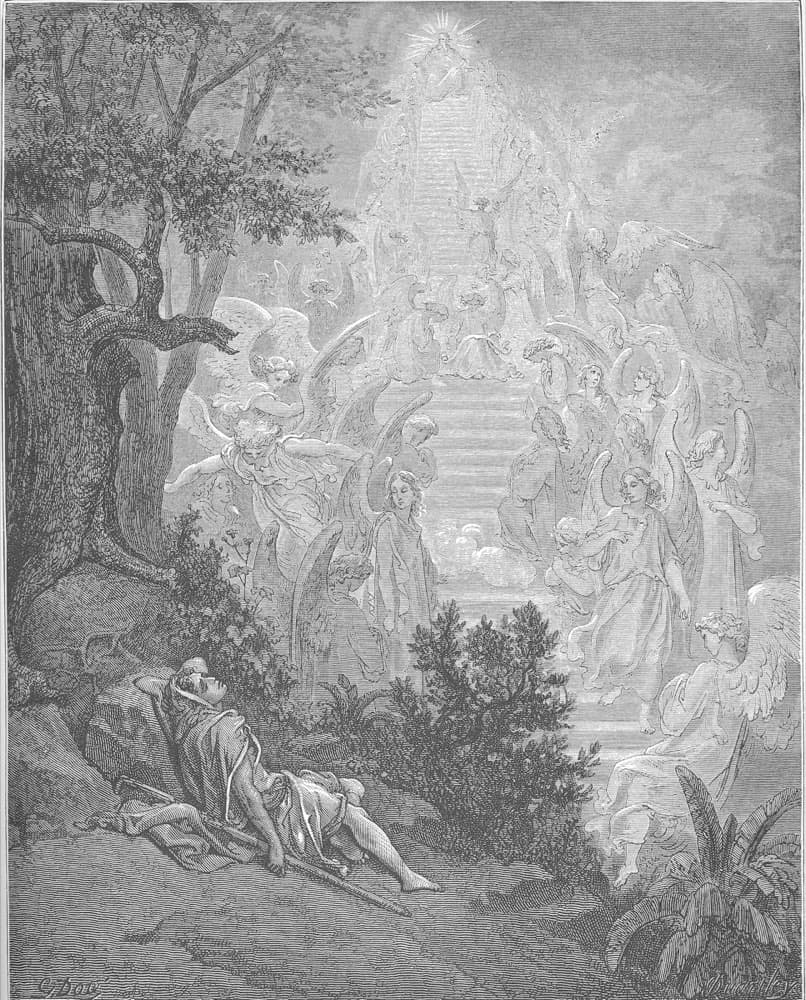
Jacob's Dream
Pearl of Great Price
The God Who Weeps
Moses 7, Enoch, and a city that was taken up
Moses 7; Genesis 5:21–24; Hebrews 11:5; D&C 38:440 min4 sections
Genesis gives Enoch four verses. The Book of Moses gives him a chapter, and in it Enoch sees God cry, asks Him how that is possible, and receives an answer that is one of the most consequential passages in Latter-day Saint scripture.
- Author
- Received by Joseph Smith during his revision of Genesis
- Date
- December 1830; the narrative is set in the antediluvian world
- Place
- Given in Fayette, New York
- Audience
- A church two months into its second year
- Genre
- Visionary narrative
By the end you should be able to
- State the definition of Zion given in Moses 7:18, and its four parts.
- Explain Enoch's question about God's tears and the answer he receives.
- Say what happened to the city of Enoch and how scripture elsewhere refers to it.
- Connect the chapter to the law of consecration and to 4 Nephi.
Four verses, and a chapter
What Genesis says, and what the Restoration adds.
22And Enoch walked with God after he begat Methuselah three hundred years, and begat sons and daughters:
24And Enoch walked with God: and he was not; for God took him.
That is the entire biblical account, plus a line in Hebrews 11:5 and a quotation in Jude 1:14–15. Ancient Jewish and Christian literature was far more interested in Enoch than the Bible is — 1 Enoch is a substantial book, quoted by Jude — so a Restoration text expanding him is not an isolated oddity.
13And so great was the faith of Enoch that he led the people of God, and their enemies came to battle against them; and he spake the word of the Lord, and the earth trembled, and the mountains fled…
17The fear of the Lord was upon all nations, so great was the glory of the Lord, which was upon his people.
18And the Lord called his people Zion, because they were of one heart and one mind, and dwelt in righteousness; and there was no poor among them.
| The clause | What it requires |
|---|---|
| Of one heart | Shared affection — they wanted the same things |
| And one mind | Shared understanding — they saw things the same way |
| Dwelt in righteousness | Conduct, sustained over time |
| And there was no poor among them | A measurable outcome, which is the only clause an outsider can check |
Principle
Zion is defined by an outcome as well as by a disposition, and the outcome is economic.
Three of the four clauses describe interior states. The fourth does not, and it is the one that makes the definition testable. 4 Nephi 1:3 reports the same result in the same terms — 'there were not rich and poor' — and Acts 4:34 says of the Jerusalem church that 'neither was there any among them that lacked.'
Enoch's question
The passage the chapter exists for.
28And it came to pass that the God of heaven looked upon the residue of the people, and he wept; and Enoch bore record of it, saying: How is it that the heavens weep, and shed forth their tears as the rain upon the mountains?
29And Enoch said unto the Lord: How is it that thou canst weep, seeing thou art holy, and from all eternity to all eternity?
32The Lord said unto Enoch: Behold these thy brethren; they are the workmanship of mine own hands, and I gave unto them their knowledge, in the day I created them; and in the Garden of Eden, gave I unto man his agency;
33And unto thy brethren have I said, and also given commandment, that they should love one another, and that they should choose me, their Father; but behold, they are without affection, and they hate their own blood;
37But behold, their sins shall be upon the heads of their fathers; Satan shall be their father, and misery shall be their doom; and the whole heavens shall weep over them, even all the workmanship of mine hands; wherefore should not the heavens weep, seeing these shall suffer?
Enoch's question is the classical theological one: how can a being who is holy and eternal be moved to tears? He is not corrected for asking. He is answered — and the answer runs on agency. God gave them knowledge and gave them agency, commanded them to love one another, and they refuse. The grief follows from the gift.
One substance in three persons, against three beings perfectly one in purpose. The difference is not a technicality — it changes what the baptism of Jesus and John 17 are describing.
The city
Taken up, and expected back.
21And he saw the Lord, and he walked with him, and was before his face continually; and he said unto the Lord: Whither goest thou? And the Lord said unto Enoch: Behold mine abode forever.
69And Enoch and all his people walked with God, and he dwelt in the midst of Zion; and it came to pass that Zion was not, for God received it up into his own bosom; and from thence went forth the saying, Zion is fled.
Where the city reappears
- Moses 7:62–64Enoch is shown Zion returning to meet the New Jerusalem, and the two embracing.
- D&C 38:4Christ identifies Himself as 'he who has taken the Zion of Enoch into mine own bosom.'
- D&C 45:11–12'Enoch and his brethren, who were separated from the earth, and were received unto myself.'
- Hebrews 11:5'By faith Enoch was translated that he should not see death.'
- Moses 7:27'The Holy Ghost fell on many, and they were caught up by the powers of heaven into Zion.'
It is worth noticing that Moses 7:27 has people continuing to join the city right up to the end. Zion is not portrayed as a closed group that qualified together; it is a place people kept being caught up into.
The instruction that follows
The chapter was given weeks before the Church was told to build one.
Moses 7 came in December 1830. In February 1831 the law of consecration was given as D&C 42, with 'thou wilt remember the poor' at its centre; by the summer the Saints were being told where to build. The sequence is not accidental — the revelation of what Zion was preceded the command to make one.
30And behold, thou wilt remember the poor, and consecrate of thy properties for their support that which thou hast to impart unto them, with a covenant and a deed which cannot be broken.
31And inasmuch as ye impart of your substance unto the poor, ye will do it unto me…
Principle
Zion is a condition before it is a place, and the condition is measurable.
The nineteenth-century attempts at a literal gathering ended; the definition did not. D&C 97:21 states it in the shortest form the canon contains: 'This is Zion — the pure in heart.' Read with Moses 7:18, the two definitions are one, since a people of one heart do not leave each other poor.
To consider
- 01Enoch asks how a holy God can weep and is answered rather than corrected. What does that suggest about the questions worth asking?
- 02Three clauses of the Zion definition are interior; one is checkable. Which do we usually measure ourselves by?
- 03People kept being caught up into the city right to the end. What does that do to the idea of a group that has already qualified?
What this lesson holds
Zion is one heart, one mind, righteousness, and no poor among them — three dispositions and one outcome.
God weeps, and the reason given is agency: He gave knowledge and freedom, commanded love, and they refuse.
The city of Enoch was taken up and is expected to return, which makes Zion both a memory and an appointment.
Check your reading
5 questions01How much does Genesis say about Enoch?
02What are the four parts of the Zion definition?
03How does God answer Enoch's question about His tears?
04What does Moses 7:27 record about the city?
05What does D&C 97:21 give as the shortest definition of Zion?
Where to go next
Sources
- Moses 7 — The primary text.
- Pearl of Great Price Student Manual
- Gospel Topics, "Zion"