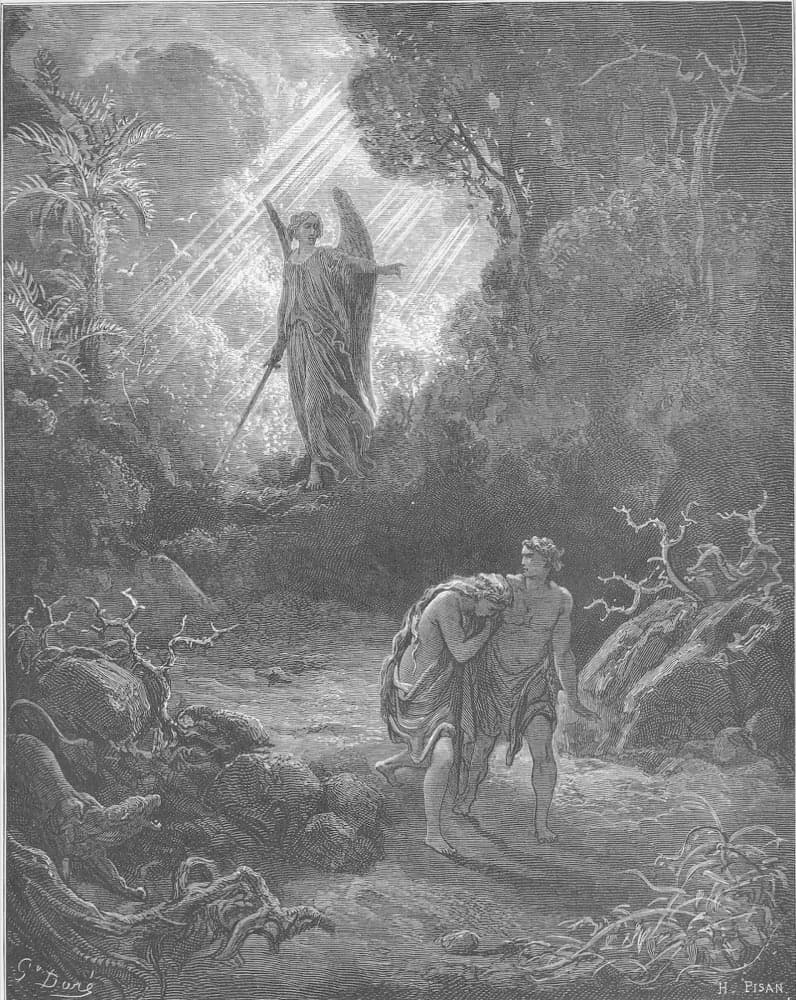
Adam and Eve Driven out of Eden
Old Testament
The Garden and the Choice
Genesis 3 with Moses 4 and 2 Nephi 2
Genesis 2:15–3:24; Moses 3–550 min4 sections
The chapter that historic Christianity reads as the origin of human ruin, and the Restoration reads as a necessary step. The Hebrew of Genesis 3 is stranger and more careful than either tradition's summary of it.
- Author
- Attributed to Moses; Moses 4–5 received by Joseph Smith in 1830
- Date
- —
- Place
- A garden eastward in Eden
- Language
- Biblical Hebrew
- Genre
- Narrative, with dense wordplay and legal-sounding pronouncements
By the end you should be able to
- Read ʿēzer kənegdô accurately and see how far the KJV's "help meet" has drifted.
- Identify what the serpent says that is true, and what makes it a temptation anyway.
- Explain the Latter-day Saint reading of the Fall as a purposed step, with its scriptural support.
- Notice what God does in Genesis 3:21, and what it implies.
Two commandments that could not both be kept
1:28And God blessed them, and God said unto them, Be fruitful, and multiply, and replenish the earth, and subdue it...
2:16And the Lord God commanded the man, saying, Of every tree of the garden thou mayest freely eat:
2:17But of the tree of the knowledge of good and evil, thou shalt not eat of it: for in the day that thou eatest thereof thou shalt surely die.
Latter-day Saint reading turns on the observation that these two commandments could not both be kept in Eden. 2 Nephi 2:23 says plainly that in that state Adam and Eve "would have had no children." Moses 3:17 preserves a phrase Genesis lacks and which changes the character of the second commandment entirely: "nevertheless, thou mayest choose for thyself, for it is given unto thee."
“Nevertheless, thou mayest choose for thyself, for it is given unto thee; but, remember that I forbid it.”
That single clause reframes the whole episode. The prohibition stands — "remember that I forbid it" — and yet the choice is explicitly placed in their hands. Whatever the Fall is in this reading, it is not a divine plan going wrong.
King James renders it “an help meet for him (Genesis 2:18)”
The KJV's phrase, compressed in later English into the noun "helpmeet," has been read as though it meant assistant. It does not. ʿĒzer is used overwhelmingly of God as Israel's help — "our help is in the name of the Lord" (Psalm 124:8) — and kənegdô means facing him, corresponding to him, over against him. A counterpart, not a subordinate.
Full lexicon entry →
What the serpent gets right
4And the serpent said unto the woman, Ye shall not surely die:
5For God doth know that in the day ye eat thereof, then your eyes shall be opened, and ye shall be as gods, knowing good and evil.
6And when the woman saw that the tree was good for food, and that it was pleasant to the eyes, and a tree to be desired to make one wise, she took of the fruit thereof, and did eat, and gave also unto her husband with her; and he did eat.
The uncomfortable fact about verse 5 is that God confirms it in verse 22: "Behold, the man is become as one of us, to know good and evil." The serpent's statement is not a lie about the effect. What makes it a temptation is the framing — that this is something being withheld out of divine self-interest — and the route, which bypasses everything else.
The pronouncements
15And I will put enmity between thee and the woman, and between thy seed and her seed; it shall bruise thy head, and thou shalt bruise his heel.
16Unto the woman he said, I will greatly multiply thy sorrow and thy conception; in sorrow thou shalt bring forth children; and thy desire shall be to thy husband, and he shall rule over thee.
17And unto Adam he said... cursed is the ground for thy sake; in sorrow shalt thou eat of it all the days of thy life;
19In the sweat of thy face shalt thou eat bread, till thou return unto the ground; for out of it wast thou taken: for dust thou art, and unto dust shalt thou return.
Verse 15 has been called the protoevangelium — the gospel in embryo — since the earliest Christian centuries. The seed of the woman crushes the serpent's head while the serpent strikes the heel: an asymmetry, one wound fatal and one not. Latter-day Saints read it alongside Moses 4:21, which preserves the same pronouncement.
Verse 17 is worth reading precisely: it is the ground that is cursed, and it is cursed "for thy sake" — for Adam's benefit. Moses 4:23 keeps the phrase. The labour that follows is presented as being to his advantage, which is a very different thing from a punishment.
21Unto Adam also and to his wife did the Lord God make coats of skins, and clothed them.
One verse, easily skipped, and it is the first act of mercy after the Fall. They had made themselves aprons of fig leaves (3:7); God replaces that with something durable. Skins imply a death — the first in the story — and a covering provided rather than improvised. The Hebrew root behind atonement, kāphar, means precisely to cover.
Fall upward
The historic Christian reading
The Fall is a catastrophe that frustrates God's design.
Human nature is corrupted at the root; guilt is inherited.
Redemption repairs damage that ought never to have occurred.
The Restoration reading
The Fall was foreknown and provided for — "all things have been done in the wisdom of him who knoweth all things" (2 Nephi 2:24).
Children are punished for their own sins, not for Adam's transgression (Articles of Faith 1:2).
"Adam fell that men might be; and men are, that they might have joy" (2 Nephi 2:25).
The difference is not that Latter-day Saints minimise the Fall. Its consequences in this theology are severe and comprehensive: physical death, spiritual death, a fallen nature, and a world of thorns. The difference is what the Fall was for. Here it is the door into a probation in which agency has stakes.
The Restoration's texts on the Fall
- 2 Nephi 2:22–25No children, no joy, no good done, no sin known — and "Adam fell that men might be."
- Moses 5:10–11Adam and Eve rejoice; Eve names the transgression as the price of seed and of "the joy of our redemption."
- Alma 12:22–25The Fall brought a probationary time — "a time to repent."
- Alma 42:2–10The cherubim and flaming sword as a mercy: had they eaten of the tree of life, there would have been no space for repentance.
- Articles of Faith 1:2Punished for their own sins, and not for Adam's transgression.
Alma 42:2–10 supplies the reading of Genesis 3:22–24 that most repays attention. The cherubim and the flaming sword are usually pictured as a punishment. Alma treats them as a protection: if fallen humanity had eaten of the tree of life immediately, there would have been no probationary space, and "the great plan of salvation would have been frustrated." Being kept from the tree is what preserves the possibility of repentance.
What this lesson holds
The Fall was a purposed step in the plan of salvation, not a defeat of it.
Adam and Eve were placed under two commandments that could not both be kept, and were given the choice.
Human beings are accountable for their own sins, not for Adam's transgression.
God's first act after the Fall is to cover them Himself.
Check your reading
5 questions01What does ʿēzer kənegdô mean in Genesis 2:18?
02What clause does Moses 3:17 add to the commandment about the tree?
03Genesis 3:17 says the ground is cursed. For whose sake?
04How does Alma 42 read the cherubim and the flaming sword?
05What is the first thing God does for Adam and Eve after the pronouncements?
Where to go next
Sources
- Genesis 2–3; Moses 3–5; 2 Nephi 2; Alma 42 — The primary texts.
- "The Family: A Proclamation to the World" — First Presidency and Quorum of the Twelve Apostles, 1995 — equal partners
- Dallin H. Oaks, "The Great Plan of Happiness" — General Conference, October 1993
- Gospel Topics, "Fall of Adam and Eve"