Library / Jesus Christ and the Everlasting Gospel
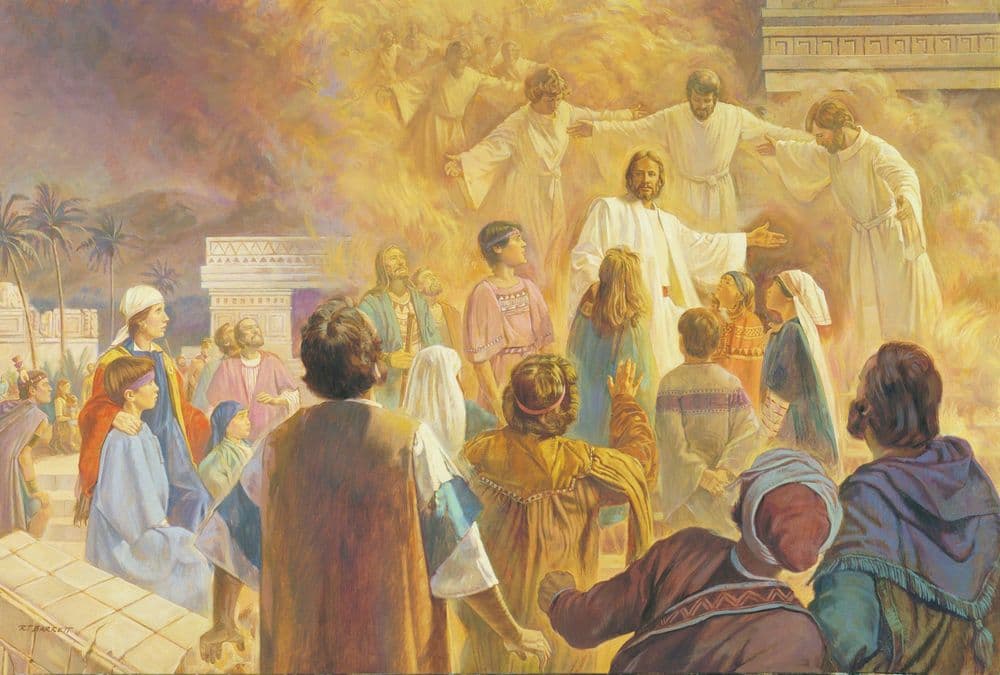
Jesus Blesses the Nephite Children · 3 Ne. 17:11–25
Across the standard works
The Condescension of God
1 Nephi 11, Philippians 2, and how far down He came
1 Nephi 11:13–33; Philippians 2:5–8; D&C 88:6; Mosiah 3:5–845 min4 sections
An angel asks Nephi whether he knows the condescension of God, and Nephi says he does not. The answer he is given is not a definition but a series of pictures — a virgin, a child, a ministry, a cross — and the Greek of Philippians 2 supplies the verb the whole doctrine turns on.
- Author
- Nephi's own record; Paul's letter to the Philippians
- Date
- c. 600–592 BC for 1 Nephi 11; c. AD 60–62 for Philippians
- Place
- The wilderness south of Jerusalem; a Roman prison
- Audience
- Nephi's descendants; a congregation Paul loved and was writing to from confinement
- Genre
- Vision with angelic interpretation; an early Christian hymn quoted in a letter
By the end you should be able to
- State what the angel's question means and how the vision answers it.
- Translate the Greek verb of Philippians 2:7 and say what it does and does not mean.
- Connect the condescension to the tree of life and to the love of God.
- Explain why 'he descended below all things' matters practically rather than only theologically.
The angel's question
Nephi asks for the interpretation of a tree and is asked a question instead.
13And it came to pass that I looked and beheld the great city of Jerusalem, and also other cities. And I beheld the city of Nazareth; and in the city of Nazareth I beheld a virgin, and she was exceedingly fair and white.
16And he said unto me: Knowest thou the condescension of God?
17And I said unto him: I know that he loveth his children; nevertheless, I do not know the meaning of all things.
18And he said unto me: Behold, the virgin whom thou seest is the mother of the Son of God, after the manner of the flesh.
20And I looked and beheld the virgin again, bearing a child in her arms.
21And the angel said unto me: Behold the Lamb of God, yea, even the Son of the Eternal Father! Knowest thou the meaning of the tree which thy father saw?
Notice the sequence. Nephi asks for the interpretation of his father's dream. Before he gets it, he is shown a young woman in a small town, asked whether he understands the condescension of God, and given the most honest answer in the Book of Mormon: 'I know that he loveth his children; nevertheless, I do not know the meaning of all things.'
Then the vision moves: the virgin, the child in her arms, the ministry, the baptism, the twelve, the healings, and finally the cross. And only after all of that does the angel return to the original question and tell him the tree is the love of God. The interpretation was not a definition; it was a biography.
Principle
The love of God is not defined in this vision. It is shown, and what is shown is a descent.
Nephi asks what the tree means and is answered with the whole arc of the Incarnation. The angel's method says something about the subject: whatever 'the love of God' names, it is not primarily an emotion but a course of action taken at cost.
The verb in Philippians 2
The word Paul uses is stranger and stronger than the English.
5Let this mind be in you, which was also in Christ Jesus:
6Who, being in the form of God, thought it not robbery to be equal with God:
7But made himself of no reputation, and took upon him the form of a servant, and was made in the likeness of men:
8And being found in fashion as a man, he humbled himself, and became obedient unto death, even the death of the cross.
Widely regarded as a pre-Pauline hymn that Paul is quoting — which would make it among the oldest Christian material we possess.
Three words the King James softens
Philippians 2
In the form of God
Emptied himself
Took the form of a slave
Made in the likeness of men
Humbled himself
Obedient unto death
Even the death of the cross
1 Nephi 11
The Lamb of God, the Son of the Eternal Father (v. 21)
Born of a virgin in Nazareth (v. 18–20)
Going forth ministering to the people (v. 28)
Baptized of a prophet (v. 27)
Judged of the world (v. 32)
Lifted up upon the cross (v. 33)
Slain for the sins of the world (v. 33)
Seven downward steps in Paul, and the same descent narrated in pictures by Nephi's angel six centuries earlier. Philippians 2:9 then reverses the direction in a single word — 'wherefore God also hath highly exalted him' — but the reversal only means what it means because of how far down the first half went.
Below all things
The Restoration's own phrase, and the practical consequence of it.
6He that ascended up on high, as also he descended below all things, in that he comprehended all things, that he might be in all and through all things, the light of truth.
'Comprehended' here carries its older sense: to encompass, to take in entirely, rather than merely to understand. The verse gives a reason for the descent — He went below all things in order to encompass all things — and D&C 122:8 turns the same doctrine into pastoral counsel for a man in a basement jail: 'The Son of Man hath descended below them all. Art thou greater than he?'
“Know thou, my son, that all these things shall give thee experience, and shall be for thy good.”
The argument in D&C 122 is not that suffering is good, and not that Joseph's suffering was deserved. It is that there is no floor he can reach that is lower than the one already occupied — which is a strange consolation until you have needed it, and then it is the only one that holds.
The same doctrine, four ways
- Alma 7:11–12He takes upon Himself pains, afflictions, temptations, sicknesses and infirmities — with the stated purpose that He would know how to succour.
- Hebrews 4:15Not a high priest who cannot be touched with the feeling of our infirmities, but one tempted in all points as we are.
- Hebrews 2:14–18He took flesh and blood because the children were flesh and blood — the kinship argument, stated as necessity.
- Mosiah 3:5–8King Benjamin's angel on what the descent would cost, given more than a century before it happened.
Principle
The condescension is what makes the succour possible: He knows how to help because He went there, not because He is informed.
Alma 7:12 gives the purpose clause explicitly — 'that he may know according to the flesh how to succor his people.' An omniscient God could have known everything about suffering without any of this. The text insists on a knowledge acquired in the flesh, which is a different kind of knowing.
Which is the love of God
Back to the tree, with the answer now in view.
22And I answered him, saying: Yea, it is the love of God, which sheddeth itself abroad in the hearts of the children of men; wherefore, it is the most desirable above all things.
23And he spake unto me, saying: Yea, and the most joyous to the soul.
25And I beheld that the rod of iron, which my father had seen, was the word of God, which led to the fountain of living waters, or to the tree of life; which waters are a representation of the love of God.
Two images for the same thing: a tree bearing fruit, and a fountain of living waters. Both are nourishment, both are freely available, and both require going to them. The rod of iron does not deliver the fruit; it leads to the tree.
King James renders it “charity; love”
The word the New Testament reaches for when it means love that is chosen and acted rather than felt and received. 1 John 4:9–10 defines it by an event rather than a feeling: 'Herein is love, not that we loved God, but that he loved us, and sent his Son.' Which is precisely how Nephi's angel answered the question.
Full lexicon entry →
To consider
- 01Nephi says 'I know that he loveth his children; nevertheless, I do not know the meaning of all things.' What is the difference between those two kinds of knowing?
- 02Philippians 2:5 asks you to have the same mind. What would emptying yourself look like this week, in one specific relationship?
- 03D&C 122:8 offers a consolation that is not an explanation. Why might that be the only honest kind?
What this lesson holds
The condescension of God is a descent taken voluntarily from a station He had every right to keep.
The love of God is shown in scripture as an event rather than defined as a sentiment.
He descended below all things, which means there is no condition a person can reach that He has not already been beneath.
Check your reading
5 questions01What does "condescension" mean in 1 Nephi 11?
02How does the angel answer Nephi's question about the tree?
03What does the Greek verb in Philippians 2:7 literally mean?
04Why does Alma 7:12 say Christ took upon Himself infirmities?
05What does D&C 88:6 give as the reason for descending below all things?
Where to go next
Chains
Sources
- 1 Nephi 11 — The primary text.
- Philippians 2:5–11 — The Christ hymn.
- Book of Mormon Student Manual
- Guide to the Scriptures, "Condescension of God"