Topics / Godhead
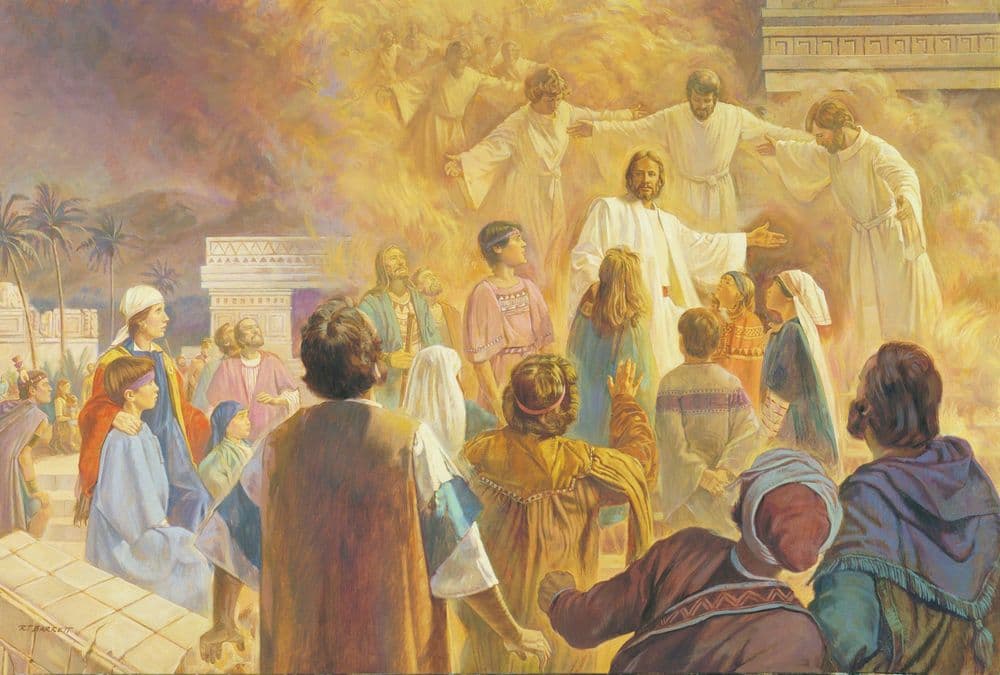
Jesus Blesses the Nephite Children · 3 Ne. 17:11–25
Three persons, one purpose
The Godhead
Latter-day Saints are not Trinitarian in the creedal sense, and the difference is not a technicality. Three distinct beings, perfectly united in purpose — a claim that resolves several New Testament passages the creeds have to work hard to accommodate.
20 min2 sections
The claim
One substance in three persons, against three beings perfectly one in purpose. The difference is not a technicality — it changes what the baptism of Jesus and John 17 are describing.
22The Father has a body of flesh and bones as tangible as man's; the Son also; but the Holy Ghost has not a body of flesh and bones, but is a personage of Spirit. Were it not so, the Holy Ghost could not dwell in us.
Two embodied persons and one personage of spirit, with a reason given for the difference. The first Article of Faith states the same thing in the plainest possible words: 'We believe in God, the Eternal Father, and in His Son, Jesus Christ, and in the Holy Ghost.' Three names, three articles, one sentence.
The creeds
One God in three persons, of one substance (homoousios).
Without body, parts or passions.
The three are distinguished by relations of origin, not by being.
Formulated at Nicaea (325) and refined for centuries afterward.
The Restoration
Three distinct beings, perfectly one in mind, purpose and will.
The Father and the Son embodied; the Holy Ghost a personage of spirit.
United by unity of purpose, which is the sense John 17 gives the word 'one.'
Stated from the First Vision onward.
In what sense "one"
21That they all may be one; as thou, Father, art in me, and I in thee, that they also may be one in us: that the world may believe that thou hast sent me.
22And the glory which thou gavest me I have given them; that they may be one, even as we are one.
This is the passage that settles the question of what 'one' means, and it settles it by extension. Christ prays that the disciples may be one as He and the Father are one. Whatever unity He is describing is a unity a group of people can enter — which rules out unity of substance, unless the disciples are to become the same substance as God.
In John 10:30 — 'I and my Father are one' — the Greek is the neuter hen rather than the masculine heis. The neuter suggests one thing, one purpose, rather than one person. Greek had a way to say 'one being' and John did not use it.
Principle
The Father, the Son and the Holy Ghost are three distinct beings, one in purpose, will and glory — and the unity described is one that disciples are invited into.
D&C 130:22 · John 17:20–22 · Articles of Faith 1:1 · 3 Nephi 11:27
What this topic holds
The Godhead is three persons united in purpose, not one being in three modes or relations.
The unity of the Godhead is the unity Christ prays His disciples will share, which locates it in will rather than in substance.
Check your reading
3 questions01What does D&C 130:22 say about the Holy Ghost?
02Why does John 17:21–22 matter for the definition of 'one'?
03What does the baptism of Jesus show about the Godhead?
Where to go next
Sources
- Gospel Topics, "Godhead"
- Bible Dictionary, "God"
- D&C 130:22; Articles of Faith 1:1 — The doctrinal statements.