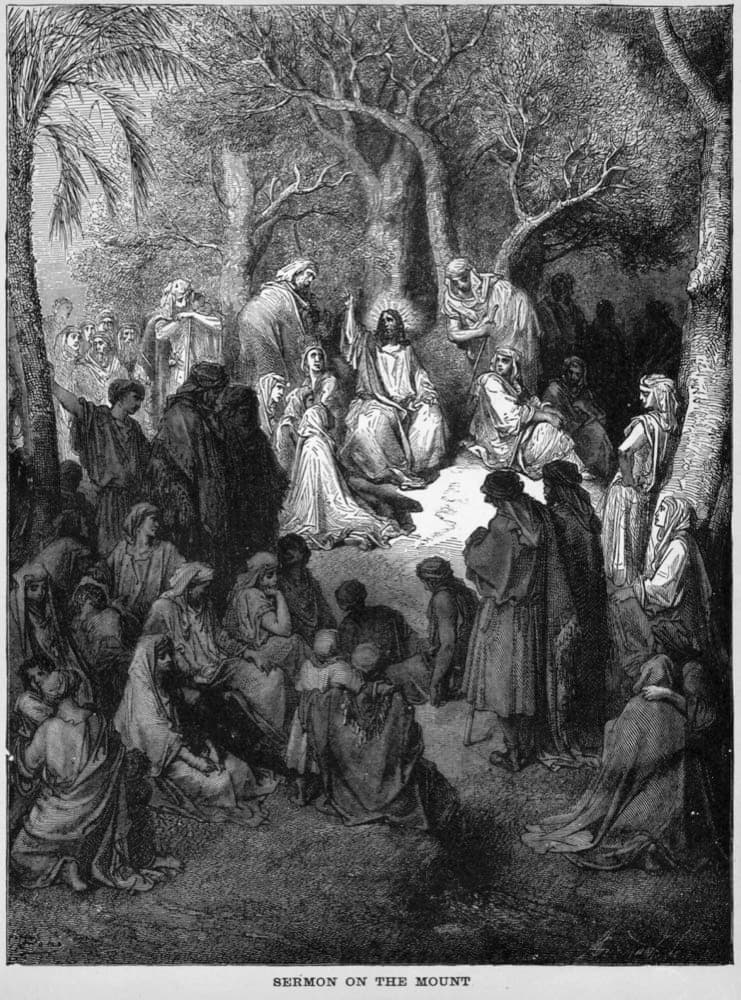
The Sermon on the Mount
New Testament
Why He Spoke in Parables
Matthew 13, and a teaching method that sorts its own audience
Matthew 13; Mark 4:1–34; JST Matthew 13:10–11; Isaiah 6:9–1045 min4 sections
A parable is not a simple story for simple people. It is a device that gives everyone the same words and lets them take away different amounts — and Matthew 13 has Christ say so, in a passage the King James makes sound considerably harsher than the Joseph Smith Translation does.
- Author
- Matthew, drawing on Mark and other material
- Date
- The teaching c. AD 29–30; the Gospel written c. AD 70–90
- Place
- By the sea of Galilee, from a boat
- Audience
- A crowd on the shore, and the disciples afterward in a house
- Language
- Greek, from Aramaic teaching
- Genre
- Parable discourse — seven parables in one chapter
By the end you should be able to
- State the reason Christ gives for teaching in parables, and how the JST changes it.
- Interpret the parable of the sower using the interpretation the text itself supplies.
- Say what the seven parables of Matthew 13 have in common.
- Distinguish a parable from an allegory, and say why the difference matters when reading one.
The reason given
The disciples ask directly, and the answer is uncomfortable in the King James.
10And the disciples came, and said unto him, Why speakest thou unto them in parables?
11He answered and said unto them, Because it is given unto you to know the mysteries of the kingdom of heaven, but to them it is not given.
13Therefore speak I to them in parables: because they seeing see not; and hearing they hear not, neither do they understand.
Read plainly, that sounds like parables are a device for withholding — a way of keeping outsiders out. Mark 4:12 is sharper still: 'lest at any time they should be converted, and their sins should be forgiven them.' Both are quoting Isaiah 6:9–10, and both have troubled readers for a very long time.
King James
“Because it is given unto you to know the mysteries of the kingdom of heaven, but to them it is not given.”
“Therefore speak I to them in parables: because they seeing see not.”
The cause runs from God's withholding to the people's blindness.
Joseph Smith Translation
“…but unto them it is not given, for they receive not my words, for they believe not on me, for they will not repent.”
The order is reversed: they do not receive, therefore they are not given.
The blindness is diagnosed, not imposed.
The JST does not soften the outcome — the people still do not understand. It relocates the cause. On this reading a parable is not a lock on the door but a mirror: it gives everyone identical words and returns to each person the measure of interest they brought.
Principle
A parable is a teaching device that sorts its own audience — it withholds nothing, and it also gives nothing to a listener who will not work.
Matthew 13:12 states the rule: 'whosoever hath, to him shall be given.' Alma 12:9–11 says the same thing at greater length, and calls the result 'the lesser portion of the word' — a portion determined by the hearer.
JST Matthew 13:10–11 · Matthew 13:12 · Alma 12:9–11
The sower
The one parable the text interprets for us — which makes it the key to the rest.
3Behold, a sower went forth to sow;
4And when he sowed, some seeds fell by the way side, and the fowls came and devoured them up:
5Some fell upon stony places, where they had not much earth: and forthwith they sprung up, because they had no deepness of earth:
7And some fell among thorns; and the thorns sprung up, and choked them:
8But other fell into good ground, and brought forth fruit, some an hundredfold, some sixtyfold, some thirtyfold.
| Ground | What happens | Why |
|---|---|---|
| By the way side | The word is taken away at once | He heareth and understandeth it not |
| Stony places | Received with joy, withers under tribulation | No root in himself — he dureth for a while |
| Among thorns | Grows, then is choked | The care of this world and the deceitfulness of riches |
| Good ground | Bears thirty, sixty, a hundredfold | He heareth and understandeth |
Seven pictures of one kingdom
What the chapter's parables have in common, and what each adds.
| Parable | Verses | What it adds |
|---|---|---|
| The sower | 3–23 | The word goes out to everyone; the ground decides the outcome |
| The wheat and the tares | 24–30, 36–43 | Good and evil grow together until the harvest, and premature sorting damages the wheat |
| The mustard seed | 31–32 | Something negligible at the start becomes the largest thing in the garden |
| The leaven | 33 | The kingdom works invisibly, from inside, through the whole lump |
| The hidden treasure | 44 | Found by accident; the finder sells everything, with joy |
| The pearl of great price | 45–46 | Found after deliberate searching; the same total price |
| The net | 47–50 | Gathers of every kind; the sorting comes at the end, and not by us |
Read as a set, the seven answer an obvious first-century objection. If the kingdom of God has arrived, why does the world look exactly as it did? The parables reply: because it starts small, works invisibly, grows alongside its opposite, and is not sorted until the end.
Two words in the discourse
Matthew 13 is taught from a boat on the Sea of Galilee, with the crowd on the shore — an accidental amphitheatre.
He that hath ears
The refrain, and what it asks of a reader.
16But blessed are your eyes, for they see: and your ears, for they hear.
17For verily I say unto you, That many prophets and righteous men have desired to see those things which ye see, and have not seen them.
51Jesus saith unto them, Have ye understood all these things? They say unto him, Yea, Lord.
52Then said he unto them, Therefore every scribe which is instructed unto the kingdom of heaven is like unto an householder, which bringeth forth out of his treasure things new and old.
Verse 52 is a parable about parables, and about study. The trained scribe is a householder with a storeroom, and what makes him useful is that he brings out both new things and old — neither a man with only the tradition nor a man with only the latest thing.
Principle
Understanding a parable is not a matter of cleverness but of willingness; the phrase repeated through the chapter is 'who hath ears to hear.'
To consider
- 01The variable in the sower is the ground. Which of the four describes how you listened to something you heard recently?
- 02The seven parables answer the objection that the world looks unchanged. Does that answer satisfy you?
- 03The scribe brings out things new and old. Which of the two are you short of?
What this lesson holds
Parables give every listener the same words and return to each the measure of interest they brought.
Matthew 13:12 · JST Matthew 13:10–11 · Alma 12:9–11
The sower scatters everywhere; what differs is the ground, which is the hearer.
The kingdom begins small, works invisibly, grows alongside its opposite, and is sorted only at the end.
Check your reading
5 questions01How does the Joseph Smith Translation change Matthew 13:11?
02What is the variable in the parable of the sower?
03What does the Greek mystērion mean?
04What is the difference between a parable and an allegory?
05What does Matthew 13:52 say a trained scribe is like?
Where to go next
Sources
- Matthew 13; Mark 4 — The primary text.
- Bible Dictionary, "Parables"
- New Testament Student Manual
- JST Matthew 13:10–11 — Printed in the Latter-day Saint edition of the Bible.