Topics / Discipleship
What a disciple actually does
Discipleship
Not what a disciple feels. Every passage in which the Lord describes His followers names specific, checkable behaviour — and the judgment scene in Matthew 25 turns entirely on six ordinary acts, none of them religious in form.
20 min2 sections
The marks
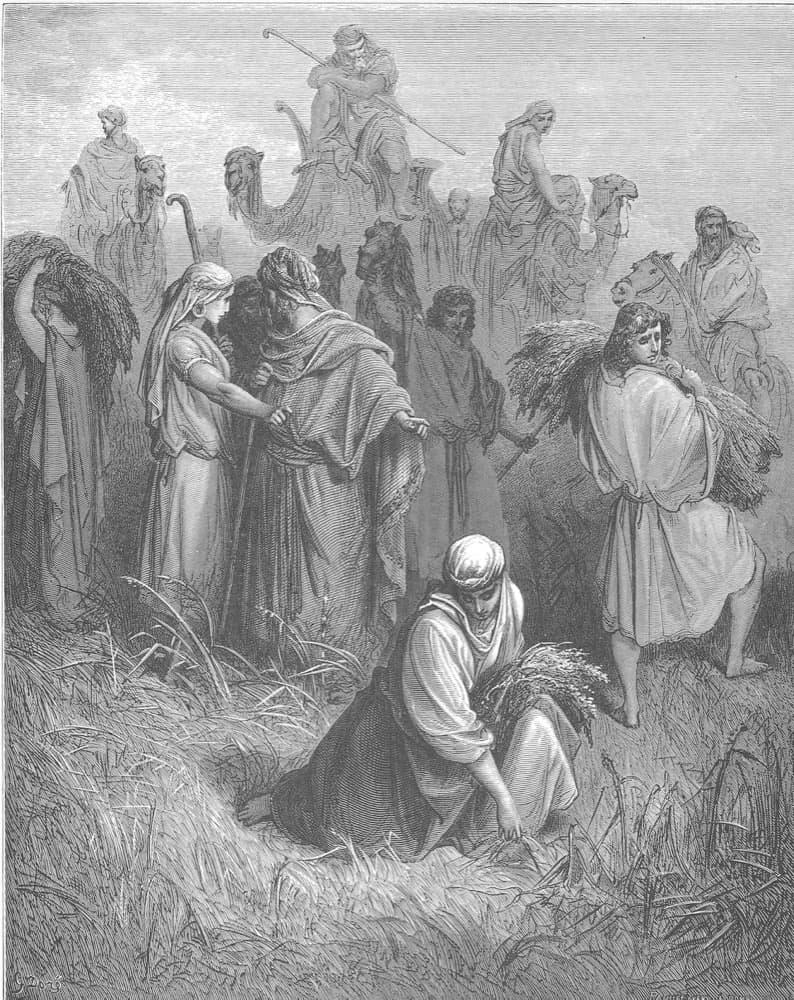
Ruth gleaning. The book turns on ḥesed — loyalty shown by someone under no obligation at all.
Galilee, Samaria, Judea and Perea, with the places the Gospels name most. Roughly seventy miles separate Nazareth from Jerusalem.
35By this shall all men know that ye are my disciples, if ye have love one to another.
The identifying mark is not belief, doctrine, worship style or attendance. It is a public, observable quality of relationship — which means it is checkable by outsiders, which is what 'all men shall know' implies.
Cross-references
- Matthew 25:34–40Six acts: food, drink, welcome, clothing, care, visitation. Both groups are surprised, which means the identification was not a reward for noticing.
- Mosiah 18:8–9Bear one another's burdens; mourn with those that mourn; comfort those in need of comfort.
- James 1:27Pure religion: visit the fatherless and widows in their affliction, and keep oneself unspotted.
- Luke 9:23'Take up his cross daily' — the daily is the hard word, and Luke is the only one who includes it.
- John 21:15–17Feed my sheep, three times, for three denials. Restoration and assignment arrive together.
The cost, stated plainly
27And whosoever doth not bear his cross, and come after me, cannot be my disciple.
28For which of you, intending to build a tower, sitteth not down first, and counteth the cost, whether he have sufficient to finish it?
The Lord's recruiting method is unusual: He tells people to count the cost before committing, and He tells the rich young ruler exactly what it would cost him. Nothing in the Gospels suggests He wanted followers who had not understood the terms.
Principle
Discipleship is identified by behaviour toward other people, and the terms are stated in advance rather than discovered later.
What this topic holds
The identifying mark of a disciple is love that other people can observe.
The judgment described in Matthew 25 turns on six ordinary acts, none of them religious in form.
Check your reading
3 questions01What does John 13:35 give as the identifying mark of disciples?
02What is notable about both groups in Matthew 25?
03What does Luke 14:28 tell would-be disciples to do?
Where to go next
Sources
- Matthew 25; John 13; Luke 14; Mosiah 18 — The primary texts.