Topics / Restoration
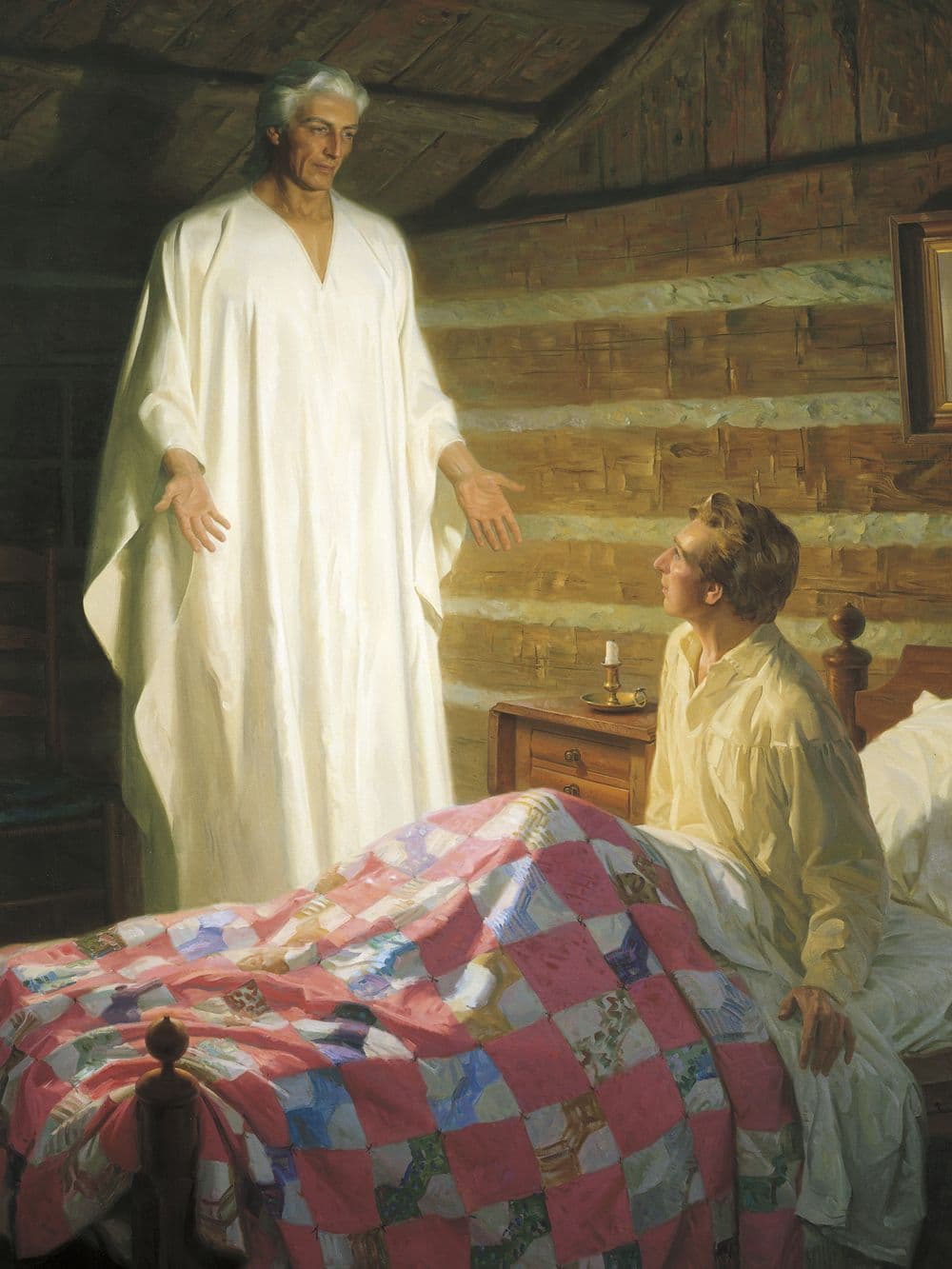
Moroni Appears to Joseph Smith in His Room · JS—H 1:27–47
Personal, prophetic, and the boundary between them
Revelation
The Restoration's central claim is that God still speaks. Scripture describes how, sets out the tests, and — importantly — bounds personal revelation by stewardship, which is a protection rather than a limitation.
22 min2 sections
How it comes
8But, behold, I say unto you, that you must study it out in your mind; then you must ask me if it be right, and if it is right I will cause that your bosom shall burn within you; therefore, you shall feel that it is right.
9But if it be not right you shall have no such feelings, but you shall have a stupor of thought that shall cause you to forget the thing which is wrong.
The order corrects the common expectation: work first, then ask. Verse 7 names the mistake explicitly — 'you took no thought save it was to ask me.' Both outcomes are answers, which means a felt absence is information rather than a failure.
- In the mind and in the heart (D&C 8:2–3) — thought is not excluded from revelation.
- As a still small voice (1 Kings 19:12) — the Hebrew is 'a sound of thin silence.'
- By dreams, visions and angels (Joel 2:28; Acts 10:3) — rarer, and never the everyday form.
- Through the scriptures (2 Nephi 32:3) — 'the words of Christ will tell you all things what ye should do.'
- Through others: parents, leaders, patriarchal blessings, and counsel from people who know you.
Boundaries and tests
2But, behold, verily, verily, I say unto thee, no one shall be appointed to receive commandments and revelations in this church excepting my servant Joseph Smith, Jun., for he receiveth them even as Moses.
7For I have given him the keys of the mysteries, and the revelations which are sealed, until I shall appoint unto them another in his stead.
Given in response to Hiram Page receiving revelations for the Church through a seer stone.
The answer to Hiram Page was not that his revelations were fake but that they were out of order. Personal revelation operates within stewardship: for yourself, your family, and your calling. That boundary prevents a church of competing revelators, and it also protects individuals from anyone claiming revelation about their life.
| Test | Source |
|---|---|
| Does it invite and entice to do good and believe in Christ? | Moroni 7:16–17 |
| Is it within your stewardship? | D&C 28:2–7 |
| Is it consistent with scripture and with the counsel of those with keys? | D&C 1:38; D&C 21:4–6 |
| What fruit does it bear over time? | Galatians 5:22–23; Matthew 7:16 |
| Did you study it out first? | D&C 9:7–8 |
Principle
Personal revelation is real, expected and bounded by stewardship — and the boundary is a protection, not a restriction.
What this topic holds
The test of a prompting is its direction and its fruit, not its intensity.
Check your reading
3 questions01What mistake does D&C 9:7 name?
02Why was D&C 28 given?
03What is the stupor of thought in D&C 9:9?
Where to go next
Sources
- Gospel Topics, "Revelation"
- D&C 8; D&C 9; D&C 28; Moroni 7 — The primary texts.