Library / Doctrine and Covenants
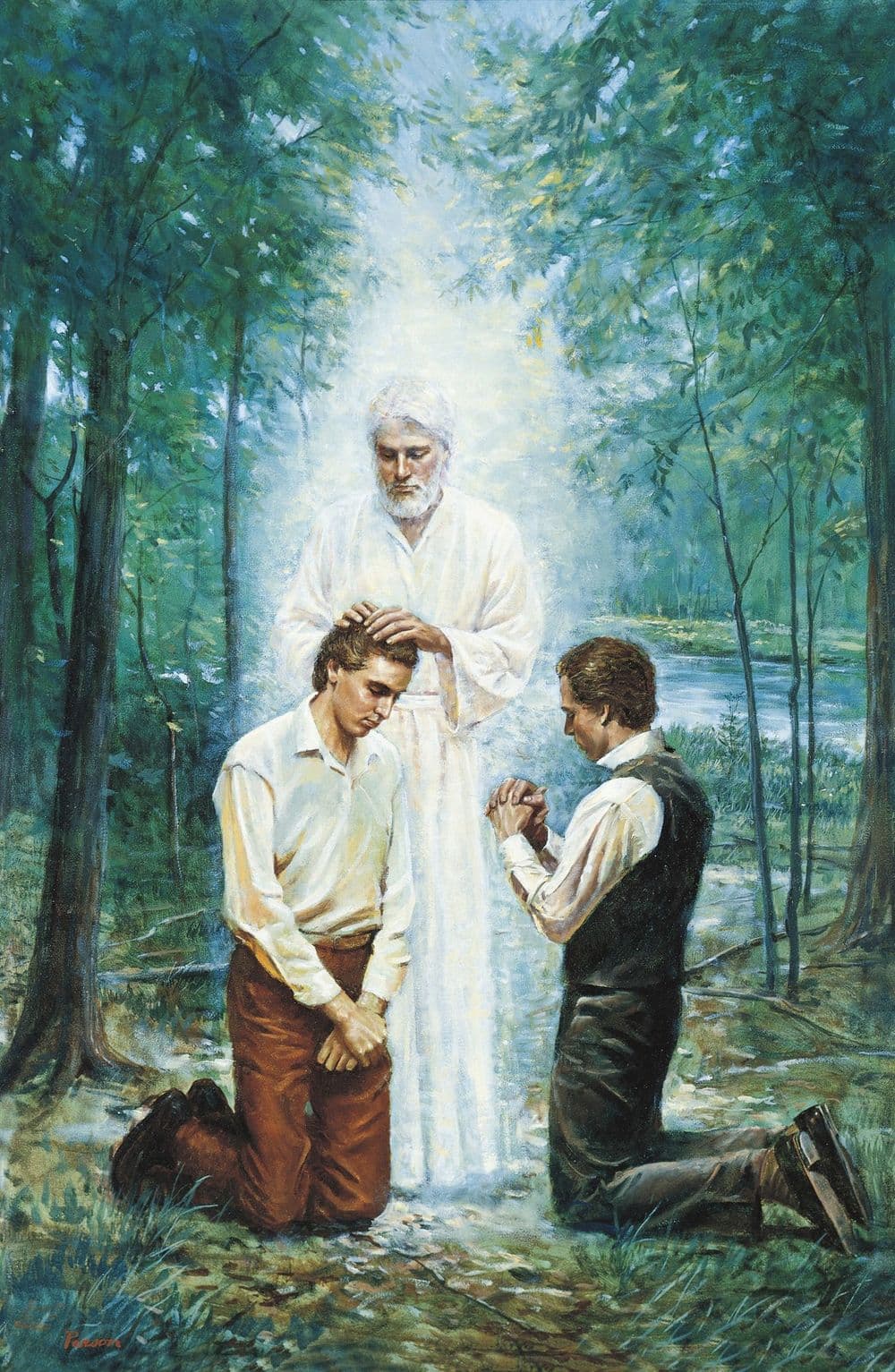
John the Baptist Conferring the Aaronic Priesthood · D&C 13
Doctrine and Covenants
The Oath and the Covenant
D&C 84, priesthood, and the promise attached to it
D&C 84:19–48; Hebrews 7:11–28; Exodus 33:20; JST Exodus 34:1–245 min4 sections
The revelation that explains what priesthood is actually for — not administration but access — and then attaches to it the most expansive promise in the Doctrine and Covenants, along with a warning that is just as expansive.
- Author
- Revelation to Joseph Smith
- Date
- 22–23 September 1832
- Place
- Kirtland, Ohio, with eleven elders newly returned from missions
- Audience
- Elders of the Church, and everyone ordained since
- Genre
- Revelation on priesthood
By the end you should be able to
- State what D&C 84:19–22 says the priesthood is for.
- Explain what Israel lost, and why, from D&C 84:23–27.
- Lay out the oath and covenant in its two halves: what is promised, and what is required.
- Say what verses 54–58 identify as the condemnation resting on the Church.
What priesthood is for
Four verses that reframe the whole subject.
19And this greater priesthood administereth the gospel and holdeth the key of the mysteries of the kingdom, even the key of the knowledge of God.
20Therefore, in the ordinances thereof, the power of godliness is manifest.
21And without the ordinances thereof, and the authority of the priesthood, the power of godliness is not manifest unto men in the flesh;
22For without this no man can see the face of God, even the Father, and live.
The claim is not that priesthood organises a church, though it does. It is that ordinances are where a particular kind of power is made available — and verse 22 states the stakes in terms that sound like Exodus 33:20, where Moses is told no man can see God and live.
The tabernacle plan is the same claim in architecture: access, granted by degrees, through ordinances.
What Israel lost
The revelation's explanation of a gap the Bible leaves open.
23Now this Moses plainly taught to the children of Israel in the wilderness, and sought diligently to sanctify his people that they might behold the face of God;
24But they hardened their hearts and could not endure his presence; therefore, the Lord in his wrath, for his anger was kindled against them, swore that they should not enter into his rest while in the wilderness, which rest is the fulness of his glory.
25Therefore, he took Moses out of their midst, and the Holy Priesthood also;
26And the lesser priesthood continued, which priesthood holdeth the key of the ministering of angels and the preparatory gospel;
27Which gospel is the gospel of repentance and of baptism, and the remission of sins, and the law of carnal commandments…
Exodus 20:18–21 records the moment from the other side: the people see the mountain smoking and ask Moses to speak with God on their behalf, 'lest we die.' The request is entirely understandable. D&C 84 says what it cost, and JST Exodus 34:1–2 says the second set of tables reflected the loss.
| Greater (Melchizedek) | Lesser (Aaronic) | |
|---|---|---|
| Holds | The key of the knowledge of God | The key of the ministering of angels |
| Administers | The gospel; the power of godliness in ordinances | The preparatory gospel: repentance, baptism, remission of sins |
| Effect | Access to the presence of God | Preparation for it |
| In Israel | Taken with Moses | Continued through Aaron's line |
The oath and the covenant
The promise, and the price, in eight verses.
33For whoso is faithful unto the obtaining these two priesthoods of which I have spoken, and the magnifying their calling, are sanctified by the Spirit unto the renewing of their bodies.
34They become the sons of Moses and of Aaron and the seed of Abraham, and the church and kingdom, and the elect of God.
35And also all they who receive this priesthood receive me, saith the Lord;
36For he that receiveth my servants receiveth me;
38And he that receiveth my Father receiveth my Father's kingdom; therefore all that my Father hath shall be given unto him.
39And this is according to the oath and covenant which belongeth to the priesthood.
40Therefore, all those who receive the priesthood, receive this oath and covenant of my Father, which he cannot break, neither can it be moved.
God's part — the oath
Sanctification by the Spirit, unto the renewing of the body
Adoption into the covenant lineage
“All that my Father hath”
An oath He cannot break, and which cannot be moved
The person's part — the covenant
Obtain the priesthood
Magnify the calling — verse 33's word is doing real work
Give diligent heed to the words of eternal life (v. 43–44)
Live by every word that proceedeth from the mouth of God
41But whoso breaketh this covenant after he hath received it, and altogether turneth therefrom, shall not have forgiveness of sins in this world nor in the world to come.
42And wo unto all those who come not unto this priesthood which ye have received, which I have appointed unto you for the sake of the whole world.
Verse 41 is severe, and the qualifier is doing the work: 'and altogether turneth therefrom.' The condition described is complete and deliberate repudiation, not failure — which is the same category D&C 76:31–35 describes and says applies to very few. Anyone reading verse 41 and worrying about it is, by that fact, not in it.
The condemnation
The end of the revelation names something the Church still quotes against itself.
54And your minds in times past have been darkened because of unbelief, and because you have treated lightly the things you have received—
55Which vanity and unbelief have brought the whole church under condemnation.
56And this condemnation resteth upon the children of Zion, even all.
57And they shall remain under this condemnation until they repent and remember the new covenant, even the Book of Mormon and the former commandments which I have given them, not only to say, but to do according to that which I have written;
58That they may bring forth fruit meet for their Father's kingdom; otherwise there remaineth a scourge and a judgment to be poured out upon the children of Zion.
The remedy named in verse 57 has two parts, and the second is the harder one: remember the Book of Mormon and the former commandments, 'not only to say, but to do.' President Ezra Taft Benson made this passage the centre of his ministry in the 1980s, arguing that the condemnation had not been lifted.
“The Book of Mormon is the keystone of our religion. The Lord Himself has stated that the Book of Mormon is the “keystone of our religion.””
Principle
The priesthood exists for access rather than administration, and the promise attached to it is unbounded and conditional in the same sentence.
To consider
- 01Verse 20 says the power of godliness is manifest in ordinances. When did an ordinance last do something rather than mean something to you?
- 02Israel asked not to hear God directly and was given a mediator. What is the modern form of that request?
- 03Verse 57's remedy is “not only to say, but to do.” What would doing look like this week?
What this lesson holds
The greater priesthood holds the key of the knowledge of God, and its ordinances are where the power of godliness is manifest.
Israel lost the higher priesthood because it declined to approach God directly, and received a preparatory law instead.
D&C 84:23–27 · Exodus 20:18–21 · JST Exodus 34:1–2
The oath is God's — sanctification, adoption, and all that the Father hath; the covenant is the person's — obtaining, magnifying, and living by every word.
Check your reading
5 questions01What does D&C 84:20 say is manifest in the ordinances of the priesthood?
02Why was the higher priesthood taken from Israel?
03What does 'magnify' mean in verse 33?
04What is promised in D&C 84:38?
05What remedy does verse 57 name for the condemnation?
Where to go next
Sources
- D&C 84 — The primary text.
- Revelations in Context, "The Vision and the Priesthood"
- Doctrine and Covenants Student Manual