Come, Follow Me / 2026 / week 51
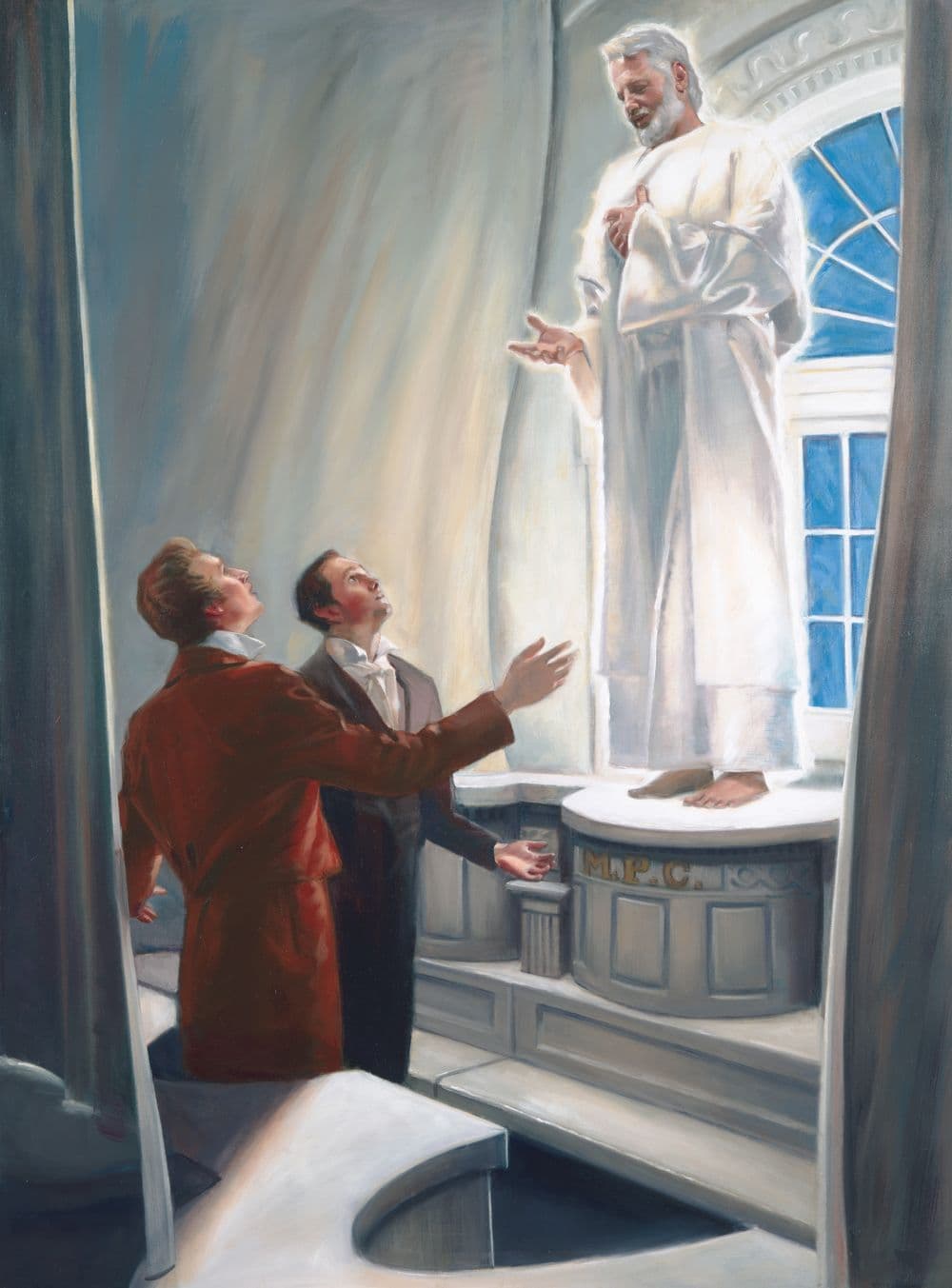
Elijah Appearing in the Kirtland Temple · Mal. 4:5–6
Week 51 of 52
study guideMalachi
December 14–20, 2026
The last two verses of the Old Testament are about Elijah — and Moroni quoted them to Joseph Smith with a variation he took care to record.
The big idea
The Old Testament's last voice promises that the Lord will come suddenly to His temple — and that Elijah will come first, to turn the hearts of families to each other.
Step 1 · Get your bearings
Before you read
Who is speaking, to whom, and what was happening to them.
- When
- c. 460–430 BC, around the time of Ezra and Nehemiah, some decades after the second temple was finished.
- Where
- Jerusalem, with a working temple and a tired priesthood.
- Who
- Priests offering blemished animals, and a people who withheld tithes, broke their marriages and asked, “What profit is it that we have kept his ordinance?” (3:14).
What was happening
The temple had been rebuilt, but the excitement had faded. Worship had become routine and grudging. Malachi's name means “my messenger,” and his book is a series of arguments: God makes a statement, the people answer “Wherein?” — prove it — and God explains.
Step 2 · See the whole
The shape of the week
Malachi is built as a set of disputes. It opens, “I have loved you, saith the Lord. Yet ye say, Wherein hast thou loved us?” The pattern repeats: how have we despised your name? how have we polluted you? how have we robbed you? The people are not openly rebellious. They are cynical — going through the motions and wondering what the point is.
The topics are practical: sacrifices of blind and lame animals, priests who teach falsely, men abandoning “the wife of thy youth,” withheld tithes. Then the book turns to the future: a messenger who prepares the way, the Lord coming suddenly to His temple like a refiner's fire, a book of remembrance for the faithful, the Sun of righteousness rising with healing, and Elijah.
After Malachi, prophecy in the Bible falls silent for about four centuries; the next prophet in the story is John the Baptist, whom Jesus identified as Malachi's messenger. The risen Savior thought these chapters important enough to give to the Nephites Himself, because their records did not contain them (3 Nephi 26:2).
Step 3 · Read
Day by day
The block in seven readings, each with one thing to look for. Tick a day off when you have read it.
MonDec 14
Notice the pattern: God speaks, the people ask “Wherein?” How many times can you find it?
ThuDec 17
What does God invite in 3:10? What is written in the book of remembrance (3:16)?
SatDec 19
Why did the Savior give these chapters to the Nephites? Compare 3 Nephi 25:2 with Malachi 4:2 — one word is different.
SunDec 20
Joseph Smith—History 1:36–39; D&C 2
How does Moroni's quotation of Malachi 4:5–6 differ from the Bible's?
Step 4 · Go slowly
Key passages
The verses the week turns on — what they meant to the people who first heard them, and what they mean for you. Tap any verse to mark it.
1Passage 1 of 5
Wherein hast thou loved us?
Malachi 1:2, 6–8ot 2I have loved you, saith the Lord. Yet ye say, Wherein hast thou loved us? Was not Esau Jacob’s brother? saith the Lord: yet I loved Jacob,
6A son honoureth his father, and a servant his master: if then I be a father, where is mine honour? and if I be a master, where is my fear? saith the Lord of hosts unto you, O priests, that despise my name. And ye say, Wherein have we despised thy name?
7Ye offer polluted bread upon mine altar; and ye say, Wherein have we polluted thee? In that ye say, The table of the Lord is contemptible.
8And if ye offer the blind for sacrifice, is it not evil? and if ye offer the lame and sick, is it not evil? offer it now unto thy governor; will he be pleased with thee, or accept thy person? saith the Lord of hosts.
What it meant then
God's first words in the book are “I have loved you.” The people answer with a shrug: prove it. Then the priests offer the animals nobody else wanted — blind, lame, sick. Try giving that to the governor, God says; would he be pleased?
What it means now
Giving God our leftovers usually means we have quietly stopped believing He loves us. The book begins with love because everything else in it depends on that — including the quality of what we offer.
Ask yourself
What would change if you gave the Lord your best rather than what is left over?
2Passage 2 of 5
Like a refiner's fire
Malachi 3:1–3ot 1Behold, I will send my messenger, and he shall prepare the way before me: and the Lord, whom ye seek, shall suddenly come to his temple, even the messenger of the covenant, whom ye delight in: behold, he shall come, saith the Lord of hosts.
2But who may abide the day of his coming? and who shall stand when he appeareth? for he is like a refiner’s fire, and like fullers’ soap:
3And he shall sit as a refiner and purifier of silver: and he shall purify the sons of Levi, and purge them as gold and silver, that they may offer unto the Lord an offering in righteousness.
What it meant then
God will send a messenger to prepare the way, and then the Lord will come suddenly to His temple. But who can stand when He appears? He is like a refiner's fire and a launderer's soap — He will sit patiently over His people until they are pure.
What it means now
Jesus said John the Baptist was the messenger (Matthew 11:10). The Lord came suddenly to His temple in Kirtland in 1836 (D&C 110:1–4). And Joseph Smith applied verse 3 to temple work for the dead: the offering in righteousness is a record of our dead, worthy of acceptance (D&C 128:24).
In the original Hebrew
King James renders it “refiner”
Refining silver means heating it until the impurities separate and can be skimmed off — too little heat and nothing happens, too much and the silver is lost. Malachi pictures the Lord sitting at the work, attending to it, not walking away from the fire.
Ask yourself
A refiner stays with the silver until it is pure. What might the Lord be refining in you?
3Passage 3 of 5
Prove me now herewith
Malachi 3:8–10ot 8Will a man rob God? Yet ye have robbed me. But ye say, Wherein have we robbed thee? In tithes and offerings.
9Ye are cursed with a curse: for ye have robbed me, even this whole nation.
10Bring ye all the tithes into the storehouse, that there may be meat in mine house, and prove me now herewith, saith the Lord of hosts, if I will not open you the windows of heaven, and pour you out a blessing, that there shall not be room enough to receive it.
What it meant then
“Will a man rob God?” The people had withheld tithes and offerings. God answers with an invitation instead of a threat: bring the whole tithe, and test whether He will not open the windows of heaven.
What it means now
The Lord established the law of tithing for the latter days in 1838 (D&C 119). The windows of heaven do not always open onto money — they open onto what is actually needed, which is often something else.
In the original Hebrew
Ask yourself
How have you seen the windows of heaven opened in ways that were not financial?
4Passage 4 of 5
A book of remembrance
Malachi 3:16–17ot 16Then they that feared the Lord spake often one to another: and the Lord hearkened, and heard it, and a book of remembrance was written before him for them that feared the Lord, and that thought upon his name.
17And they shall be mine, saith the Lord of hosts, in that day when I make up my jewels; and I will spare them, as a man spareth his own son that serveth him.
What it meant then
While cynics were saying that serving God was pointless (3:14–15), those who feared the Lord talked with one another — and God listened, and had it written in a book of remembrance. They will be His, “in that day when I make up my jewels.”
What it means now
Adam's family kept a book of remembrance (Moses 6:5–6), and family history continues the practice. God notices quiet faithfulness between friends, and treasures it.
In the original Hebrew
King James renders it “jewels”
The same word God used at Sinai when He promised Israel would be “a peculiar treasure unto me” (Exodus 19:5) — the word studied in this library's Sinai lesson. A king's səgullāh was his private treasure, as opposed to the property of the state. The Old Testament ends by repeating the promise it made at the mountain.
Ask yourself
What conversations about the Lord from this week would be worth writing down?
5Passage 5 of 5
I will send you Elijah the prophet
Malachi 4:5–6ot 5Behold, I will send you Elijah the prophet before the coming of the great and dreadful day of the Lord:
6And he shall turn the heart of the fathers to the children, and the heart of the children to their fathers, lest I come and smite the earth with a curse.
What it meant then
The last words of the Old Testament: before the great and dreadful day of the Lord, Elijah will come to turn the hearts of fathers and children toward each other — or the earth will be struck with a curse.
What it means now
Elijah came on 3 April 1836 in the Kirtland Temple and committed the sealing keys to Joseph Smith and Oliver Cowdery (D&C 110:13–16). Moroni had quoted this passage to Joseph in 1823 with a telling difference — Elijah would reveal the priesthood, and plant in the hearts of the children the promises made to the fathers (Joseph Smith—History 1:38–39).
Ask yourself
Whose heart in your family — living or dead — could you turn toward this week?
Every page points to Him
Look for Christ
“They are they which testify of me” (John 5:39). Where this week's reading does.
The Lord suddenly in His temple
Malachi promised a messenger and then the Lord Himself, coming suddenly to His temple. John the Baptist prepared the way; Jesus came to the temple and cleansed it; and He came again, suddenly, to the temple in Kirtland.
Healing in His wings
The Sun of righteousness will rise “with healing in his wings.” The Book of Mormon renders it “Son of Righteousness.” The Hebrew word for wings, kānāp, also means the corner or hem of a garment, where the tassels hung (Numbers 15:38) — which is why readers have long connected this verse with the woman healed by touching the hem of His garment. That connection is a reading, not something the text states.
The refiner and purifier
The Lord who refines His people does it through His Atonement: sins as scarlet made white, and a people purified until they can stand in His presence.
Latter-day light
What the Restoration adds
What the Book of Mormon, the Doctrine and Covenants, the Pearl of Great Price and the Joseph Smith Translation bring to this block.
Given to the Nephites
The risen Savior recited Malachi 3–4 to the Nephites because their records did not have them — Lehi's family had left Jerusalem well over a century before Malachi wrote. He then expounded all things to them, from the beginning.
Moroni's version
When Moroni quoted Malachi 4:5–6 to Joseph Smith, the wording differed from the Bible's, and Joseph recorded it carefully. It became section 2 of the Doctrine and Covenants.
The welding link
Joseph Smith wrote that the earth would be smitten with a curse unless there is a welding link between the fathers and the children — and that the link is baptism and ordinances for the dead.
What to carry out of the week
Principles to live
- 1
God's love comes first; faithful obedience answers it.
- 2
The Lord deserves our best, not our leftovers.
- 3
The Lord refines those who come to Him.
- 4
Paying tithing opens the windows of heaven.
- 5
God remembers those who fear Him and speak of Him to each other.
- 6
The sealing power binds families across generations.
Make it yours
Ponder and record
Pick one question. Write what comes — a sentence is enough.
- 01The people kept asking “Wherein?” — how have you loved us? What questions like that do people ask God today?
- 02Malachi 3:6 says, “I am the Lord, I change not.” Why is that comforting in a book about people who had drifted?
- 03Why do you think the Old Testament ends with a promise about families?
- 04The Savior made sure the Nephites had Malachi 3–4. What does that suggest about how much He wants us to have them?
- 05What would it take for your heart to turn toward your ancestors this week?
Kept on this device, and collected in your notebook with everything else.
Teaching it
At home or in class
Simple ways to study this week together.
- Idea 1Write family names on paper strips and link them into a chain while reading Malachi 4:6 and D&C 128:18.
- Idea 2Start or add to a family book of remembrance: each person writes one thing they noticed the Lord do this week (3:16).
- Idea 3Look at a piece of jewellery and read 3:17. What does it mean that God calls His people His treasure?
Keep going
More in this library
Full lessons, topics and word studies that bear on this week's block.
Lessons
Full studies on this block — setting, original language, doctrine, sources.
Doctrinal topics
The doctrine this block raises, followed wherever it goes in the canon.
Reference chains
Passages in a deliberate order, each step earning the next.
Hebrew & Greek
The words underneath the English, where the translation cost something.
Sources
- Come, Follow Me — For Home and Church: Old Testament 2026
- Old Testament Student Manual: 1 Kings–Malachi — Church Educational System, on Malachi
- Bible Dictionary, “Elijah”
- Brown, Driver and Briggs, A Hebrew and English Lexicon of the Old Testament — s.v. צרף, מעשׂר, בחן, סגלה, כנף
Scripture text is the Church’s edition of the King James Version, fetched from the Gospel Library rather than retyped.