Come, Follow Me / 2026 / week 50
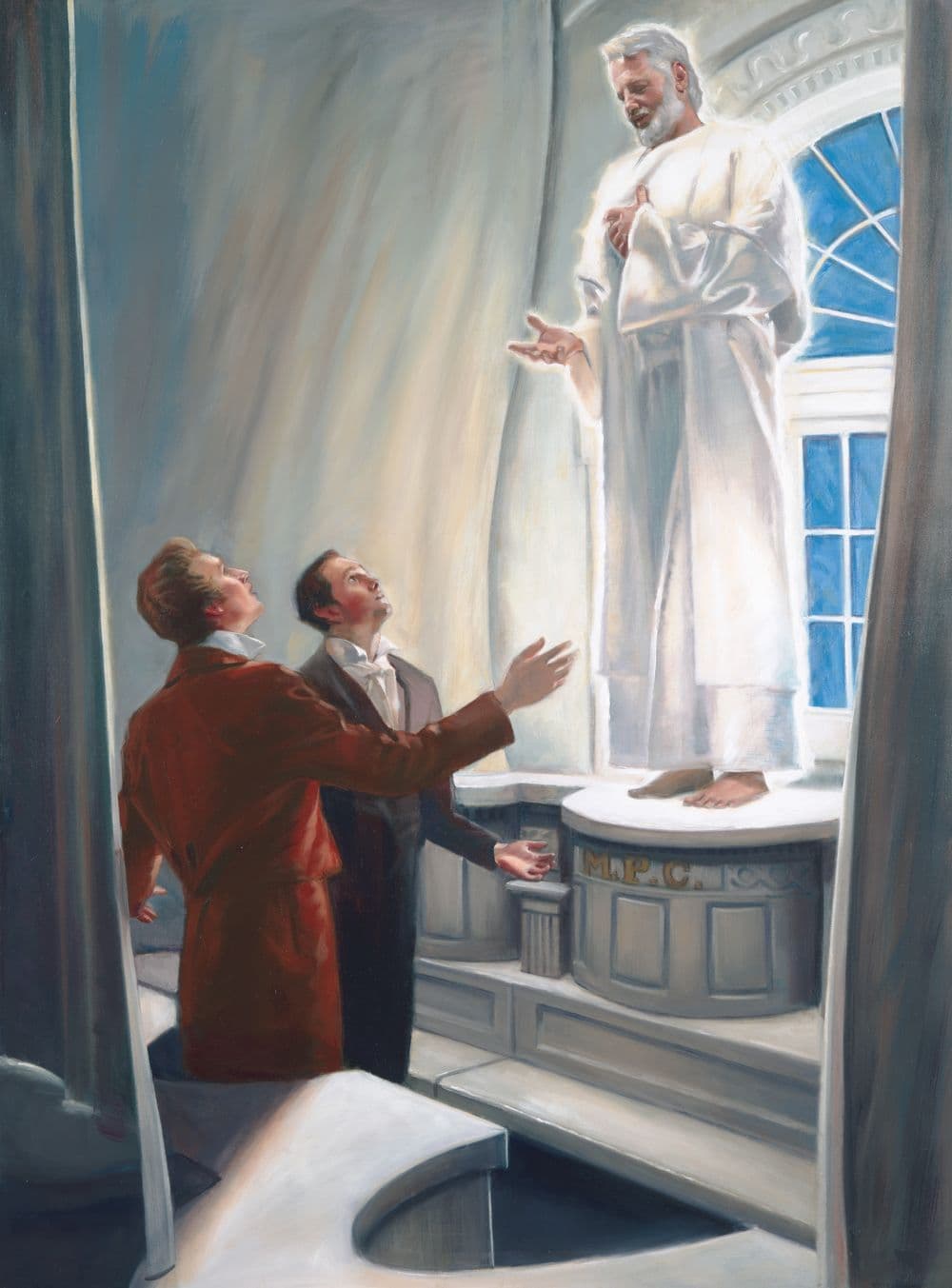
Elijah Appearing in the Kirtland Temple · Mal. 4:5–6
Week 50 of 52
study guideHaggai 1–2; Zechariah 1–4; 7–14
December 7–13, 2026
Zechariah 12:10 — “they shall look upon me whom they have pierced” — where the speaker is the Lord and the piercing is done to Him.
The big idea
Build the Lord's house first — and watch for the King who comes riding on a donkey, and who keeps the wounds He received in the house of His friends.
Step 1 · Get your bearings
Before you read
Who is speaking, to whom, and what was happening to them.
- When
- 520 BC, the second year of the Persian king Darius (Haggai 1:1; Zechariah 1:1). The temple was finished in 515 BC (Ezra 6:15).
- Where
- Jerusalem, about eighteen years after the first exiles came home under Cyrus.
- Who
- Zerubbabel the governor, Joshua the high priest, and returned exiles who had rebuilt their own homes but left the temple a bare foundation.
What was happening
The first returnees laid the temple's foundation around 536 BC and then stopped, worn down by opposition and poverty. For nearly two decades it sat unfinished while people panelled their own houses. Haggai and Zechariah began preaching in the same year, and within about four years the temple stood again (Ezra 5:1–2; 6:14–15).
Step 2 · See the whole
The shape of the week
Haggai is four short, dated messages given over four months. The first asks a blunt question — why do you live in panelled houses while God's house lies in ruins? — and the people respond within twenty-four days (1:15) — a striking contrast with the long years the foundation had sat untouched.
Zechariah opens with eight visions in one night: horsemen patrolling the earth, a man with a measuring line, the high priest's filthy clothes replaced with clean ones, a golden lampstand fed by two olive trees. Chapters 7–8 answer a question about fasting by talking about mercy instead. Chapters 9–14 look ahead to a coming King — and they are among the Old Testament passages most often quoted in the Gospel accounts of Jesus' last week.
Read chapters 9–14 with the New Testament open. The king on a donkey, the thirty pieces of silver, the shepherd struck and the sheep scattered, the one they pierced, the wounds in his hands, the Lord standing on the Mount of Olives — all of it reappears in the Gospels or in the Doctrine and Covenants.
Step 3 · Read
Day by day
The block in seven readings, each with one thing to look for. Tick a day off when you have read it.
MonDec 7
What had the people built for themselves (1:4)? What happens within twenty-four days (1:12–15)?
FriDec 11
Zechariah 9–10; Matthew 21:1–5
Read 9:9, then Matthew 21. What kind of king arrives, and on what?
SatDec 12
What is the shepherd paid in 11:12, and where is it thrown? Then read 12:10 slowly — who is pierced?
SunDec 13
Read 13:6 beside D&C 45:51–53. Where does the Lord stand in 14:4?
Step 4 · Go slowly
Key passages
The verses the week turns on — what they meant to the people who first heard them, and what they mean for you. Tap any verse to mark it.
1Passage 1 of 5
Consider your ways
Haggai 1:4–9ot 4Is it time for you, O ye, to dwell in your ceiled houses, and this house lie waste?
5Now therefore thus saith the Lord of hosts; Consider your ways.
6Ye have sown much, and bring in little; ye eat, but ye have not enough; ye drink, but ye are not filled with drink; ye clothe you, but there is none warm; and he that earneth wages earneth wages to put it into a bag with holes.
7Thus saith the Lord of hosts; Consider your ways.
8Go up to the mountain, and bring wood, and build the house; and I will take pleasure in it, and I will be glorified, saith the Lord.
9Ye looked for much, and, lo, it came to little; and when ye brought it home, I did blow upon it. Why? saith the Lord of hosts. Because of mine house that is waste, and ye run every man unto his own house.
What it meant then
The people said it was not yet the right time to build the temple (1:2), while living in finished, panelled houses. Meanwhile nothing satisfied: they sowed much and harvested little, and wages vanished “into a bag with holes.”
What it means now
The Lord gave the Saints almost the same rebuke in 1833, when they delayed building the Kirtland Temple (D&C 95:1–3). We can misread the results of misplaced priorities as bad luck — Haggai asks us to consider our ways instead.
In the original Hebrew
King James renders it “cieled”
“Cieled” is old English for panelled — walls lined with wood, the finishing touch of a wealthy home. The complaint is not that they had houses, but that they had finished theirs down to the decoration while God's had not been started.
Ask yourself
What commitment to the Lord have you left unfinished while you finished your own projects?
2Passage 2 of 5
Take away the filthy garments
Zechariah 3:1–5ot 1And he shewed me Joshua the high priest standing before the angel of the Lord, and Satan standing at his right hand to resist him.
2And the Lord said unto Satan, The Lord rebuke thee, O Satan; even the Lord that hath chosen Jerusalem rebuke thee: is not this a brand plucked out of the fire?
3Now Joshua was clothed with filthy garments, and stood before the angel.
4And he answered and spake unto those that stood before him, saying, Take away the filthy garments from him. And unto him he said, Behold, I have caused thine iniquity to pass from thee, and I will clothe thee with change of raiment.
5And I said, Let them set a fair mitre upon his head. So they set a fair mitre upon his head, and clothed him with garments. And the angel of the Lord stood by.
What it meant then
Joshua the high priest stands before the angel of the Lord in filthy clothes, and the Accuser stands beside him to condemn him. The Lord rebukes the Accuser, has the filthy garments taken away, and clothes Joshua in clean robes and a clean turban.
What it means now
The accuser does not get the last word. Alma describes the faithful whose garments were “washed white through the blood of the Lamb” (Alma 13:11). And the high priest's name, Joshua, is the Hebrew form of the name Jesus.
In the original Hebrew
King James renders it “Satan”
In Hebrew this is a title before it is a name: “the accuser,” the prosecutor in a court. Revelation calls him “the accuser of our brethren… which accused them before our God day and night” (Revelation 12:10). In Zechariah he stands to accuse — and is silenced.
Ask yourself
When the accuser reminds you of your filthy garments, what does this chapter say God does?
3Passage 3 of 5
Not by might, nor by power, but by my spirit
Zechariah 4:6–7, 10ot 6Then he answered and spake unto me, saying, This is the word of the Lord unto Zerubbabel, saying, Not by might, nor by power, but by my spirit, saith the Lord of hosts.
7Who art thou, O great mountain? before Zerubbabel thou shalt become a plain: and he shall bring forth the headstone thereof with shoutings, crying, Grace, grace unto it.
10For who hath despised the day of small things? for they shall rejoice, and shall see the plummet in the hand of Zerubbabel with those seven; they are the eyes of the Lord, which run to and fro through the whole earth.
What it meant then
Zerubbabel faced a mountain of obstacles — opposition, poverty, a discouraged people. God's word to him is that the work will be finished, not by force or resources, but by His Spirit, and the mountain will become a plain. Then: “who hath despised the day of small things?”
What it means now
The Lord said the same to the early Saints: “out of small things proceedeth that which is great” (D&C 64:33). God's work rarely looks impressive at the start.
In the original Hebrew
King James renders it “by my spirit”
Rûaḥ is spirit, breath and wind at once. The contrast is between things you can count — armies, money — and something you cannot see but can feel moving.
Full lexicon entry →
Ask yourself
What “day of small things” in your life might God be quietly building on?
4Passage 4 of 5
Thy King cometh, lowly, and riding upon an ass
Zechariah 9:9ot 9Rejoice greatly, O daughter of Zion; shout, O daughter of Jerusalem: behold, thy King cometh unto thee: he is just, and having salvation; lowly, and riding upon an ass, and upon a colt the foal of an ass.
What it meant then
Jerusalem is told to shout for joy: its king is coming — righteous, bringing salvation, and humble. Kings rode war horses into cities they had conquered. This king comes on a donkey's colt, in peace.
What it means now
Five centuries later, Jesus rode into Jerusalem exactly this way, and both Matthew and John quote the verse (Matthew 21:4–5; John 12:14–15). He chose the way He would be recognised.
In the original Hebrew
King James renders it “lowly”
The word describes the poor and the afflicted as much as the humble. The King of Zion comes identified with the people who have least.
Ask yourself
What does it tell you about Jesus that He chose to enter Jerusalem as this verse describes?
5Passage 5 of 5
Me whom they have pierced
Zechariah 12:10ot 10And I will pour upon the house of David, and upon the inhabitants of Jerusalem, the spirit of grace and of supplications: and they shall look upon me whom they have pierced, and they shall mourn for him, as one mourneth for his only son, and shall be in bitterness for him, as one that is in bitterness for his firstborn.
Zechariah 13:6ot 6And one shall say unto him, What are these wounds in thine hands? Then he shall answer, Those with which I was wounded in the house of my friends.
What it meant then
In 12:10 the speaker is the Lord Himself: they will look upon me whom they have pierced, and mourn as for an only son. In 13:6 someone is asked about the wounds in his hands, and answers that he received them in the house of his friends.
What it means now
John saw 12:10 fulfilled at the cross (John 19:37). The Doctrine and Covenants places 13:6 at the Second Coming: the Jews will ask about the wounds in His hands and feet, and know that He is the Lord (D&C 45:51–53).
Ask yourself
Why would the Savior keep His wounds, even in resurrected glory?
Every page points to Him
Look for Christ
“They are they which testify of me” (John 5:39). Where this week's reading does.
Thirty pieces of silver
In Zechariah 11 a shepherd is valued at thirty pieces of silver, which are thrown to the potter in the house of the Lord. Judas was paid thirty pieces, threw them down in the temple, and they bought a potter's field. Matthew attributes the prophecy to Jeremiah — probably because he combined Zechariah's words with Jeremiah's potter and field passages.
Smite the shepherd
On the way to the Mount of Olives, Jesus quoted Zechariah 13:7 about Himself: the shepherd would be struck and the sheep scattered — and within hours the disciples fled.
The man whose name is the Branch
Joshua the high priest is crowned in Zechariah 6 and linked to “the man whose name is The BRANCH” — a title Isaiah and Jeremiah give the coming Messiah. A priest named Jesus, crowned as king, is a picture of Christ.
Zechariah 3:8 · Zechariah 6:11–13 · Isaiah 11:1 · Jeremiah 23:5
Latter-day light
What the Restoration adds
What the Book of Mormon, the Doctrine and Covenants, the Pearl of Great Price and the Joseph Smith Translation bring to this block.
Haggai's rebuke, repeated in Kirtland
In June 1833 the Lord told the Saints they had sinned “a very grievous sin” by not building His house. They began the Kirtland Temple within days — as Haggai's people began within weeks.
The Mount of Olives and the wounds
Modern revelation expands Zechariah 12–14: the Lord will set His foot on the Mount of Olives, it will split in two, and the Jews will ask about the wounds in His hands and feet, and weep because they persecuted their King.
Holiness unto the Lord
Zechariah 14:20 pictures even the bells on horses inscribed with “HOLINESS UNTO THE Lord” — the words written on every temple of the Church. In Zion, ordinary things become holy.
What to carry out of the week
Principles to live
- 1
Putting the Lord first sets the rest of life in order.
- 2
When we turn to God, He turns to us.
- 3
The Lord takes away our iniquity and clothes us anew.
- 4
God's work goes forward by His Spirit, not by human power.
- 5
Do not despise the day of small things.
- 6
The Savior's wounds testify of His love, and will identify Him at His coming.
Make it yours
Ponder and record
Pick one question. Write what comes — a sentence is enough.
- 01Haggai 2:4 says, “be strong… and work: for I am with you.” Which of those three do you need most this week?
- 02In Zechariah 7 the people asked about a fasting ritual, and God answered about mercy and justice (7:9–10). Why?
- 03Zechariah 8:4–5 pictures Zion as old people sitting in the streets and children playing. Why would God describe it with such ordinary scenes?
- 04What mountain (4:7) stands in front of you, and what would “by my spirit” look like against it?
- 05If even horse bells can be holy (14:20), what ordinary parts of your life could be?
Kept on this device, and collected in your notebook with everything else.
Teaching it
At home or in class
Simple ways to study this week together.
- Idea 1Pour coins or dried beans into a bag with a hole in it while reading Haggai 1:6. Talk about what happens when priorities are out of order.
- Idea 2Wash a dirty cloth until it is clean, then read Zechariah 3:3–5. What does the Savior do for us?
- Idea 3Act out the entry into Jerusalem with branches, reading Zechariah 9:9 and Matthew 21:8–9.
Keep going
More in this library
Full lessons, topics and word studies that bear on this week's block.
Doctrinal topics
The doctrine this block raises, followed wherever it goes in the canon.
Reference chains
Passages in a deliberate order, each step earning the next.
Hebrew & Greek
The words underneath the English, where the translation cost something.
Sources
- Come, Follow Me — For Home and Church: Old Testament 2026
- Old Testament Student Manual: 1 Kings–Malachi — Church Educational System, on Haggai and Zechariah
- Bible Dictionary, “Zechariah”
- Brown, Driver and Briggs, A Hebrew and English Lexicon of the Old Testament — s.v. ספן, שׂטן, רוח, עני
Scripture text is the Church’s edition of the King James Version, fetched from the Gospel Library rather than retyped.