Come, Follow Me / 2026 / week 49
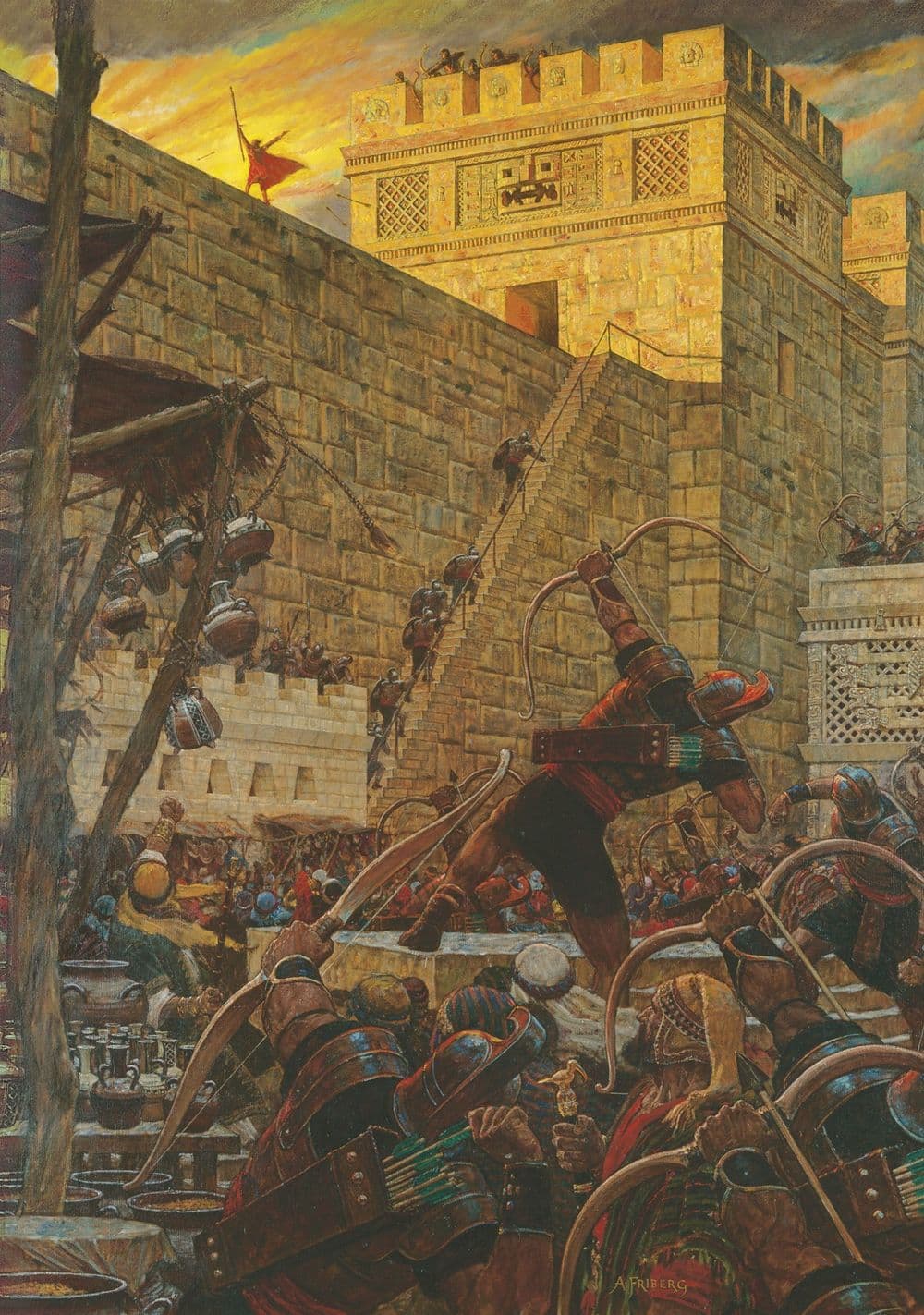
Samuel the Lamanite on the Wall · Hel. 13:1–16:8
Week 49 of 52
study guideMicah; Nahum; Habakkuk; Zephaniah
November 30–December 6, 2026
Micah 5:2 is specific enough to be checkable, which is why Herod's scribes could answer the wise men without hesitation. Micah 6:8 puts the whole law in a single sentence.
The big idea
What the Lord requires fits in one sentence — do justly, love mercy, walk humbly — and the just live by faith even when the fig tree does not blossom.
Step 1 · Get your bearings
Before you read
Who is speaking, to whom, and what was happening to them.
- When
- About a century of Judah's history: Micah c. 735–700 BC, Zephaniah c. 630 BC, Nahum before Nineveh's fall in 612 BC, Habakkuk c. 605 BC as Babylon rose.
- Where
- Judah. Micah came from Moresheth, a small country town (1:1). Nahum's message concerns Nineveh, the Assyrian capital.
- Who
- Four prophets: a country preacher in Isaiah's day, a prophet of Nineveh's fall, a prophet in good King Josiah's reign, and one who argued with God.
What was happening
These four short books span the years from Assyria's height to Babylon's rise. Micah denounces leaders who fleece the people and promises a ruler from Bethlehem. Nahum pronounces the fall of Nineveh — the city that repented under Jonah and returned to cruelty. Zephaniah warns of the day of the Lord. Habakkuk asks God why He allows evil, and waits on a watchtower for the answer.
Step 2 · See the whole
The shape of the week
Micah was a contemporary of Isaiah — 4:1–3 is almost word for word Isaiah 2:2–4. He attacks leaders who “hate the good, and love the evil” (Micah 3:2) and warns that Zion will be ploughed like a field (3:12). A century later that warning was quoted in court to save Jeremiah's life (Jeremiah 26:17–19). Then come three of the most loved passages in the prophets: Bethlehem (5:2), what the Lord requires (6:8), and sins cast into the sea (7:18–19).
Nahum is the other half of Jonah's story. Nineveh repented once; within a century it was the capital of a cruel empire again, and in 612 BC it fell. Nahum's name comes from the same root as “comfort” — his message was comfort to every nation Assyria had crushed.
Habakkuk is a conversation. He complains to God about injustice, receives an answer he finds worse, complains again, and then climbs a watchtower to wait. God's reply contains the line Paul built his teaching on faith around: “the just shall live by his faith.” The book ends with a psalm of trust written before anything has improved. Zephaniah, after warnings of judgement, closes with one of the most tender verses in the Old Testament: God rejoicing over His people with singing.
Step 3 · Read
Day by day
The block in seven readings, each with one thing to look for. Tick a day off when you have read it.
WedDec 2
Read 6:6–8 as a conversation. What does the worshipper offer, and what does God actually want?
FriDec 4
What does Habakkuk ask in 1:2–4? What does he do while waiting for an answer (2:1)?
Step 4 · Go slowly
Key passages
The verses the week turns on — what they meant to the people who first heard them, and what they mean for you. Tap any verse to mark it.
1Passage 1 of 5
But thou, Bethlehem
Micah 5:2ot 2But thou, Beth-lehem Ephratah, though thou be little among the thousands of Judah, yet out of thee shall he come forth unto me that is to be ruler in Israel; whose goings forth have been from of old, from everlasting.
What it meant then
Bethlehem was a small place among Judah's clans — notable mainly as David's home town. From there, Micah says, will come a ruler whose origins are ancient: “from of old, from everlasting.”
What it means now
When the wise men asked where the King of the Jews was to be born, Herod's scribes answered at once from this verse (Matthew 2:4–6). “From everlasting” points past Bethlehem to the premortal Christ, who told the brother of Jared, “I am he who was prepared from the foundation of the world” (Ether 3:14).
In the original Hebrew
King James renders it “from everlasting”
ʿÔlām means time stretching out of sight in either direction. The ruler born in Bethlehem is not new; He is coming forth into time from somewhere older than it.
Full lexicon entry →
Ask yourself
Why do you think God chose a small, overlooked town for the birth of the King?
2Passage 2 of 5
What doth the LORD require of thee?
Micah 6:6–8ot 6Wherewith shall I come before the Lord, and bow myself before the high God? shall I come before him with burnt offerings, with calves of a year old?
7Will the Lord be pleased with thousands of rams, or with ten thousands of rivers of oil? shall I give my firstborn for my transgression, the fruit of my body for the sin of my soul?
8He hath shewed thee, O man, what is good; and what doth the Lord require of thee, but to do justly, and to love mercy, and to walk humbly with thy God?
What it meant then
A worshipper asks what he should bring to God, and each offer outbids the last: calves, thousands of rams, rivers of oil — even his firstborn child. God's answer sets every one of them aside for three things any person can do.
What it means now
The Talmud records a rabbinic tradition that Micah gathered all the commandments of the law into these three (Makkot 24a). Jesus made the same point when He told the Pharisees they had tithed their herbs and neglected “the weightier matters of the law, judgment, mercy, and faith” (Matthew 23:23).
In the original Hebrew
Ask yourself
Which of the three — doing justly, loving mercy, walking humbly — needs the most attention in your life right now?
3Passage 3 of 5
Who is a God like unto thee?
Micah 7:18–19ot 18Who is a God like unto thee, that pardoneth iniquity, and passeth by the transgression of the remnant of his heritage? he retaineth not his anger for ever, because he delighteth in mercy.
19He will turn again, he will have compassion upon us; he will subdue our iniquities; and thou wilt cast all their sins into the depths of the sea.
What it meant then
The book ends with a question that plays on the prophet's own name. Micah — Mîkāyāh — means “Who is like the Lord?” The answer: a God who pardons, does not stay angry, delights in mercy, and throws His people's sins into the depths of the sea.
What it means now
Forgiven sin is not stored for later use. The Lord told Joseph Smith, “he who has repented of his sins, the same is forgiven, and I, the Lord, remember them no more” (D&C 58:42).
In the original Hebrew
King James renders it “Who is a God like unto thee”
The prophet's name, turned into a question and answered with a description of mercy. Micah's whole book ends by explaining his name.
Ask yourself
What sins have you asked God to cast into the sea — and then gone back fishing for?
4Passage 4 of 5
The just shall live by his faith
Habakkuk 2:1–4ot 1I will stand upon my watch, and set me upon the tower, and will watch to see what he will say unto me, and what I shall answer when I am reproved.
2And the Lord answered me, and said, Write the vision, and make it plain upon tables, that he may run that readeth it.
3For the vision is yet for an appointed time, but at the end it shall speak, and not lie: though it tarry, wait for it; because it will surely come, it will not tarry.
4Behold, his soul which is lifted up is not upright in him: but the just shall live by his faith.
What it meant then
Habakkuk asked why God let injustice go on (1:2–4). God's answer — that Babylon would punish Judah — seemed worse, so he asked again (1:12–17). Then he climbed his watchtower to wait. God tells him to write the vision plainly: it will come at its appointed time, and meanwhile the righteous will live by faithfulness.
What it means now
Paul built his teaching on faith around verse 4 (Romans 1:17; Galatians 3:11). Habakkuk shows that honest questions and faith are not opposites. He asked, then watched, then waited — and the answer came.
In the original Hebrew
King James renders it “by his faith”
ʾĔmûnāh is steadiness — faith that holds over time rather than a single moment of belief. The righteous live by staying faithful through the wait.
Full lexicon entry →
Ask yourself
What question are you waiting on the Lord to answer? Where is your watchtower?
5Passage 5 of 5
Although the fig tree shall not blossom
Habakkuk 3:17–19ot 17Although the fig tree shall not blossom, neither shall fruit be in the vines; the labour of the olive shall fail, and the fields shall yield no meat; the flock shall be cut off from the fold, and there shall be no herd in the stalls:
18Yet I will rejoice in the Lord, I will joy in the God of my salvation.
19The Lord God is my strength, and he will make my feet like hinds’ feet, and he will make me to walk upon mine high places. To the chief singer on my stringed instruments.
What it meant then
Habakkuk imagines everything failing — no figs, no grapes, no olives, empty fields, no flock, no herd — and says he will rejoice in the Lord anyway. God will make his feet like a deer's, sure-footed on the heights.
What it means now
This is faith after the question. Not confidence that everything will turn out as he hopes, but trust in God if it does not. It is the same spirit as “but if not” in Daniel 3.
Ask yourself
Could you write your own “although… yet” sentence for this season of your life?
Every page points to Him
Look for Christ
“They are they which testify of me” (John 5:39). Where this week's reading does.
Out of Bethlehem
Micah named the town seven centuries early. Matthew records Herod's scribes reading it, and John records a crowd arguing that the Christ must come from Bethlehem — not knowing that He had.
The just shall live by faith
Habakkuk 2:4 became the foundation of Paul's teaching that we are made righteous through faith in Christ. The righteous one of Habakkuk's vision lives by trusting God; in Christ, that trust has a person to rest on.
Habakkuk 2:4 · Romans 1:16–17 · Galatians 3:11 · Hebrews 10:38
The LORD in the midst of thee
Zephaniah twice says the Lord is “in the midst” of His people. The Gospel of John says the Word was made flesh and dwelt among us, and Matthew gives Him the name Emmanuel — God with us.
Latter-day light
What the Restoration adds
What the Book of Mormon, the Doctrine and Covenants, the Pearl of Great Price and the Joseph Smith Translation bring to this block.
The mountain of the Lord's house
Micah 4:1–2 and Isaiah 2:2–3 describe nations streaming to “the mountain of the Lord” to learn His ways. Latter-day Saints read it as the gathering to temples, and the Mountain of the Lord pattern study traces the idea through scripture.
A lion among the Gentiles
The risen Savior quoted Micah to the Nephites — the remnant of Jacob among the Gentiles “as a lion among the beasts of the forest” — as part of His teaching about the last days.
How long?
Habakkuk asked “how long” from a watchtower; Joseph Smith asked it from Liberty Jail. Both received answers that did not remove the trial but changed how they saw it.
What to carry out of the week
Principles to live
- 1
The Lord requires justice, mercy and humility.
- 2
God delights in mercy, and does not keep forgiven sins.
- 3
God uses small and humble things for His great work.
- 4
Honest questions, brought to God, can lead to deeper faith.
- 5
The just live by faithfulness, even when blessings fail.
- 6
The Lord rejoices over His people.
Make it yours
Ponder and record
Pick one question. Write what comes — a sentence is enough.
- 01Micah's warning in 3:12 was remembered a century later and saved Jeremiah's life (Jeremiah 26:17–19). How do prophetic words keep working long after they are spoken?
- 02Nahum's name means comfort, yet his book announces a city's destruction. How can God's justice be a comfort to people who have been oppressed?
- 03Habakkuk argued with God and was not rebuked. What does that teach you about bringing hard questions to Him?
- 04Micah 7:8 says, “when I fall, I shall arise; when I sit in darkness, the Lord shall be a light unto me.” Where do you need that promise?
- 05Zephaniah 3:17 pictures God singing over His people. How does that change the way you picture Him?
Kept on this device, and collected in your notebook with everything else.
Teaching it
At home or in class
Simple ways to study this week together.
- Idea 1Write “do justly,” “love mercy” and “walk humbly” on three cards. Draw one each morning this week and act on it.
- Idea 2Drop a stone into deep water while reading Micah 7:19. Could you get it back? Talk about what God does with forgiven sins.
- Idea 3Read Habakkuk 3:17–18 and let everyone write their own sentence: “Although ___, yet I will rejoice in the Lord.”
Keep going
More in this library
Full lessons, topics and word studies that bear on this week's block.
Doctrinal topics
The doctrine this block raises, followed wherever it goes in the canon.
Reference chains
Passages in a deliberate order, each step earning the next.
Hebrew & Greek
The words underneath the English, where the translation cost something.
Sources
- Come, Follow Me — For Home and Church: Old Testament 2026
- Old Testament Student Manual: 1 Kings–Malachi — Church Educational System, on Micah, Nahum, Habakkuk and Zephaniah
- Babylonian Talmud, Makkot 24a — The tradition that Micah reduced the commandments to three
- Brown, Driver and Briggs, A Hebrew and English Lexicon of the Old Testament — s.v. עולם, חסד, צנע, אמונה
Scripture text is the Church’s edition of the King James Version, fetched from the Gospel Library rather than retyped.