Come, Follow Me / 2026 / week 48
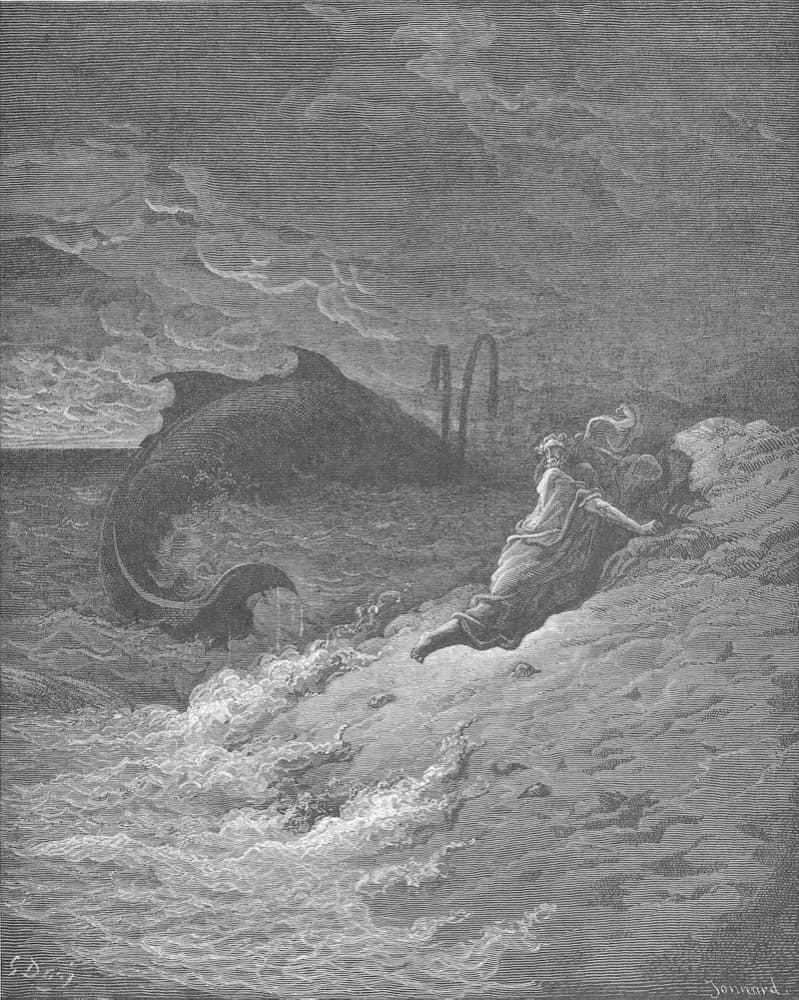
Jonah Is Spewed Forth by the Whale
Week 48 of 52
study guideAmos; Obadiah; Jonah
November 23–29, 2026
Amos names the apostasy as a famine of hearing the word — and Jonah is a book about a prophet who is angry that his preaching worked.
The big idea
God reveals His purposes to His prophets, cares how the poor are treated, and is merciful even to the enemies we would rather He judged.
Step 1 · Get your bearings
Before you read
Who is speaking, to whom, and what was happening to them.
- When
- Amos, c. 760 BC under Jeroboam II (Amos 1:1). Jonah lived in the same reign (2 Kings 14:25). Obadiah probably wrote after Jerusalem fell in 586 BC.
- Where
- Amos preached at Bethel, the northern kingdom's royal shrine (7:10–13). Obadiah speaks against Edom. Jonah is sent to Nineveh, capital of Assyria.
- Who
- A farmer from Judah with no prophetic credentials; a prophet answering a brother nation's betrayal; and a reluctant prophet sent to his people's enemies.
What was happening
Israel under Jeroboam II was rich and at peace — and its wealth rested on the poor. Amos walked north from his farm and told them so. Obadiah answers a betrayal: when Babylon sacked Jerusalem, the Edomites, descendants of Jacob's brother Esau, cheered and helped. Jonah is told to preach to Nineveh, capital of the empire that would destroy Israel — and runs the other way.
Step 2 · See the whole
The shape of the week
Amos begins with a clever trap. He pronounces judgement on Damascus, Gaza, Tyre, Edom, Ammon and Moab — Israel's neighbours and enemies — and his audience would have agreed with every word. Then he turns on Judah, and then on Israel itself. His charges are specific: selling the poor for a pair of sandals, cheating with false weights, holding lavish feasts while the needy starve.
Obadiah is the shortest book in the Old Testament — twenty-one verses against Edom's pride and cruelty. It ends with a line Joseph Smith took up for the work of the temple: “saviours shall come up on mount Zion.”
Jonah is unlike any other prophetic book. It is almost entirely a story about the prophet himself — and he is the one who needs to repent. The sailors pray, the fish obeys, and Nineveh repents at a five-word sermon, but Jonah sulks because God is merciful. The book ends with God asking him a question, and never records the answer.
Step 3 · Read
Day by day
The block in seven readings, each with one thing to look for. Tick a day off when you have read it.
Step 4 · Go slowly
Key passages
The verses the week turns on — what they meant to the people who first heard them, and what they mean for you. Tap any verse to mark it.
1Passage 1 of 5
He revealeth his secret unto his servants the prophets
Amos 3:7–8ot 7Surely the Lord God will do nothing, but he revealeth his secret unto his servants the prophets.
8The lion hath roared, who will not fear? the Lord God hath spoken, who can but prophesy?
What it meant then
Amos builds up to this with a run of cause-and-effect questions (3:3–6): two do not walk together unless they agree; a lion does not roar without prey. Nothing happens without a cause — and God does nothing without first revealing it to His prophets.
What it means now
This is one of the Old Testament's Doctrinal Mastery passages, and the Restoration's plainest case for living prophets. If God still acts in the world, He still reveals His purposes to someone first.
In the original Hebrew
King James renders it “secret”
Sôd means both a confidential plan and the council where such plans are made — the circle of trusted intimates. Jeremiah asks who has “stood in the counsel of the LORD” (Jeremiah 23:18). A prophet, in Amos's sense, is someone admitted to God's council.
Ask yourself
How do you seek to know what the Lord has revealed through His prophets now?
2Passage 2 of 5
Let judgment run down as waters
Amos 5:21–24ot 21I hate, I despise your feast days, and I will not smell in your solemn assemblies.
22Though ye offer me burnt offerings and your meat offerings, I will not accept them: neither will I regard the peace offerings of your fat beasts.
23Take thou away from me the noise of thy songs; for I will not hear the melody of thy viols.
24But let judgment run down as waters, and righteousness as a mighty stream.
What it meant then
God rejects Israel's festivals, offerings and songs — because they were paid for by cheating the poor and taking bribes in the courts (5:11–12). What He wants is justice flowing like a river that never dries up.
What it means now
Martin Luther King Jr. quoted verse 24 in his 1963 “I Have a Dream” speech. King Benjamin makes the same connection: we cannot claim God's mercy while withholding ours from the beggar (Mosiah 4:16–26).
In the original Hebrew
King James renders it “judgment … righteousness”
The prophets' favourite pair. Mišpāṭ is putting things right — especially for those who cannot defend themselves; ṣədāqāh is right relationship. Together they mean a society where the weak are protected. The image is a wadi that flows all year, not one that runs only after rain.
Full lexicon entry →
Ask yourself
Where does worship in your life need to become justice — a stream that actually reaches someone?
3Passage 3 of 5
A famine of hearing the words of the LORD
Amos 8:11–12ot 11Behold, the days come, saith the Lord God, that I will send a famine in the land, not a famine of bread, nor a thirst for water, but of hearing the words of the Lord:
12And they shall wander from sea to sea, and from the north even to the east, they shall run to and fro to seek the word of the Lord, and shall not find it.
What it meant then
Amos warns of a famine unlike any other — not of bread or water, but of God's word. People will stagger from sea to sea searching for it and not find it.
What it means now
Latter-day Saints read this as a description of the Great Apostasy, and of what the Restoration ended. It also works in miniature: it is possible to go hungry for God's word while surrounded by it.
Ask yourself
Is there a famine of hearing anywhere in your own life right now?
4Passage 4 of 5
Saviours shall come up on mount Zion
Obadiah 1:3–4, 15, 21ot 3The pride of thine heart hath deceived thee, thou that dwellest in the clefts of the rock, whose habitation is high; that saith in his heart, Who shall bring me down to the ground?
4Though thou exalt thyself as the eagle, and though thou set thy nest among the stars, thence will I bring thee down, saith the Lord.
15For the day of the Lord is near upon all the heathen: as thou hast done, it shall be done unto thee: thy reward shall return upon thine own head.
21And saviours shall come up on mount Zion to judge the mount of Esau; and the kingdom shall be the Lord’s.
What it meant then
Edom lived in fortresses cut into high cliffs and thought no one could reach them. God says He will bring them down from the stars — and that what they did to Jerusalem will be done to them. The book ends with saviours going up to Mount Zion.
What it means now
Joseph Smith taught that Latter-day Saints become saviours on Mount Zion by building temples and receiving ordinances on behalf of their dead. Every name taken to the temple is this verse fulfilled in a small way.
Ask yourself
Whose ordinances could you help provide — someone in your family who cannot do it for themselves?
5Passage 5 of 5
Should not I spare Nineveh?
Jonah 4:1–2, 10–11ot 1But it displeased Jonah exceedingly, and he was very angry.
2And he prayed unto the Lord, and said, I pray thee, O Lord, was not this my saying, when I was yet in my country? Therefore I fled before unto Tarshish: for I knew that thou art a gracious God, and merciful, slow to anger, and of great kindness, and repentest thee of the evil.
10Then said the Lord, Thou hast had pity on the gourd, for the which thou hast not laboured, neither madest it grow; which came up in a night, and perished in a night:
11And should not I spare Nineveh, that great city, wherein are more than sixscore thousand persons that cannot discern between their right hand and their left hand; and also much cattle?
What it meant then
Nineveh repents and God spares it — and Jonah is furious. He finally admits why he ran: he knew God was gracious, merciful and slow to anger. He quotes God's own self-description from Exodus 34:6, as a complaint.
What it means now
God answers with a question about a withered plant and a city of people and animals, and the book stops. Jonah never replies. The reader has to.
In the original Hebrew
King James renders it “and of great kindness”
Jonah is quoting the words God spoke to Moses on Sinai. It is one of the most repeated descriptions of God in the Old Testament — and Jonah is the only person in scripture who says it as an accusation.
Full lexicon entry →
Ask yourself
Is there anyone you would be disappointed to see God forgive?
Every page points to Him
Look for Christ
“They are they which testify of me” (John 5:39). Where this week's reading does.
The sign of the prophet Jonas
Asked for a sign, Jesus pointed to Jonah: three days and nights in the belly of the fish, as He would be in the heart of the earth. The Third Day pattern study in this library follows that interval through the whole canon.
Salvation is of the LORD
Jonah's prayer from the fish ends with one line: salvation belongs to the Lord. The Hebrew word for salvation shares its root with the name Jesus — Yeshua, “the Lord saves.”
The tabernacle of David raised up
At the council in Jerusalem, James quoted Amos 9:11–12 to show that God had always intended the Gentiles to come in. The promise to restore David's fallen house was fulfilled in the Son of David and the Church He built.
Latter-day light
What the Restoration adds
What the Book of Mormon, the Doctrine and Covenants, the Pearl of Great Price and the Joseph Smith Translation bring to this block.
Living prophets
Amos 3:7 is why Latter-day Saints expect prophets today. The Lord told Joseph Smith that His word, whether by His own voice or by His servants, is the same.
The famine ended
The famine Amos describes is the condition the young Joseph Smith found in 1820: sincere seekers and no clear word. The First Vision was God's answer to exactly the search Amos pictured.
Saviours on Mount Zion
Temple work for the dead gives Obadiah's last verse its Restoration meaning. The dead cannot be made perfect without us, Joseph Smith wrote, and neither can we without them.
What to carry out of the week
Principles to live
- 1
God reveals His will to His children through prophets.
- 2
How we treat the poor is part of how we worship.
- 3
Pride goes before a fall.
- 4
No one can outrun God — or His mercy.
- 5
God's mercy reaches people we might want Him to reject.
- 6
Salvation belongs to the Lord.
Make it yours
Ponder and record
Pick one question. Write what comes — a sentence is enough.
- 01Amos was a herdsman, not a trained prophet (7:14–15). What does that tell you about whom God calls?
- 02Amos condemned Israel's enemies first and then Israel. Why is it easier to agree with a prophet when he is talking about other people?
- 03Jonah bought a ticket “to flee unto Tarshish from the presence of the Lord” (1:3). What do people run from today, and where do they try to go?
- 04The sailors and the Ninevites — outsiders — respond to God faster than the prophet does. What does that suggest?
- 05How would you answer God's question at the end of Jonah?
Kept on this device, and collected in your notebook with everything else.
Teaching it
At home or in class
Simple ways to study this week together.
- Idea 1Retell Jonah 1 in order — storm, sailors, lots, sea, fish — and notice that everyone obeys God before Jonah does.
- Idea 2Read Jonah 4:10–11, and let each person quietly think of someone they find hard to love. Pray for those people together.
- Idea 3Pour water from a jug in a steady stream while reading Amos 5:24. What would justice “rolling down” look like in your home?
Keep going
More in this library
Full lessons, topics and word studies that bear on this week's block.
Doctrinal topics
The doctrine this block raises, followed wherever it goes in the canon.
Reference chains
Passages in a deliberate order, each step earning the next.
Hebrew & Greek
The words underneath the English, where the translation cost something.
Sources
- Come, Follow Me — For Home and Church: Old Testament 2026
- Old Testament Student Manual: 1 Kings–Malachi — Church Educational System, on Amos, Obadiah and Jonah
- Teachings of Presidents of the Church: Joseph Smith (2007) — Ch. 41, “Becoming Saviors on Mount Zion”
- Brown, Driver and Briggs, A Hebrew and English Lexicon of the Old Testament — s.v. סוד, משׁפט, חסד
Scripture text is the Church’s edition of the King James Version, fetched from the Gospel Library rather than retyped.