Come, Follow Me / 2026 / week 47
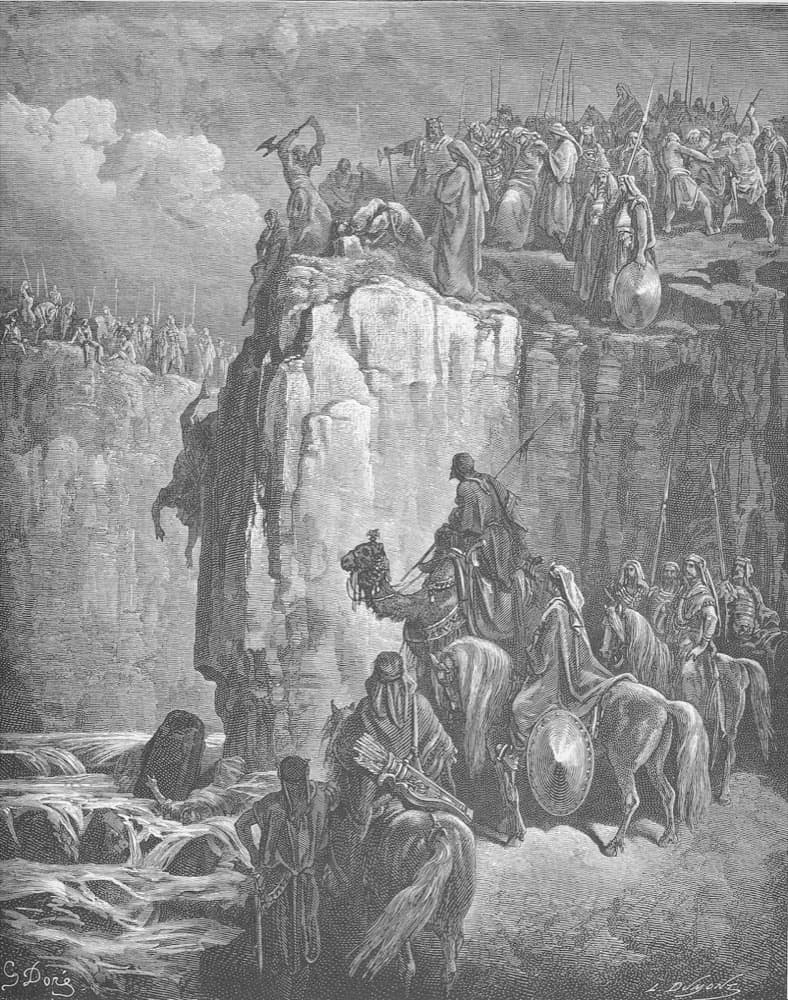
The Prophets of Baal Are Slaughtered
Week 47 of 52
study guideHosea 1–6; 10–14; Joel
November 16–22, 2026
A prophet told to marry a woman who will leave him, so that Israel can see what it looks like from God's side. Joel supplies the passage Moroni quoted.
The big idea
God loves His people the way a faithful husband loves an unfaithful wife — enough to go after her, and pay to bring her home.
Step 1 · Get your bearings
Before you read
Who is speaking, to whom, and what was happening to them.
- When
- Hosea prophesied c. 755–715 BC, the last decades of the northern kingdom before Assyria destroyed it in 722 BC. Joel's date is uncertain.
- Where
- Hosea preached to the northern kingdom of Israel, often called Ephraim; Joel to Judah and Jerusalem.
- Who
- A prosperous nation worshipping Baal alongside the Lord — and Hosea's own wife and children, whose lives became the message.
What was happening
Israel had prospered and drifted, giving Baal, the Canaanite fertility god, the credit for the grain and wine God had given (2:8). Hosea is told to marry Gomer, who will be unfaithful, so his marriage can show Israel what their unfaithfulness looks like from God's side. Joel, facing a plague of locusts that stripped the land bare, calls the nation to rend their hearts — then looks ahead to the day God pours out His Spirit on everyone.
Step 2 · See the whole
The shape of the week
Hosea's children carry prophetic names: Jezreel, Lo-ruhamah — “not pitied” — and Lo-ammi — “not my people.” Then, in 2:23, God reverses them: “I will have mercy upon her that had not obtained mercy; and I will say to them which were not my people, Thou art my people.” The whole book moves from the first set of names to the second.
Chapter 2 is a courtship after betrayal. God will lead Israel back into the wilderness, where their covenant began, and “speak comfortably unto her” — the same Hebrew phrase as Isaiah 40:2, “speak to her heart.” He betroths her again with five covenant gifts. In chapter 3 Hosea acts it out: he goes and buys Gomer back. Chapter 11 shows God as a parent who taught His child to walk, and then cries, “How shall I give thee up?”
Joel is short and urgent. A locust plague becomes a picture of judgement, and the answer is inward: “rend your heart, and not your garments.” Then comes the promise Peter quoted at Pentecost and Moroni quoted to Joseph Smith — that God will pour out His Spirit on all flesh.
Step 3 · Read
Day by day
The block in seven readings, each with one thing to look for. Tick a day off when you have read it.
MonNov 16
Write down the three children's names and what they mean. Then find how God reverses them in 2:23.
TueNov 17
What does Hosea pay to buy Gomer back (3:2)? According to 4:6, why are the people being destroyed?
FriNov 20
Find the promise about death in 13:14. Then read 14:4 — how does God say He will love?
SunNov 22
Joel 3; Joseph Smith—History 1:41
What is the “valley of decision” (3:14)? Then read what Moroni said about Joel 2:28–32.
Step 4 · Go slowly
Key passages
The verses the week turns on — what they meant to the people who first heard them, and what they mean for you. Tap any verse to mark it.
1Passage 1 of 5
I will betroth thee unto me for ever
Hosea 2:14–16, 19–20ot 14Therefore, behold, I will allure her, and bring her into the wilderness, and speak comfortably unto her.
15And I will give her her vineyards from thence, and the valley of Achor for a door of hope: and she shall sing there, as in the days of her youth, and as in the day when she came up out of the land of Egypt.
16And it shall be at that day, saith the Lord, that thou shalt call me Ishi; and shalt call me no more Baali.
19And I will betroth thee unto me for ever; yea, I will betroth thee unto me in righteousness, and in judgment, and in lovingkindness, and in mercies.
20I will even betroth thee unto me in faithfulness: and thou shalt know the Lord.
What it meant then
After describing Israel's betrayal in painful detail, God does not divorce her. He plans to win her back: take her into the wilderness where their covenant began, speak to her heart, and marry her again — this time for ever.
What it means now
Scripture describes covenants as marriage because they are relationships of promised love, not contracts to be enforced. Verses 19–20 read like a covenant dictionary — righteousness, justice, loyal love, compassion, faithfulness — and the goal of all of it is the last line: “thou shalt know the Lord.”
In the original Hebrew
Ask yourself
Which of the five gifts in verses 19–20 do you most need from the Lord right now?
2Passage 2 of 5
Go yet, love a woman
Hosea 3:1–3ot 1Then said the Lord unto me, Go yet, love a woman beloved of her friend, yet an adulteress, according to the love of the Lord toward the children of Israel, who look to other gods, and love flagons of wine.
2So I bought her to me for fifteen pieces of silver, and for an homer of barley, and an half homer of barley:
3And I said unto her, Thou shalt abide for me many days; thou shalt not play the harlot, and thou shalt not be for another man: so will I also be for thee.
What it meant then
Gomer has left, and seems to have ended up in some form of servitude. God tells Hosea to love her again — and Hosea buys her back with silver and barley, a payment roughly in the range the law of Moses set as the value of a servant (Exodus 21:32).
What it means now
This is redemption in its most literal sense: paying to bring back someone who sold herself. It is the gospel told as a marriage. The Redeemer does not wait for the one who left to earn her way home.
Ask yourself
What does it mean to you that God pursues — and pays for — the one who walked away?
3Passage 3 of 5
I desired mercy, and not sacrifice
Hosea 6:1, 4, 6ot 1Come, and let us return unto the Lord: for he hath torn, and he will heal us; he hath smitten, and he will bind us up.
4O Ephraim, what shall I do unto thee? O Judah, what shall I do unto thee? for your goodness is as a morning cloud, and as the early dew it goeth away.
6For I desired mercy, and not sacrifice; and the knowledge of God more than burnt offerings.
What it meant then
Israel offered plenty of sacrifices, but their loyalty evaporated “as a morning cloud.” God says what He wants is ḥesed — faithful love — and the knowledge of Him, more than burnt offerings.
What it means now
Jesus quoted verse 6 twice: when He was criticised for eating with sinners (Matthew 9:13), and when His disciples picked grain on the sabbath (Matthew 12:7). Ordinances and observances matter enormously — as expressions of love, never as substitutes for it.
In the original Hebrew
King James renders it “the knowledge of God”
From yādaʿ, knowing by relationship. Hosea uses it to mean the kind of knowing a faithful spouse has — which is why 4:6 can say the people are destroyed for lack of it. They had information about God. They did not know Him.
Full lexicon entry →
Ask yourself
Where might you be offering God a sacrifice when what He wants is your heart?
4Passage 4 of 5
How shall I give thee up, Ephraim?
Hosea 11:1–4, 8ot 1When Israel was a child, then I loved him, and called my son out of Egypt.
2As they called them, so they went from them: they sacrificed unto Baalim, and burned incense to graven images.
3I taught Ephraim also to go, taking them by their arms; but they knew not that I healed them.
4I drew them with cords of a man, with bands of love: and I was to them as they that take off the yoke on their jaws, and I laid meat unto them.
8How shall I give thee up, Ephraim? how shall I deliver thee, Israel? how shall I make thee as Admah? how shall I set thee as Zeboim? mine heart is turned within me, my repentings are kindled together.
What it meant then
God remembers Israel as a toddler He taught to walk, holding them by the arms, drawing them “with cords of a man, with bands of love.” After every warning, His heart turns over: how can He give them up?
What it means now
Matthew applies verse 1 to the child Jesus coming out of Egypt (Matthew 2:15). But the heart of the chapter is verse 8 — God's anguish over a child who has left. Enoch saw the same thing and asked how the heavens could weep (Moses 7:28–33).
In the original Hebrew
King James renders it “my repentings are kindled together”
The word the King James renders “repentings” comes from nāḥam — the same root as “comfort ye” in Isaiah 40:1. God's compassion is not a calm disposition here; it runs hot.
Ask yourself
When you picture God looking at you, do you picture Him saying, “How shall I give thee up?”
5Passage 5 of 5
Rend your heart — and I will pour out my spirit
Joel 2:12–13, 28–29ot 12Therefore also now, saith the Lord, turn ye even to me with all your heart, and with fasting, and with weeping, and with mourning:
13And rend your heart, and not your garments, and turn unto the Lord your God: for he is gracious and merciful, slow to anger, and of great kindness, and repenteth him of the evil.
28And it shall come to pass afterward, that I will pour out my spirit upon all flesh; and your sons and your daughters shall prophesy, your old men shall dream dreams, your young men shall see visions:
29And also upon the servants and upon the handmaids in those days will I pour out my spirit.
What it meant then
Locusts had stripped the land. Joel calls a fast, but warns that tearing your clothes, the traditional sign of grief, is not enough: tear your heart. Then he looks beyond the plague to a day when God pours out His Spirit on everyone — sons and daughters, old and young, even servants.
What it means now
Peter quoted this passage on the day of Pentecost to explain what the crowd was seeing (Acts 2:16–21). In 1823 Moroni quoted it to Joseph Smith and told him it “was not yet fulfilled, but was soon to be” (Joseph Smith—History 1:41).
In the original Hebrew
King James renders it “rend your heart”
Qāraʿ is the verb for tearing cloth — what Jacob did to his clothes when he believed Joseph was dead (Genesis 37:34). Joel keeps the gesture and moves it inside.
Ask yourself
What would rending your heart look like, compared with the outward signs of repentance?
Every page points to Him
Look for Christ
“They are they which testify of me” (John 5:39). Where this week's reading does.
The Bridegroom
Hosea pictures God as a husband who pursues His bride. Jesus called Himself the Bridegroom, told a parable of ten virgins waiting for Him, and John saw the marriage supper of the Lamb.
Hosea 2:19–20 · Matthew 9:15 · Matthew 25:1–13 · Revelation 19:7–9
Out of Egypt have I called my son
Matthew reads Hosea 11:1 as fulfilled when Joseph brought the child Jesus back from Egypt. Jesus retraces Israel's story in His own life — out of Egypt, into the wilderness, faithful where Israel had not been.
O death, where is thy sting?
Hosea 13:14 taunts death itself. Paul quotes it as fulfilled in the Resurrection, and Abinadi says the same thing before King Noah: the sting of death is swallowed up in Christ.
Latter-day light
What the Restoration adds
What the Book of Mormon, the Doctrine and Covenants, the Pearl of Great Price and the Joseph Smith Translation bring to this block.
Moroni quoted Joel
On the night of 21 September 1823, among the scriptures Moroni quoted to Joseph Smith was Joel 2:28–32 — and he added that it was not yet fulfilled, but soon would be. The outpouring of the Spirit is part of the Restoration's own story.
“Not my people” becomes “my people”
Paul and Peter both apply Hosea's reversed names to everyone who comes into the covenant. The Lord promised Abraham the same: all who receive the gospel are counted as his seed.
The Bridegroom cometh
Modern revelation uses the same imagery for the Second Coming: go out to meet the Bridegroom, and be ready.
What to carry out of the week
Principles to live
- 1
God's covenant love pursues us, even when we leave.
- 2
God wants faithful love and real knowledge of Him more than outward observance.
- 3
- 4
Real repentance is a change of heart, not a display.
- 5
God's Spirit is promised to all — young and old, men and women.
- 6
Christ has conquered death.
Make it yours
Ponder and record
Pick one question. Write what comes — a sentence is enough.
- 01Why do you think God chose a marriage, rather than a law court, to describe His relationship with Israel?
- 02Israel gave Baal the credit for grain and wine that God had given (2:8). What blessings do people today credit to something other than God?
- 03Hosea 10:12 says, “it is time to seek the Lord.” What would seeking Him look like for you this week?
- 04Joel 2:25 promises to restore “the years that the locust hath eaten.” What lost time or loss would you ask the Lord to restore?
- 05Joel 3:14 describes multitudes “in the valley of decision.” What decision is in front of you?
Kept on this device, and collected in your notebook with everything else.
Teaching it
At home or in class
Simple ways to study this week together.
- Idea 1Read 11:3–4 while a parent helps a small child walk by holding their arms. Talk about how God teaches us to walk spiritually.
- Idea 2Tear a piece of paper, then read Joel 2:13. Talk about what it means to tear a heart instead.
- Idea 3List the good things in your home and read Hosea 2:8. Who gave each one?
Keep going
More in this library
Full lessons, topics and word studies that bear on this week's block.
Doctrinal topics
The doctrine this block raises, followed wherever it goes in the canon.
Reference chains
Passages in a deliberate order, each step earning the next.
Hebrew & Greek
The words underneath the English, where the translation cost something.
Sources
- Come, Follow Me — For Home and Church: Old Testament 2026
- Old Testament Student Manual: 1 Kings–Malachi — Church Educational System, on Hosea and Joel
- Bible Dictionary, “Hosea”
- Brown, Driver and Briggs, A Hebrew and English Lexicon of the Old Testament — s.v. ארשׂ, חסד, ידע, נחם, קרע
Scripture text is the Church’s edition of the King James Version, fetched from the Gospel Library rather than retyped.