Come, Follow Me / 2026 / week 46
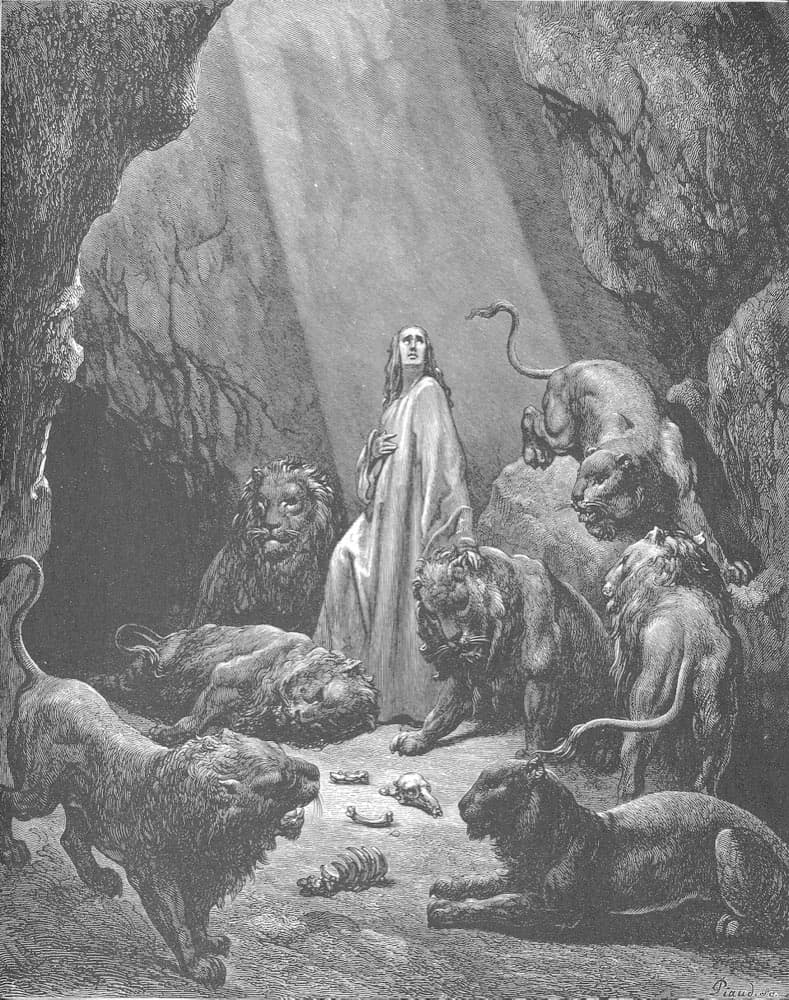
Daniel in the Lions' Den
Week 46 of 52
study guideDaniel 1–7
November 9–15, 2026
A stone cut out of the mountain without hands, filling the whole earth — and a set of young men who decline the king's meat first.
The big idea
Daniel and his friends were faithful in small, quiet choices long before the furnace or the lions — and God's kingdom will outlast every empire that tested them.
Step 1 · Get your bearings
Before you read
Who is speaking, to whom, and what was happening to them.
- When
- Daniel was taken to Babylon in 605 BC in the first deportation (1:1) and lived through the whole exile, into the reign of Cyrus (1:21; 6:28).
- Where
- The royal courts of Babylon, and later of Persia.
- Who
- Young Jewish captives chosen for government service — given Babylonian names, a Babylonian education and the king's own food.
What was happening
The real pressure in Daniel is not mainly lions or fire. It is quieter: new names, new food, the expectation to become Babylonian. The book shows four young men deciding in small things long before the big tests came — and then steps back to show empires rising and falling while God's kingdom endures.
Step 2 · See the whole
The shape of the week
Daniel is two books in one. Chapters 1–6 are stories about faithfulness in a foreign court; chapters 7–12 are visions of the future. This week covers all six stories and the first vision. Part of the book, from 2:4 to the end of chapter 7, is written in Aramaic, the international language of the empire, rather than Hebrew.
Chapters 1, 3 and 6 share a shape: a royal command, a choice, faithfulness at a cost, deliverance, and a foreign king who ends up praising Israel's God. Chapters 2 and 7 share another: a sequence of kingdoms, each passing away, until God sets up a kingdom that never will.
An honest note: scholars debate when the book reached its final form — many date it to the second century BC. Traditional readers, including Latter-day Saints, take Daniel to be a prophet of the sixth century, and Jesus referred to “Daniel the prophet” (Matthew 24:15).
Step 3 · Read
Day by day
The block in seven readings, each with one thing to look for. Tick a day off when you have read it.
MonNov 9
What had Daniel “purposed in his heart” (verse 8)? Notice how respectfully he asked.
TueNov 10
What did Daniel do before interpreting the dream (verses 17–23)? What is the stone in 34–35 and 44–45?
ThuNov 12
Who is narrating this chapter? What did it take for him to learn that “the most High ruleth”?
FriNov 13
What was Belshazzar drinking from when the hand appeared (verses 2–5)? Read verse 22 closely.
SatNov 14
Daniel knew the decree was signed (verse 10). What did he do — and notice the phrase “as he did aforetime.”
Step 4 · Go slowly
Key passages
The verses the week turns on — what they meant to the people who first heard them, and what they mean for you. Tap any verse to mark it.
1Passage 1 of 5
Daniel purposed in his heart
Daniel 1:8, 12, 15, 17ot 8But Daniel purposed in his heart that he would not defile himself with the portion of the king’s meat, nor with the wine which he drank: therefore he requested of the prince of the eunuchs that he might not defile himself.
12Prove thy servants, I beseech thee, ten days; and let them give us pulse to eat, and water to drink.
15And at the end of ten days their countenances appeared fairer and fatter in flesh than all the children which did eat the portion of the king’s meat.
17As for these four children, God gave them knowledge and skill in all learning and wisdom: and Daniel had understanding in all visions and dreams.
What it meant then
The king's food and wine would have made the young men ritually unclean — probably because it was not prepared under the law of Moses or had been offered to idols. Daniel did not refuse defiantly. He proposed a ten-day test, and asked.
What it means now
The Word of Wisdom promises what Daniel received: health, wisdom and “great treasures of knowledge” (D&C 89:18–21). The larger lesson is timing — Daniel's quiet decision about food came years before the lions, and it is what made him ready for them.
In the original Hebrew
King James renders it “pulse”
“Pulse” is an old English word for legumes. The Hebrew is broader: food grown from seed — vegetables and grains. It was simple food, and ten days of it did what the king's table could not.
Ask yourself
What have you already decided in your heart, before the test arrives?
2Passage 2 of 5
A stone cut out without hands
Daniel 2:34–35, 44–45ot 34Thou sawest till that a stone was cut out without hands, which smote the image upon his feet that were of iron and clay, and brake them to pieces.
35Then was the iron, the clay, the brass, the silver, and the gold, broken to pieces together, and became like the chaff of the summer threshingfloors; and the wind carried them away, that no place was found for them: and the stone that smote the image became a great mountain, and filled the whole earth.
44And in the days of these kings shall the God of heaven set up a kingdom, which shall never be destroyed: and the kingdom shall not be left to other people, but it shall break in pieces and consume all these kingdoms, and it shall stand for ever.
45Forasmuch as thou sawest that the stone was cut out of the mountain without hands, and that it brake in pieces the iron, the brass, the clay, the silver, and the gold; the great God hath made known to the king what shall come to pass hereafter: and the dream is certain, and the interpretation thereof sure.
What it meant then
Nebuchadnezzar dreamed of a great image — head of gold, then silver, bronze, iron and clay: a series of kingdoms beginning with his own. A stone nobody carved struck its feet, and the whole image blew away like chaff while the stone became a mountain filling the earth.
What it means now
The Lord applied this to His latter-day Church: the gospel will “roll forth… as the stone which is cut out of the mountain without hands… until it has filled the whole earth” (D&C 65:2). “Without hands” means it is God's work, not a human project — which is also why it cannot be stopped.
Ask yourself
What does “without hands” tell you about how God's kingdom grows — and about your part in it?
3Passage 3 of 5
But if not
Daniel 3:16–18, 25ot 16Shadrach, Meshach, and Abed-nego, answered and said to the king, O Nebuchadnezzar, we are not careful to answer thee in this matter.
17If it be so, our God whom we serve is able to deliver us from the burning fiery furnace, and he will deliver us out of thine hand, O king.
18But if not, be it known unto thee, O king, that we will not serve thy gods, nor worship the golden image which thou hast set up.
25He answered and said, Lo, I see four men loose, walking in the midst of the fire, and they have no hurt; and the form of the fourth is like the Son of God.
What it meant then
Commanded to bow to a gold statue or be thrown into a furnace, three young men say that God is able to deliver them — “but if not,” they will still not bow. They were not bargaining. They had decided before they knew the outcome.
What it means now
This is faith that does not depend on the result. In the fire, a fourth figure walks with them. Elder Dennis E. Simmons gave a general conference address on these two words; it is in the Talks library.
In the original Aramaic
King James renders it “the Son of God”
These are Nebuchadnezzar's words, and in his Aramaic they mean “a divine being” — a pagan king describing what he saw in his own terms. The King James capitalises it, and Christian readers have long seen the premortal Christ in the fire. The text does not say so; the image has earned the reading.
Ask yourself
What would your faith look like if God said “not this time”?
4Passage 4 of 5
As he did aforetime
Daniel 6:10, 22ot 10Now when Daniel knew that the writing was signed, he went into his house; and his windows being open in his chamber toward Jerusalem, he kneeled upon his knees three times a day, and prayed, and gave thanks before his God, as he did aforetime.
22My God hath sent his angel, and hath shut the lions’ mouths, that they have not hurt me: forasmuch as before him innocency was found in me; and also before thee, O king, have I done no hurt.
What it meant then
Daniel knew the law was signed. He went home, opened his windows toward Jerusalem and prayed three times a day, “as he did aforetime.” He did not start praying because of the crisis. He simply did not stop.
What it means now
The famous part of the story is the lions. The important part is “as he did aforetime.” A habit of prayer built in ordinary days is what held when prayer became costly.
Ask yourself
What spiritual habit do you have that would keep going even if it became dangerous?
5Passage 5 of 5
One like the Son of man
Daniel 7:9–10, 13–14ot 9I beheld till the thrones were cast down, and the Ancient of days did sit, whose garment was white as snow, and the hair of his head like the pure wool: his throne was like the fiery flame, and his wheels as burning fire.
10A fiery stream issued and came forth from before him: thousand thousands ministered unto him, and ten thousand times ten thousand stood before him: the judgment was set, and the books were opened.
13I saw in the night visions, and, behold, one like the Son of man came with the clouds of heaven, and came to the Ancient of days, and they brought him near before him.
14And there was given him dominion, and glory, and a kingdom, that all people, nations, and languages, should serve him: his dominion is an everlasting dominion, which shall not pass away, and his kingdom that which shall not be destroyed.
What it meant then
After four terrifying beasts — four kingdoms — Daniel sees the Ancient of days on a fiery throne, and then one “like the Son of man” coming with the clouds to receive a kingdom that will never be destroyed.
What it means now
Jesus called Himself the Son of man more than by any other title, and when the high priest demanded to know who He was, He quoted this very passage (Matthew 26:64). The Doctrine and Covenants identifies the Ancient of Days as Adam (D&C 27:11; 116:1).
In the original Aramaic
King James renders it “like the Son of man”
In Aramaic “son of man” simply means a human being. That is the point of the vision: after a lion, a bear, a leopard and a monster, the one who receives God's kingdom is human. The kingdoms of the world are beastly; God's kingdom has a human face.
Ask yourself
Why might Jesus have preferred to call Himself “the Son of man”?
Every page points to Him
Look for Christ
“They are they which testify of me” (John 5:39). Where this week's reading does.
The fourth in the fire
Isaiah promised that when God's people walk through the fire they will not be burned, because He is with them. Daniel 3 shows it happening — a fourth figure in the furnace, and not a hair singed.
The Son of man coming in the clouds
Before the high priest, Jesus answered with Daniel 7: “Hereafter shall ye see the Son of man sitting on the right hand of power, and coming in the clouds of heaven.” It was the claim that got Him condemned. Stephen saw the Son of man standing at God's right hand as he died.
The stone that fills the earth
The stone of Daniel 2 is the kingdom of God; the Stone of the Psalms and the Gospels is Christ Himself — the rock of our Redeemer on which a sure foundation is built.
Latter-day light
What the Restoration adds
What the Book of Mormon, the Doctrine and Covenants, the Pearl of Great Price and the Joseph Smith Translation bring to this block.
The stone rolling forth
In 1831 the Lord told the Saints that the keys of the kingdom had been given to men on earth, and that the gospel would roll forth like Daniel's stone until it filled the earth.
Daniel and the Word of Wisdom
The promises attached to the Word of Wisdom — health, wisdom, hidden treasures of knowledge, running without weariness — read like a description of what happened to Daniel and his friends.
The Ancient of Days
Modern revelation identifies Daniel's Ancient of Days as Adam, and connects the scene to a gathering at Adam-ondi-Ahman before the Second Coming.
What to carry out of the week
Principles to live
- 1
Small, early choices prepare us for large tests.
- 2
God blesses obedience with health and understanding.
- 3
Faith trusts God whether or not He delivers us.
- 4
The Lord is with His people in the fire.
- 5
God's kingdom will outlast every human kingdom.
- 6
God gives understanding to those who ask — and who give Him the credit.
Make it yours
Ponder and record
Pick one question. Write what comes — a sentence is enough.
- 01Daniel and his friends were given Babylonian names (1:7). How does the world try to rename you — and how do you keep your own?
- 02Before interpreting the dream, Daniel asked his friends to pray with him (2:17–18). Who do you pray with when something is hard?
- 03Nebuchadnezzar learned humility the hard way. What helps you remember that “the most High ruleth”?
- 04Belshazzar knew exactly what had happened to Nebuchadnezzar and did it anyway (5:22). Why do people ignore lessons they already know?
- 05If your prayers suddenly became costly, would they continue “as aforetime”?
Kept on this device, and collected in your notebook with everything else.
Teaching it
At home or in class
Simple ways to study this week together.
- Idea 1Eat a simple meal of vegetables and water and read 1:12–15. Talk about what simple obedience has done for you.
- Idea 2Build a tower of blocks and knock it down with a small stone while reading 2:34–35. What does the stone become?
- Idea 3Read 3:17–18 and let everyone finish the sentence: “God is able to ___. But if not, I will still ___.”
Keep going
More in this library
Full lessons, topics and word studies that bear on this week's block.
Doctrinal topics
The doctrine this block raises, followed wherever it goes in the canon.
Reference chains
Passages in a deliberate order, each step earning the next.
Hebrew & Greek
The words underneath the English, where the translation cost something.
Sources
- Come, Follow Me — For Home and Church: Old Testament 2026
- Old Testament Student Manual: 1 Kings–Malachi — Church Educational System, on Daniel
- Bible Dictionary, “Daniel”
- Dennis E. Simmons, “But If Not …” — General Conference, April 2004 — in the Talks library
Scripture text is the Church’s edition of the King James Version, fetched from the Gospel Library rather than retyped.