Come, Follow Me / 2026 / week 45
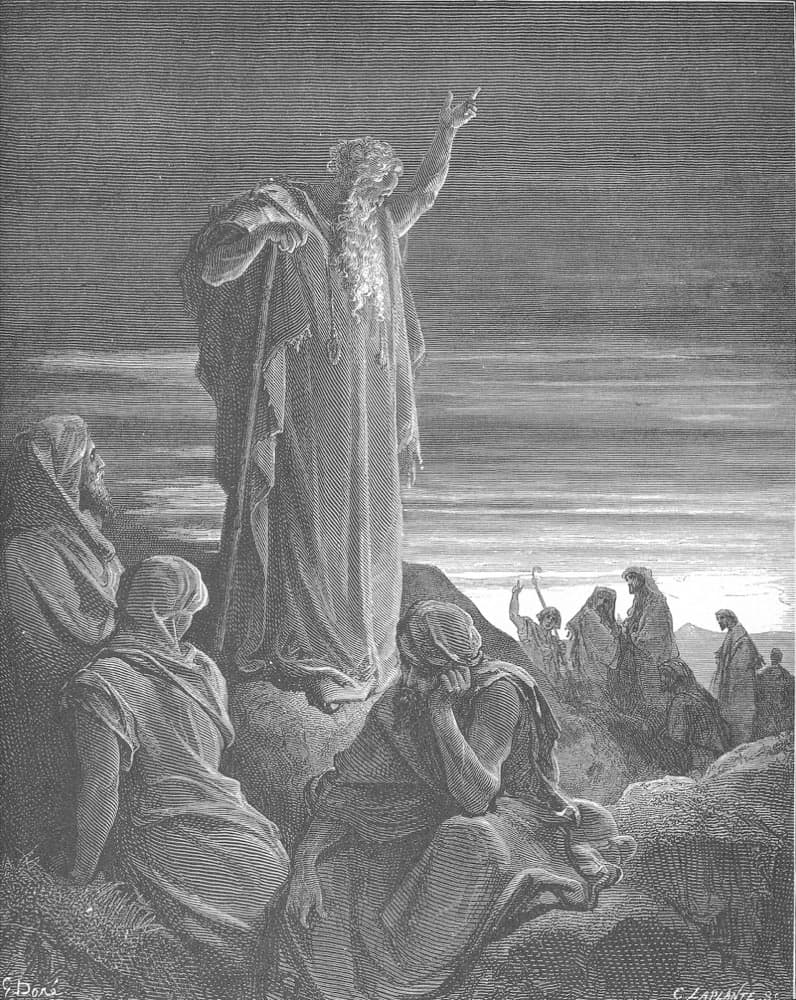
The Prophet Ezekiel
Week 45 of 52
study guideEzekiel 1–3; 33–34; 36–37; 47
November 2–8, 2026
The valley of dry bones, and the two sticks becoming one in the hand — which is the passage Latter-day Saints have read as the Book of Mormon since 1830.
The big idea
God's glory is not confined to a building — it came to exiles by a river in Babylon, and it can breathe life into bones that have given up.
Step 1 · Get your bearings
Before you read
Who is speaking, to whom, and what was happening to them.
- When
- Ezekiel was taken to Babylon in 597 BC and saw his first vision in 593 BC (1:1–3). He prophesied until about 571 BC.
- Where
- Among the exiles at Tel-abib, by the river Chebar — an irrigation canal near the city of Babylon.
- Who
- A priest with no temple, speaking to exiles who believed they had been cut off from God for good.
What was happening
Ezekiel was already in Babylon while Jerusalem still stood. His early messages warned that it would fall. In chapter 33 a survivor arrives with the news that it has. From then on the book turns to restoration: a new shepherd, new hearts, dry bones living, and a river of healing flowing from a new temple.
Step 2 · See the whole
The shape of the week
The book opens with one of the strangest visions in scripture: wheels within wheels, creatures with four faces, and above them a throne with a figure “as the appearance of a man.” Do not try to draw it. Notice where it happens — in a foreign land, far from the temple. The first thing Ezekiel learns is that God's glory can travel.
Chapter 33 is the hinge of the book. The watchman passage is repeated, and then word comes that Jerusalem has fallen (33:21). Everything after that is about rebuilding: God will shepherd His people Himself (34), give them new hearts (36), raise them from a valley of bones (37), join the divided kingdoms into one (37), and send a river from His house that heals whatever it touches (47).
Ezekiel communicated by visions and by acting things out — he ate a scroll, lay on his side for months, and held two sticks as one in his hand. Read for the point of each scene rather than decoding every detail.
Step 3 · Read
Day by day
The block in seven readings, each with one thing to look for. Tick a day off when you have read it.
MonNov 2
Don't try to picture every detail. Notice where Ezekiel is (verses 1–3) and how carefully he describes the figure in 26–28.
TueNov 3
What does Ezekiel eat in 3:1–3, and how does it taste? What is a watchman's duty (3:17–21)?
WedNov 4
Verse 21 is the turning point of the whole book. What news arrives? Then read verse 32.
ThuNov 5
List what the bad shepherds failed to do (verse 4) and what God will do instead (verse 16).
SatNov 7
Count the times breath, wind or spirit appears in verses 1–14. Then read verses 15–19 beside 2 Nephi 3:12.
SunNov 8
Follow the river in verses 1–12. How deep does it get, and what happens wherever it flows?
Step 4 · Go slowly
Key passages
The verses the week turns on — what they meant to the people who first heard them, and what they mean for you. Tap any verse to mark it.
1Passage 1 of 5
The likeness of the glory of the LORD
Ezekiel 1:26–28ot 26And above the firmament that was over their heads was the likeness of a throne, as the appearance of a sapphire stone: and upon the likeness of the throne was the likeness as the appearance of a man above upon it.
27And I saw as the colour of amber, as the appearance of fire round about within it, from the appearance of his loins even upward, and from the appearance of his loins even downward, I saw as it were the appearance of fire, and it had brightness round about.
28As the appearance of the bow that is in the cloud in the day of rain, so was the appearance of the brightness round about. This was the appearance of the likeness of the glory of the Lord. And when I saw it, I fell upon my face, and I heard a voice of one that spake.
What it meant then
By a canal in Babylon, a priest who will never serve in the temple sees what the temple was built to house: a throne, a rainbow of light, and on the throne a figure like a man. He falls on his face.
What it means now
The Lord met His people in exile, not only in Jerusalem. When He appeared in the Kirtland Temple, Joseph Smith described His voice in Ezekiel's terms — “as the sound of the rushing of great waters” (D&C 110:3; Ezekiel 43:2). And the figure on the throne looks like a man (D&C 130:22).
In the original Hebrew
King James renders it “the glory of the LORD”
Kābôd comes from a root meaning heavy. God's glory is His weight — His substance and reality made visible. Ezekiel later watches that glory leave the temple (10:18–19) and, in his last vision, return (43:4).
Full lexicon entry →
Ask yourself
Where is your river Chebar — a place you did not expect to meet God, where He met you?
2Passage 2 of 5
I will seek that which was lost
Ezekiel 34:11–16ot 11For thus saith the Lord God; Behold, I, even I, will both search my sheep, and seek them out.
12As a shepherd seeketh out his flock in the day that he is among his sheep that are scattered; so will I seek out my sheep, and will deliver them out of all places where they have been scattered in the cloudy and dark day.
13And I will bring them out from the people, and gather them from the countries, and will bring them to their own land, and feed them upon the mountains of Israel by the rivers, and in all the inhabited places of the country.
14I will feed them in a good pasture, and upon the high mountains of Israel shall their fold be: there shall they lie in a good fold, and in a fat pasture shall they feed upon the mountains of Israel.
15I will feed my flock, and I will cause them to lie down, saith the Lord God.
16I will seek that which was lost, and bring again that which was driven away, and will bind up that which was broken, and will strengthen that which was sick: but I will destroy the fat and the strong; I will feed them with judgment.
What it meant then
Israel's leaders — its “shepherds” — fed themselves and neglected the flock: they did not strengthen the weak, heal the sick or look for the lost (34:2–4). God's answer is that He will do it Himself.
What it means now
Jesus took up this chapter when He said, “I am the good shepherd,” and spoke of “other sheep” who would hear His voice (John 10:11–16) — sheep He later told the Nephites were them (3 Nephi 15:21). Ministering is verse 16 put into practice.
Ask yourself
Verse 16 names four kinds of sheep: lost, driven away, broken, sick. Which describes you, or someone you love, right now?
3Passage 3 of 5
A new heart also will I give you
Ezekiel 36:25–27ot 25Then will I sprinkle clean water upon you, and ye shall be clean: from all your filthiness, and from all your idols, will I cleanse you.
26A new heart also will I give you, and a new spirit will I put within you: and I will take away the stony heart out of your flesh, and I will give you an heart of flesh.
27And I will put my spirit within you, and cause you to walk in my statutes, and ye shall keep my judgments, and do them.
What it meant then
God promises three things in order: to wash His people clean, to replace their hearts of stone with hearts of flesh, and to put His own spirit inside them so they can walk in His ways.
What it means now
It is Jeremiah's new covenant in different words — and a picture of baptism followed by the gift of the Holy Ghost. King Benjamin's people described receiving it as “a mighty change… in our hearts” (Mosiah 5:2), and Alma asks whether we have felt it (Alma 5:14).
Ask yourself
What is still stony in you that you would ask the Lord to replace?
4Passage 4 of 5
Can these bones live?
Ezekiel 37:3–10ot 3And he said unto me, Son of man, can these bones live? And I answered, O Lord God, thou knowest.
4Again he said unto me, Prophesy upon these bones, and say unto them, O ye dry bones, hear the word of the Lord.
5Thus saith the Lord God unto these bones; Behold, I will cause breath to enter into you, and ye shall live:
6And I will lay sinews upon you, and will bring up flesh upon you, and cover you with skin, and put breath in you, and ye shall live; and ye shall know that I am the Lord.
7So I prophesied as I was commanded: and as I prophesied, there was a noise, and behold a shaking, and the bones came together, bone to his bone.
8And when I beheld, lo, the sinews and the flesh came up upon them, and the skin covered them above: but there was no breath in them.
9Then said he unto me, Prophesy unto the wind, prophesy, son of man, and say to the wind, Thus saith the Lord God; Come from the four winds, O breath, and breathe upon these slain, that they may live.
10So I prophesied as he commanded me, and the breath came into them, and they lived, and stood up upon their feet, an exceeding great army.
What it meant then
A valley of bones, very dry — a people who say, “Our bones are dried, and our hope is lost” (37:11). God asks Ezekiel if they can live. Ezekiel prophesies, and bone comes to bone, flesh covers them, and breath enters them.
What it means now
The vision promises the restoration of Israel, and Latter-day Saints also read it as the literal resurrection — Joseph F. Smith named it among the prophecies he saw fulfilled in the world of spirits (D&C 138:43). There is no condition so dry that God cannot breathe into it.
In the original Hebrew
King James renders it “breath · winds · spirit”
One Hebrew word appears about ten times in verses 1–14, and the King James translates it three ways. “Come from the four winds, O breath” and “shall put my spirit in you” use the same word. In Hebrew there is no line between God's Spirit and the breath that makes the dead live.
Full lexicon entry →
Ask yourself
What feels like dry bones in your life — hopeless — that God could still breathe into?
5Passage 5 of 5
The stick of Judah and the stick of Joseph
Ezekiel 37:15–19ot 15The word of the Lord came again unto me, saying,
16Moreover, thou son of man, take thee one stick, and write upon it, For Judah, and for the children of Israel his companions: then take another stick, and write upon it, For Joseph, the stick of Ephraim, and for all the house of Israel his companions:
17And join them one to another into one stick; and they shall become one in thine hand.
18And when the children of thy people shall speak unto thee, saying, Wilt thou not shew us what thou meanest by these?
19Say unto them, Thus saith the Lord God; Behold, I will take the stick of Joseph, which is in the hand of Ephraim, and the tribes of Israel his fellows, and will put them with him, even with the stick of Judah, and make them one stick, and they shall be one in mine hand.
What it meant then
Ezekiel writes on two sticks — one for Judah, one for Joseph through Ephraim — and holds them together until they become one in his hand. The divided kingdoms of Israel and Judah will be reunited.
What it means now
Since the earliest days of the Restoration, Latter-day Saints have read the sticks as records: the Bible, from Judah, and the Book of Mormon, from Joseph's descendants through Lehi — the two “growing together” as Joseph of Egypt had prophesied (2 Nephi 3:12). The Lord calls it “the record of the stick of Ephraim” (D&C 27:5).
In the original Hebrew
King James renders it “stick”
The ordinary word for wood. The reading of the sticks as records is an interpretation, and it is worth being clear about that — but it rests on something in the text: Ezekiel is told to write on them (37:16), and wooden writing boards were a common way of keeping records in the ancient world.
Ask yourself
What do the Bible and the Book of Mormon teach together that neither teaches as clearly alone?
Every page points to Him
Look for Christ
“They are they which testify of me” (John 5:39). Where this week's reading does.
The Good Shepherd
Ezekiel 34 promises one shepherd, “my servant David,” who will feed the flock. Jesus, the Son of David, said, “I am the good shepherd,” and told the Nephites they were among the other sheep He had spoken of.
Living water from the house of God
In Ezekiel 47 a river flows out of the temple, growing deeper, healing the Dead Sea and feeding trees whose leaves are medicine. John saw the same river in his vision of the holy city, and Jesus promised that rivers of living water would flow from those who believe in Him.
One like the Son of Man
Ezekiel saw a figure like a man on the throne of God, with a voice like many waters. John saw “one like unto the Son of man” with the same voice — and He said, “I am he that liveth, and was dead.”
Latter-day light
What the Restoration adds
What the Book of Mormon, the Doctrine and Covenants, the Pearl of Great Price and the Joseph Smith Translation bring to this block.
The stick of Ephraim
Joseph of Egypt prophesied that his descendants' writings and Judah's would “grow together.” Nephi saw the same thing, and the Lord told Joseph Smith that Moroni held “the keys of the record of the stick of Ephraim.”
Ezekiel in the spirit world
In his 1918 vision of the redemption of the dead, Joseph F. Smith saw Ezekiel among the prophets, and described the valley of dry bones as a vision of the resurrection.
Watchmen on the tower
The watchman's duty in Ezekiel 3 and 33 appears in modern revelation as a responsibility for every member: it becomes everyone who has been warned to warn their neighbour.
What to carry out of the week
Principles to live
- 1
God's presence is not limited to one place or one circumstance.
To the exiles He promised, “yet will I be to them as a little sanctuary in the countries where they shall come.”
- 2
God takes no pleasure in anyone's loss; He pleads with us to turn.
- 3
The Lord Himself seeks the lost and binds up the broken.
- 4
God can replace a heart of stone with a heart of flesh.
- 5
The Spirit of God gives life to what is dead.
- 6
The Bible and the Book of Mormon testify together.
Make it yours
Ponder and record
Pick one question. Write what comes — a sentence is enough.
- 01Ezekiel ate a scroll full of “lamentations, and mourning, and woe” (2:10), and it tasted like honey (3:3). How can hard truths from God be sweet?
- 02Ezekiel 33:32 describes people who enjoyed the prophet like a lovely song but did nothing he said. How do you avoid being one of them?
- 03God asked, “Can these bones live?” and Ezekiel answered, “thou knowest.” Why is that such a good answer?
- 04The river in chapter 47 gets deeper the farther it flows. How has your testimony deepened over time?
- 05Which of the four sheep in 34:16 do you most relate to right now — and what would it mean to be found?
Kept on this device, and collected in your notebook with everything else.
Teaching it
At home or in class
Simple ways to study this week together.
- Idea 1Give everyone a taste of honey and read 3:1–3. Talk about a time a hard truth from God turned out to be good.
- Idea 2Label two sticks “Judah” and “Joseph,” read 37:16–17, then set a Bible and a Book of Mormon side by side.
- Idea 3Read 47:3–5 while stepping into a basin or pool: ankle, knee, waist, over the head. How has the gospel grown deeper for each of you?
Keep going
More in this library
Full lessons, topics and word studies that bear on this week's block.
Doctrinal topics
The doctrine this block raises, followed wherever it goes in the canon.
Reference chains
Passages in a deliberate order, each step earning the next.
Diagrams & maps
Drawn for this library — worth a minute even when the prose was clear.
Hebrew & Greek
The words underneath the English, where the translation cost something.
Sources
- Come, Follow Me — For Home and Church: Old Testament 2026
- Old Testament Student Manual: 1 Kings–Malachi — Church Educational System, on Ezekiel
- Bible Dictionary, “Ezekiel”
- Brown, Driver and Briggs, A Hebrew and English Lexicon of the Old Testament — s.v. כבוד, רוח, עץ
Scripture text is the Church’s edition of the King James Version, fetched from the Gospel Library rather than retyped.